 Skip to content
A dish garden can be far more interesting than a few small plants grouped in a bowl. With the right container, a handful of stones, and plants that suit the same growing conditions, you can build a tiny landscape that feels like a real part of your home decor. Some arrangements look like miniature mountain paths. Others feel like little woodland corners, desert scenes, courtyards, or lush tabletop jungles.
The fun is in the details. A curved pebble path gives the eye somewhere to travel. A single upright plant creates height. Moss softens hard rock edges. Even a tipped terracotta pot can become a strong focal point when you build the planting around it instead of simply placing it on top.
Before you begin, remember one practical rule: group plants that enjoy similar light and watering. Succulents and cacti are happiest in drier mixes, while ferns, moss, and many tropical foliage plants prefer more even moisture. If you match their needs from the start, your indoor dish garden will be much easier to maintain.
Use these indoor dish garden ideas as a starting point, then adjust the plants, stones, and container to suit your room. You do not need to copy every detail. In fact, the arrangements usually look better when they feel a little personal.
1. Pebble River Succulent Dish Garden
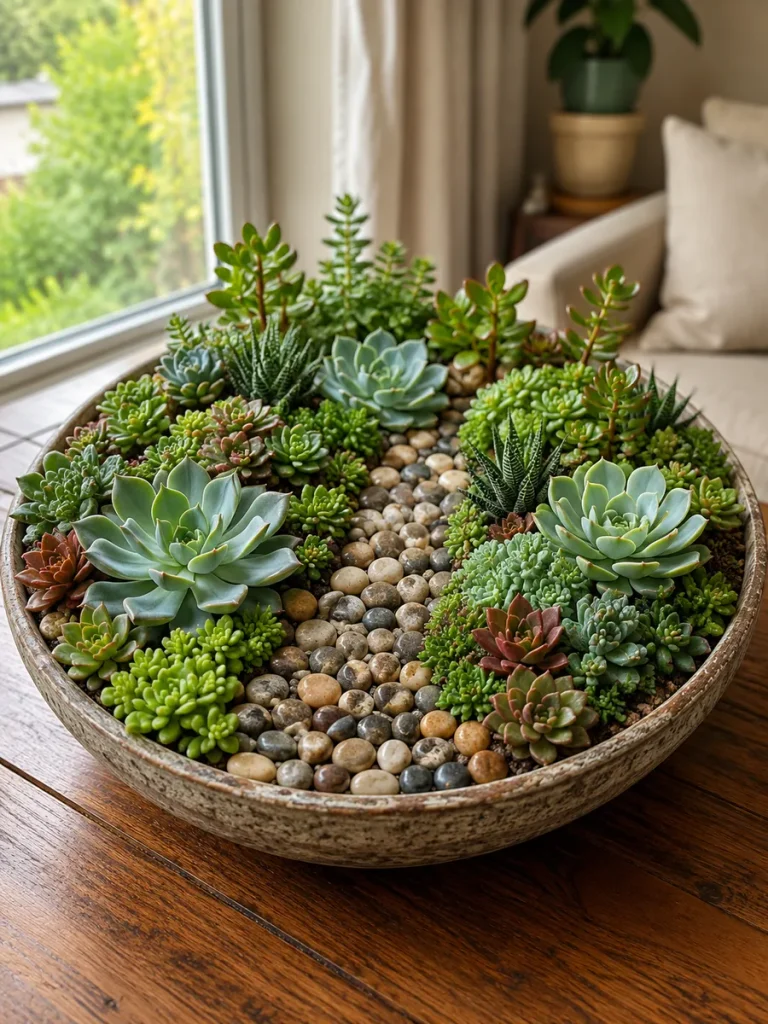
Start with a broad, shallow bowl and make the pebble river before you plant anything. Let it curve gently from the front toward the back rather than running in a straight line. Smooth stones in cream, gray, brown, and charcoal create a natural dry-stream effect.
Plant echeveria, haworthia, jade, and small sedums on both banks. Keep some plants larger and some tiny. That difference in scale helps the scene feel like a miniature landscape instead of a flat succulent arrangement.
2. Tilted Terracotta Pot Garden
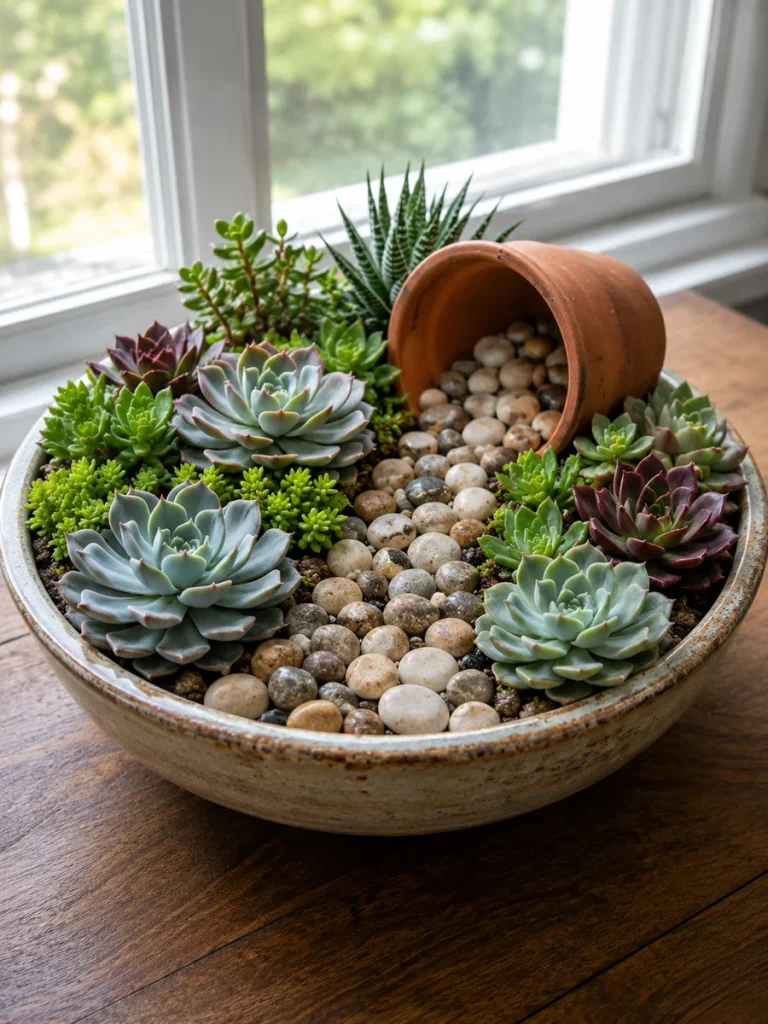
A small weathered terracotta pot lying on its side gives you an instant focal point. Partly bury it toward the back of a wide dish, then let stones or low-growing succulents appear to spill from the opening.
Keep the surrounding plants varied but compact. Echeverias, haworthias, and small jade plants work well. The trick is to make the pot look as though it has been sitting there for a while, so tuck plants close to its base and soften the edges with gravel.
3. Layered Indoor Mountain Garden
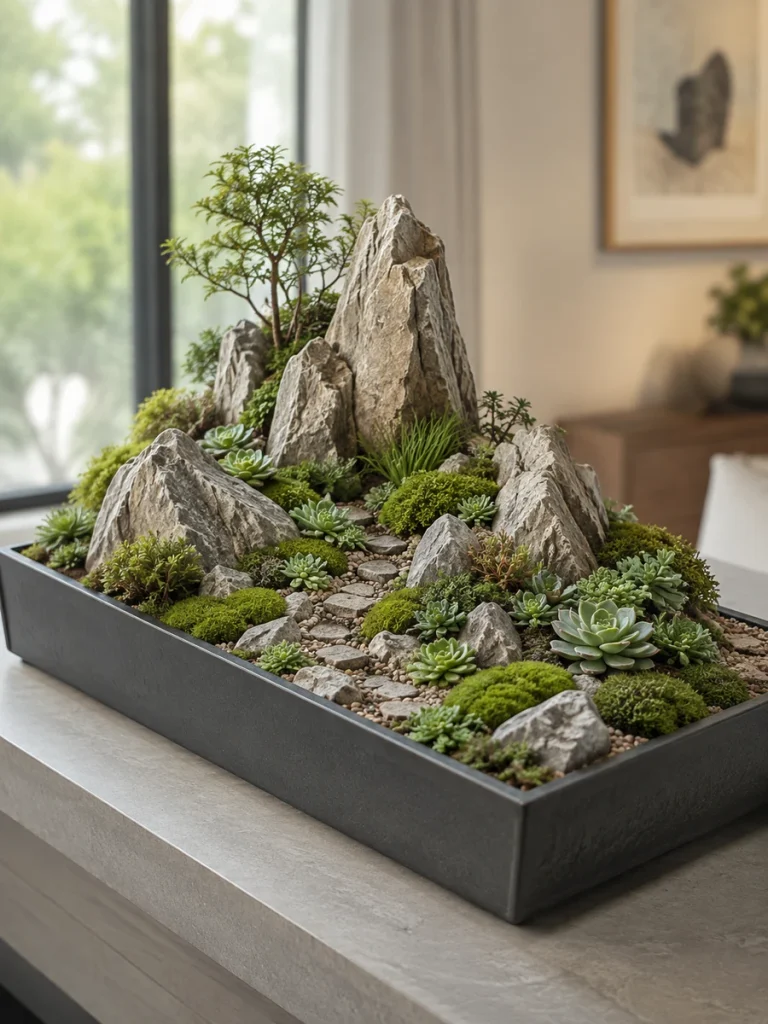
If you want a dish garden that feels more like sculpture, build upward. Use angular rocks to form a small ridge, with one or two taller stones creating the highest point. Tuck moss, sedum, and miniature rosette succulents into the spaces between them.
Do not cover every rock. Exposed stone is part of the design. A tiny tree-like plant near the top adds scale and makes the whole scene feel much larger than the container really is.
4. Mixed Snake Plant and ZZ Dish Garden
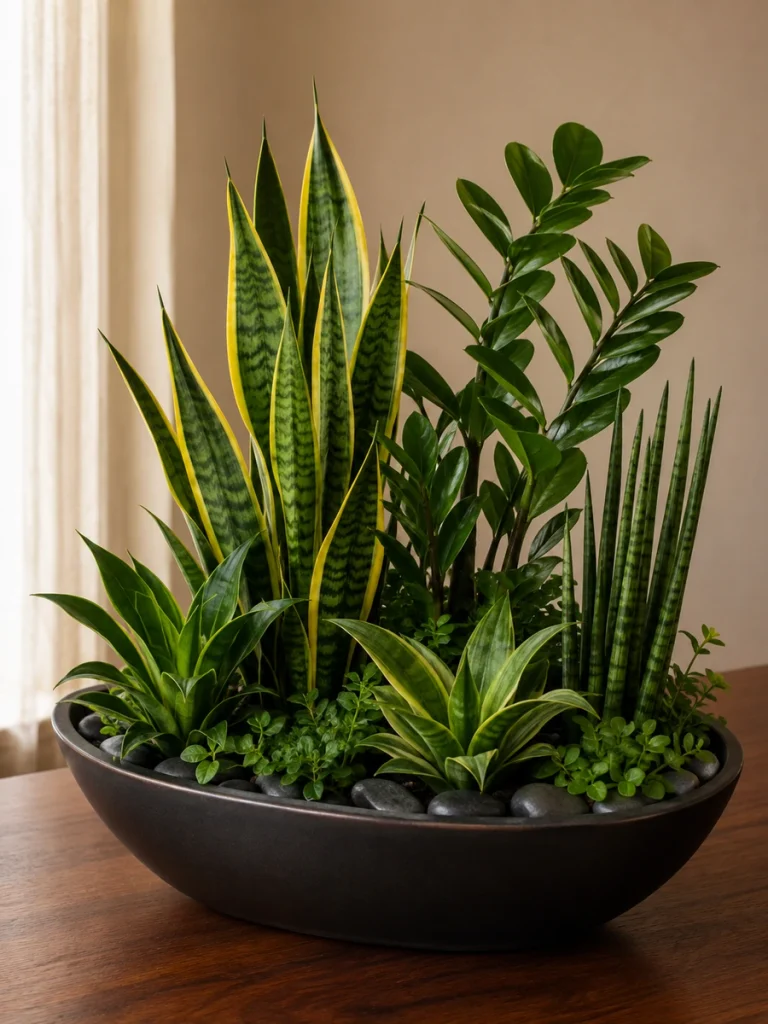
This idea works beautifully when you want strong vertical lines. Combine compact snake plant varieties with young ZZ plants and a few lower green companions. A dark oval bowl makes the foliage stand out and gives the arrangement a polished look.
Place the tallest leaves toward the back or slightly off-center. Add smooth dark stones around the base instead of filling every gap with plants. It is bold, clean, and especially useful for an office, entry table, or modern living room.
5. Miniature Woodland Ridge
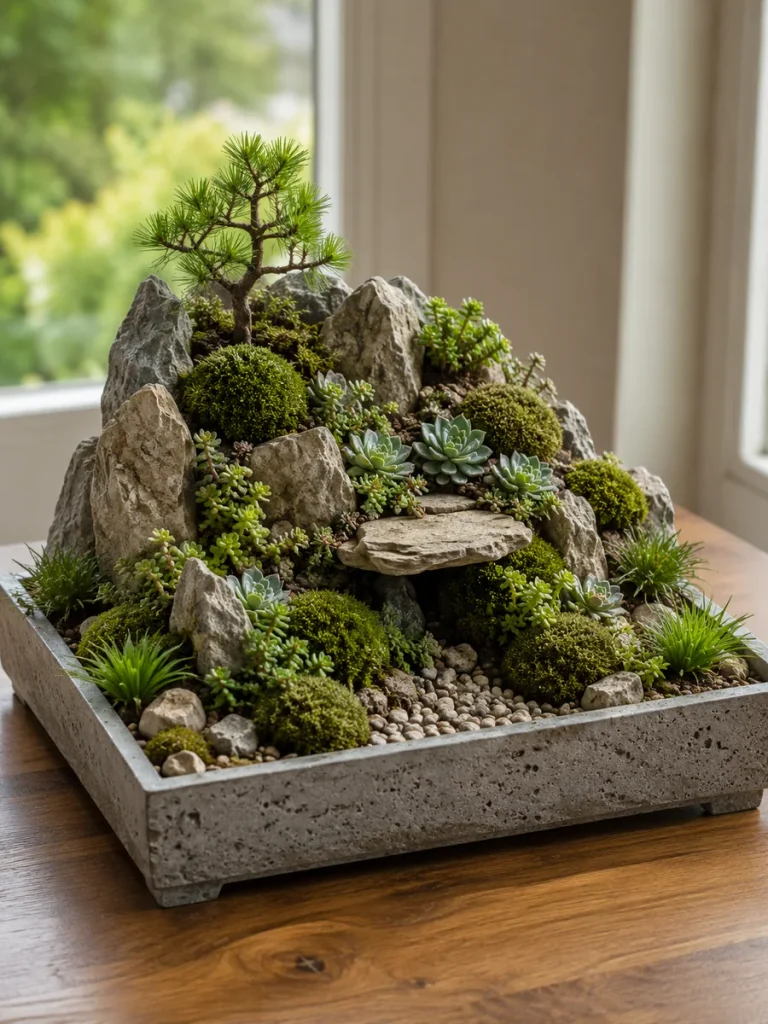
Build a low hill in a rectangular planter using soil and stone, then cover parts of it with moss and tiny groundcover plants. Add a small conifer-like plant or fine-leaved shrub near the highest point.
A few flat rocks can act like ledges along the slope. Let the layout stay a little uneven. Woodland scenes look more convincing when one side is fuller, one stone sits at an angle, and small pockets of moss creep into the gaps.
6. Window-Side Succulent Landscape
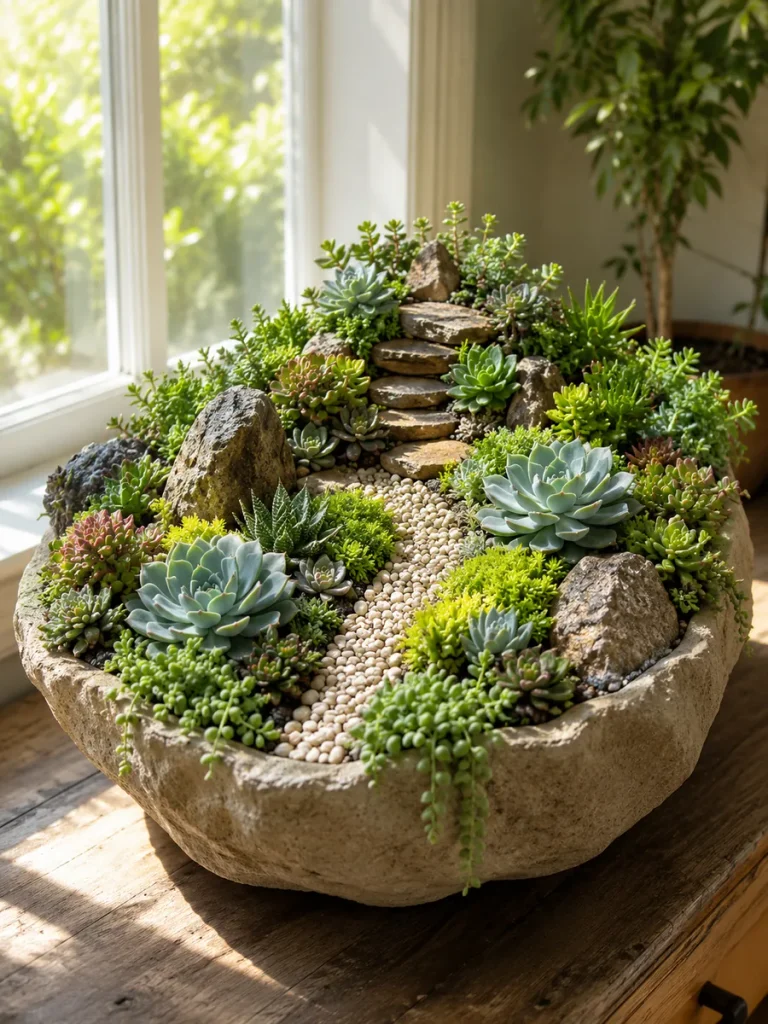
A bright window is the perfect place for a fuller succulent landscape. Use an irregular stone-effect bowl and combine echeveria, sedum, haworthia, jade, and a few trailing varieties. Build a raised section at the back with stacked flat rocks.
Then add a narrow gravel path that winds down toward the front. Because the planting is lush, the path keeps the arrangement from looking crowded. It also gives the eye a clear route through the garden.
7. Tall-and-Low Mixed Foliage Bowl
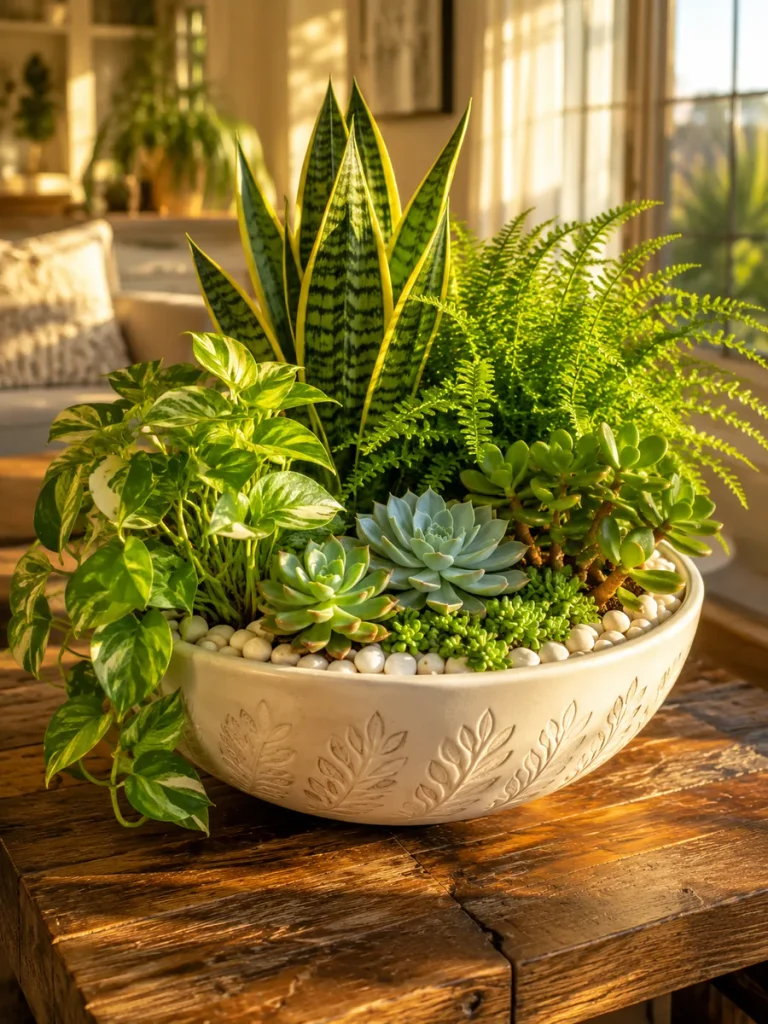
Think in layers here. Use one tall snake plant as the anchor, then bring in a small fern, pothos, jade, and a couple of low rosette succulents. The contrast between upright and trailing growth gives the bowl movement.
This style is useful when you want one planter to give you the effect of several houseplants. A pale bowl and light stones keep the arrangement fresh, while the foliage provides all the color you need.
8. Mini Zen Courtyard Dish
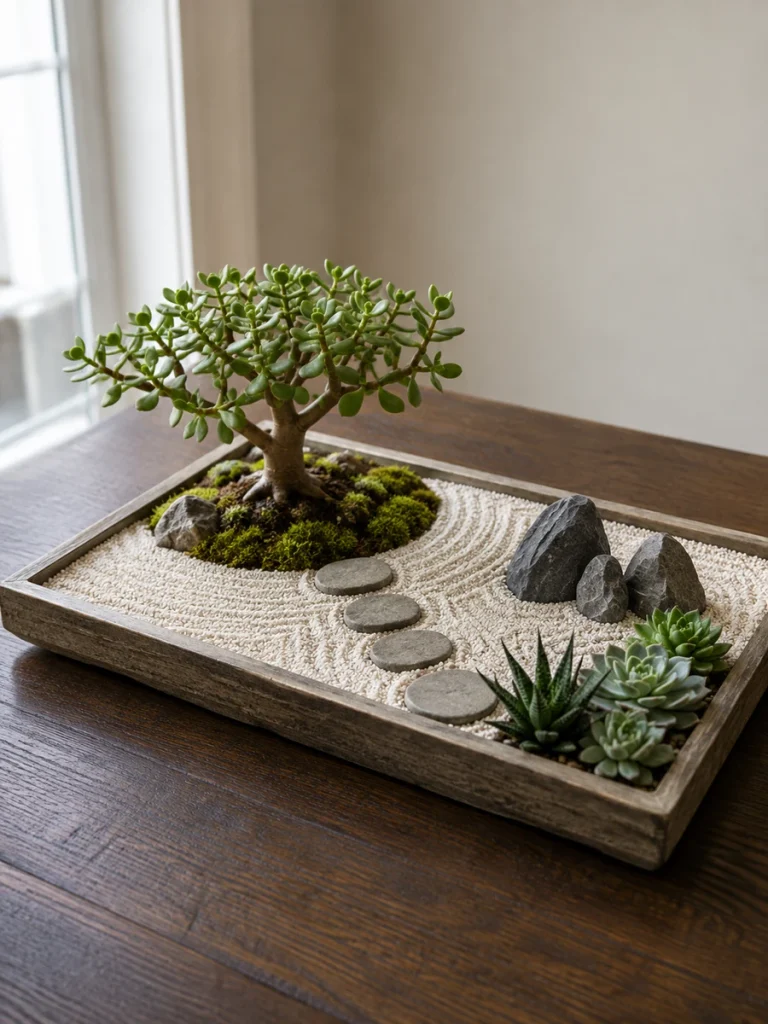
Not every dish garden needs to be full. A Zen-inspired arrangement looks better when part of the surface is left open. Use fine pale gravel, one bonsai-like jade, a patch of moss, and a small cluster of stones or succulents.
Rake soft lines into the gravel if you like, but keep the pattern simple. A few flat stepping stones can lead toward the main plant. The open space is what gives this design its calm, uncluttered character.
9. Stone Stairway Garden
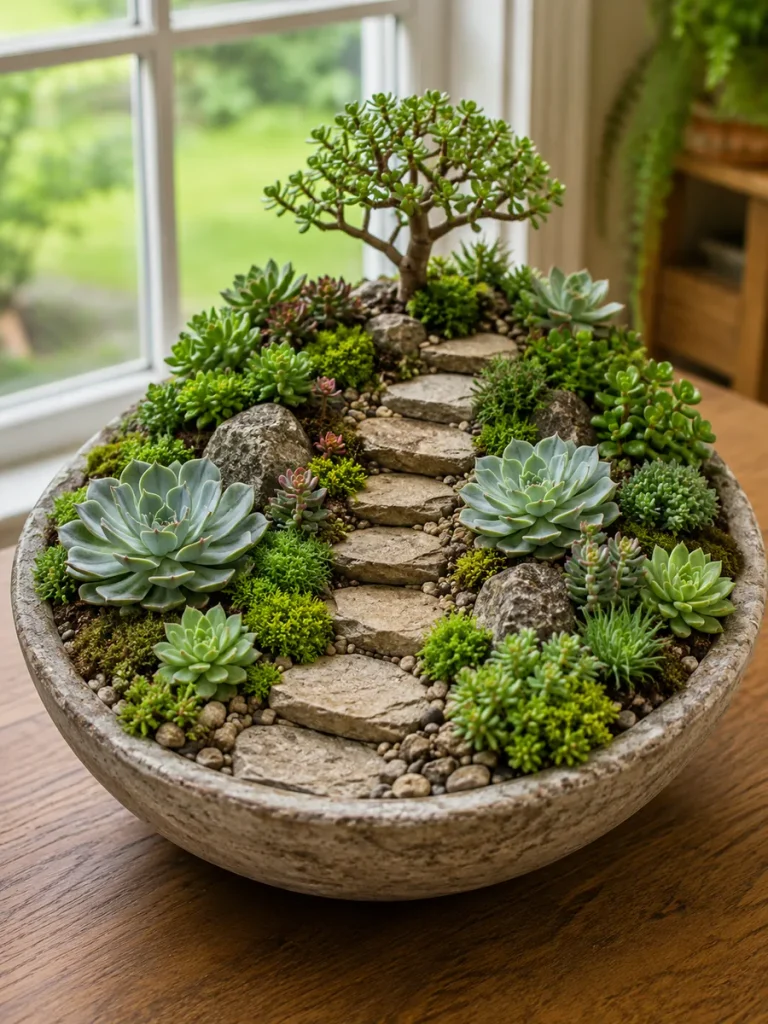
Flat stones can become a miniature staircase climbing through a planted slope. Start the first step near the front and raise each one gradually toward the back. Build the soil up on both sides so the steps feel integrated into the landscape.
Plant moss, echeveria, sedum, and small grass-like plants along the edges. A tiny jade or tree-like succulent at the top gives the staircase a destination and makes the scene feel intentional.
10. Succulent Island with Dry Creek
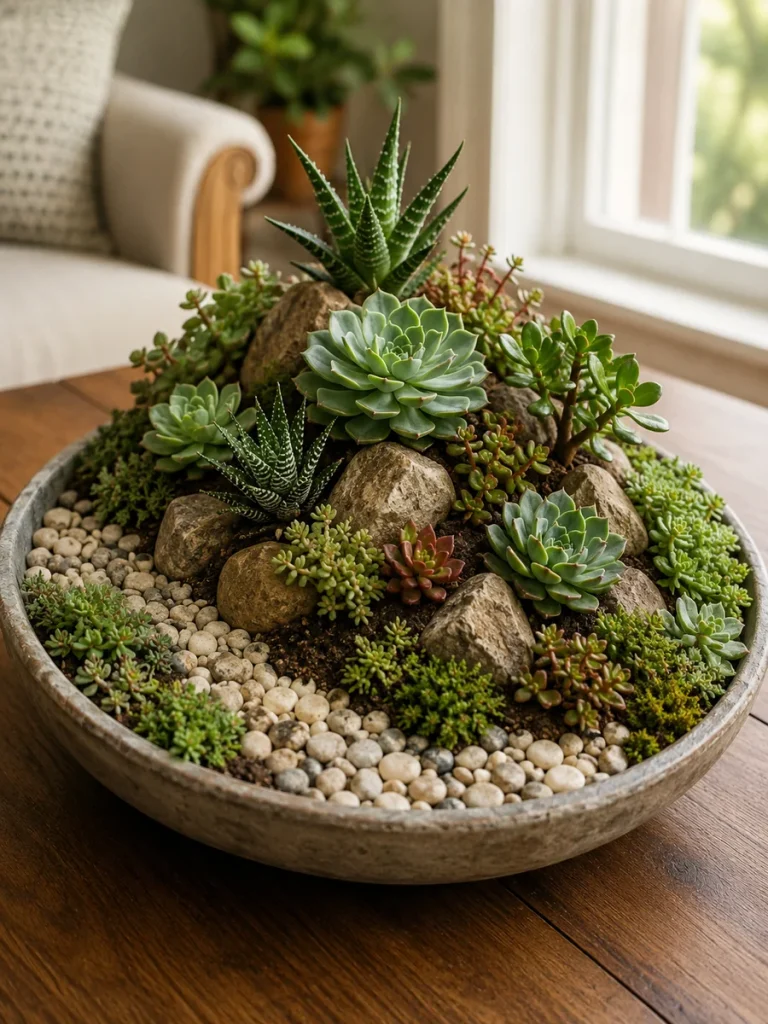
Create a raised planted island in the middle of a broad bowl, then curve a band of small pebbles around it. The stones act like a dry creek, while the center becomes the lush focal point.
Use different succulent forms on the island: rosettes, spiky haworthias, compact jade, and low sedum. A taller plant at the back keeps the design from feeling flat. Avoid making the creek a perfect circle; a loose curve looks far more natural.
11. Mini Cottage Path Garden
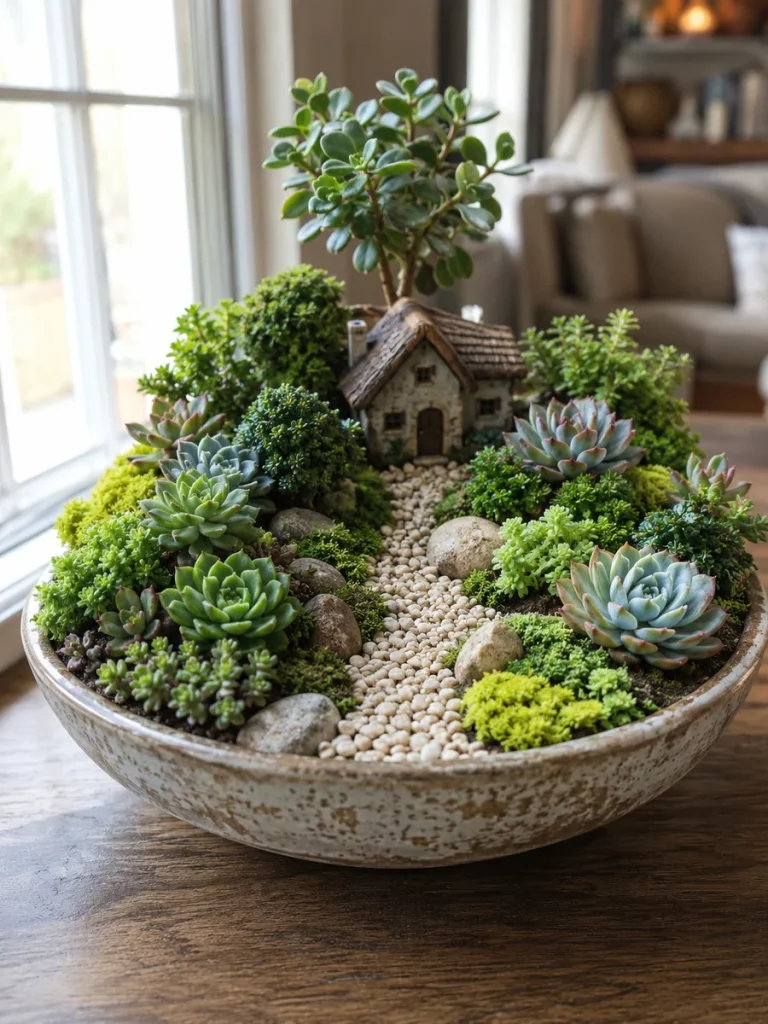
A tiny cottage can be charming without taking over the whole display. Place one neutral-toned cottage toward the back, then build a narrow path of pale gravel leading toward it. Let greenery partially surround the structure so it feels tucked into the garden.
Moss, low succulents, small jade plants, and a few rounded stones work nicely here. Skip the extra signs, fences, and figurines. One house and one path are enough to tell the story.
12. Tropical Tabletop Jungle
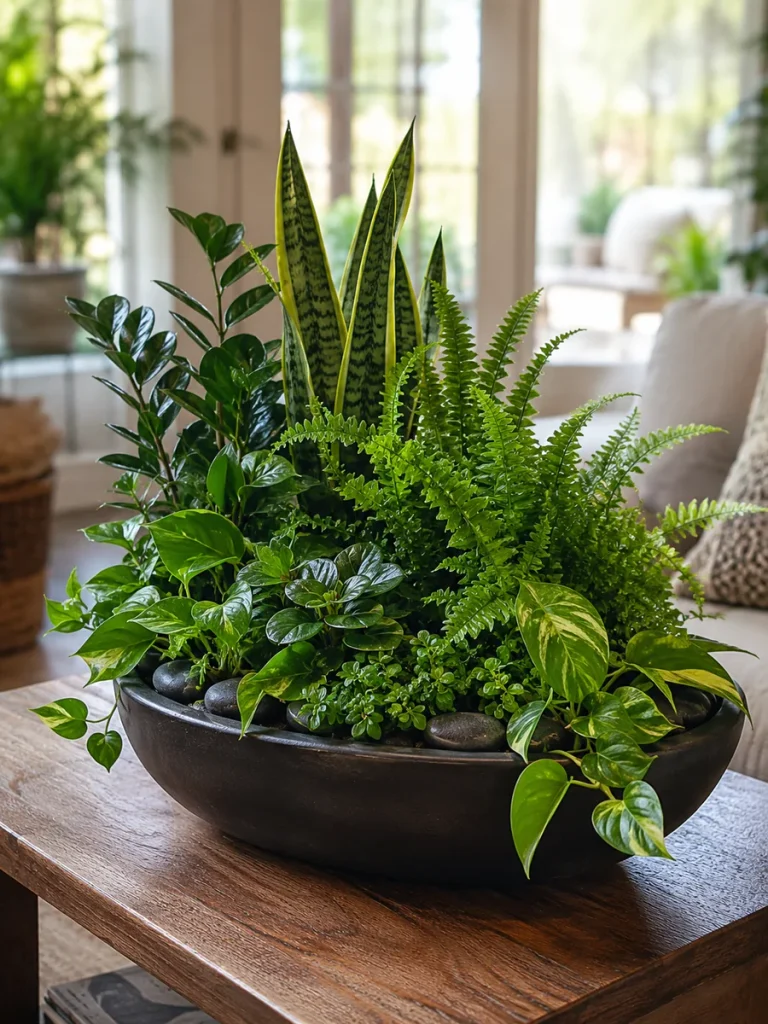
If succulents are not your thing, go leafy. A deeper bowl can hold a compact fern, young snake plant, dwarf pothos, peperomia, and a small ZZ plant. Let the leaves overlap rather than trying to keep each plant in its own neat section.
Dark pebbles at the base make the greens look richer. This arrangement suits a bright bathroom, sunroom, or living area where the slightly humid conditions may also help the foliage stay fresh.
13. Rocky Ravine Dish Garden
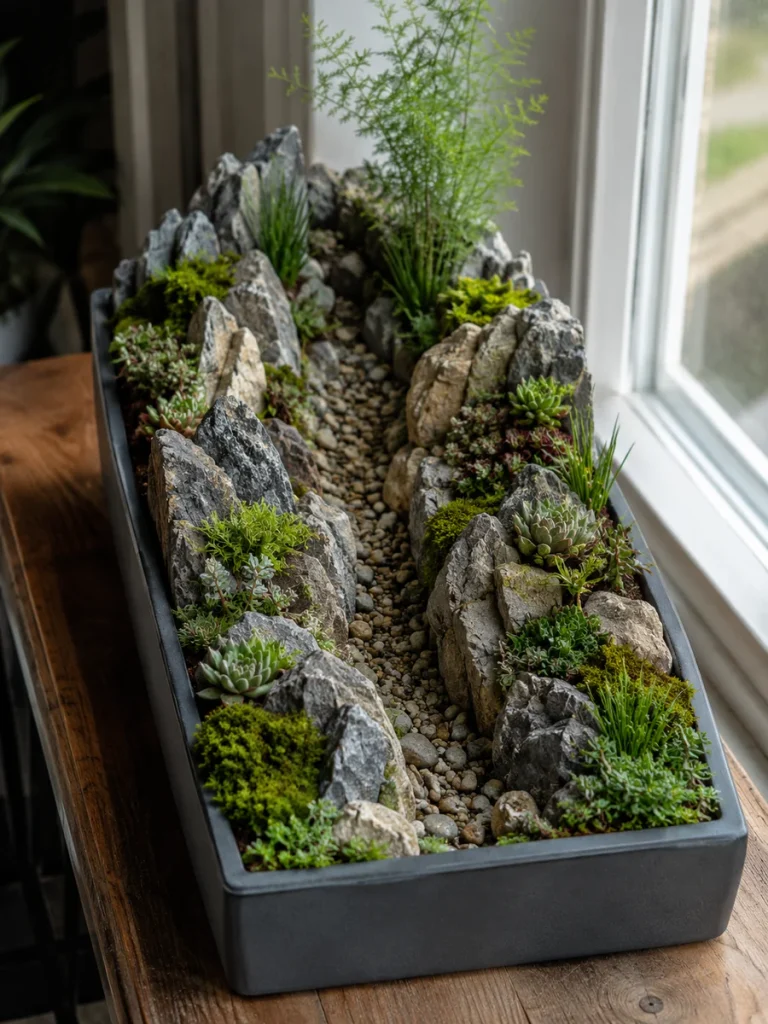
Use a long rectangular planter to create two rocky banks with a narrow gravel channel between them. The central gap should stay visible from the front all the way toward the back so the ravine effect reads clearly.
Tuck moss, low sedum, and small succulents along the stone edges. One taller fine-leaved plant at the rear adds depth. This design looks especially good when the rock shapes are rough and irregular rather than perfectly matched.
14. Jade Tree Courtyard
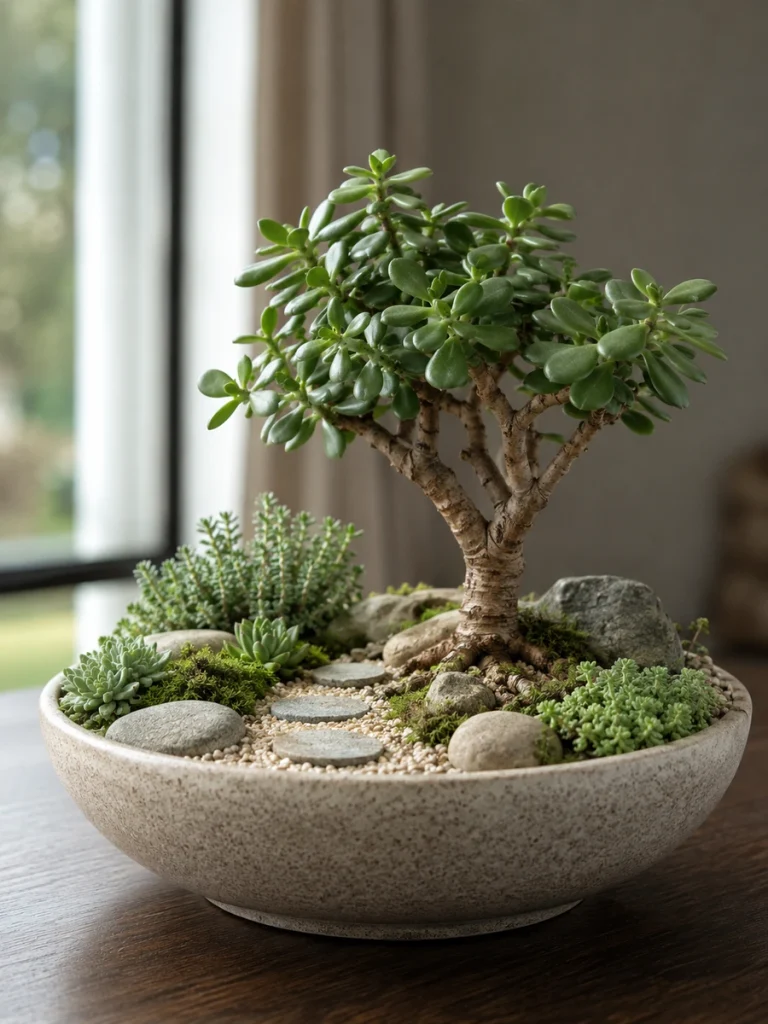
A mature-looking jade plant can play the role of a miniature tree. Give it space. Place it slightly off-center in a shallow bowl and keep the area beneath the canopy relatively open.
Use fine gravel to create a little courtyard, then add a few stepping stones, moss patches, and tiny succulents around the edges. The strong trunk and branching shape should remain the focus, so resist the urge to fill every inch.
15. Moss Hill and Stone Valley
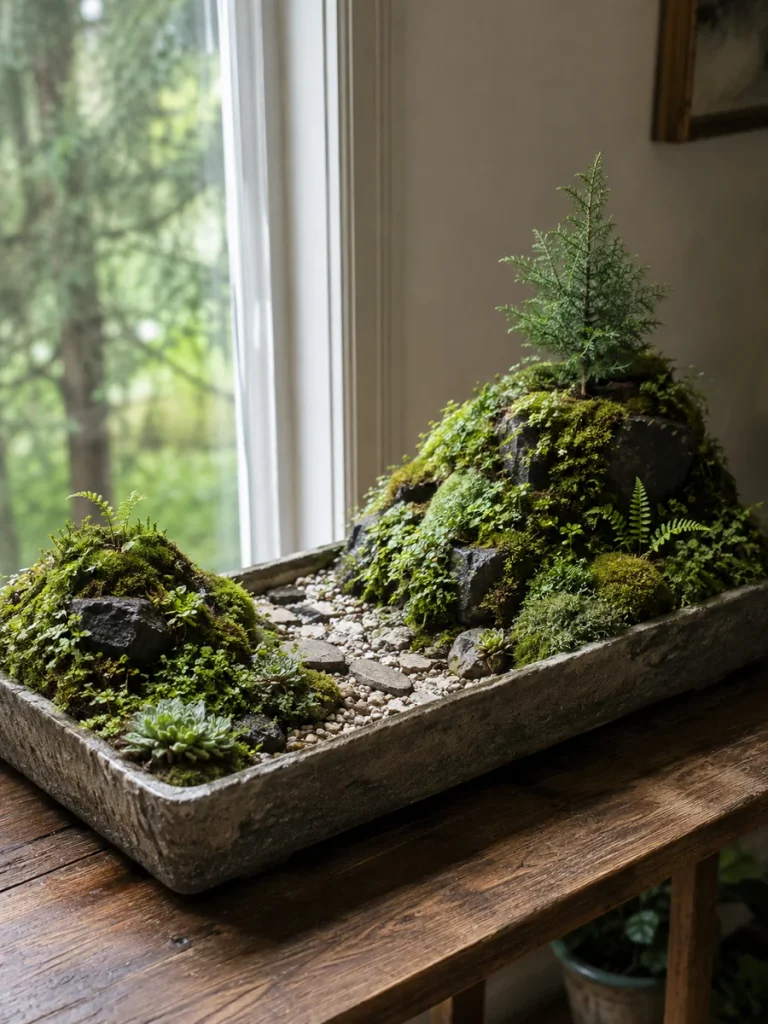
Build two small raised mounds on opposite sides of a long dish and leave a lower valley through the center. Cover the hills with moss and low greenery, then use gravel and flat stones in the valley.
A miniature evergreen-style plant can sit on the taller mound. This arrangement has a softer feel than a dry succulent garden, so it works well in rooms where you want greenery that feels calm and woodland-inspired.
Explore More Garden Ideas
45 Vegetable Garden Design Ideas for an Organized Backyard Garden
23 Handmade DIY Flower Pot Decoration Ideas You’ll Want to Recreate

45 Unique Indoor Pothos Climbing Ideas for a Dreamy Green Home
45 Inspiring Trellis Panels Ideas for Gardening for a Dreamy Outdoor Space
20 Creative DIY Garden Decor Ideas Made From Recycled Materials
45 Creative Wall Planter Ideas for a Gorgeous Outdoor Garden Display
16. Broken-Pot Terrace Garden
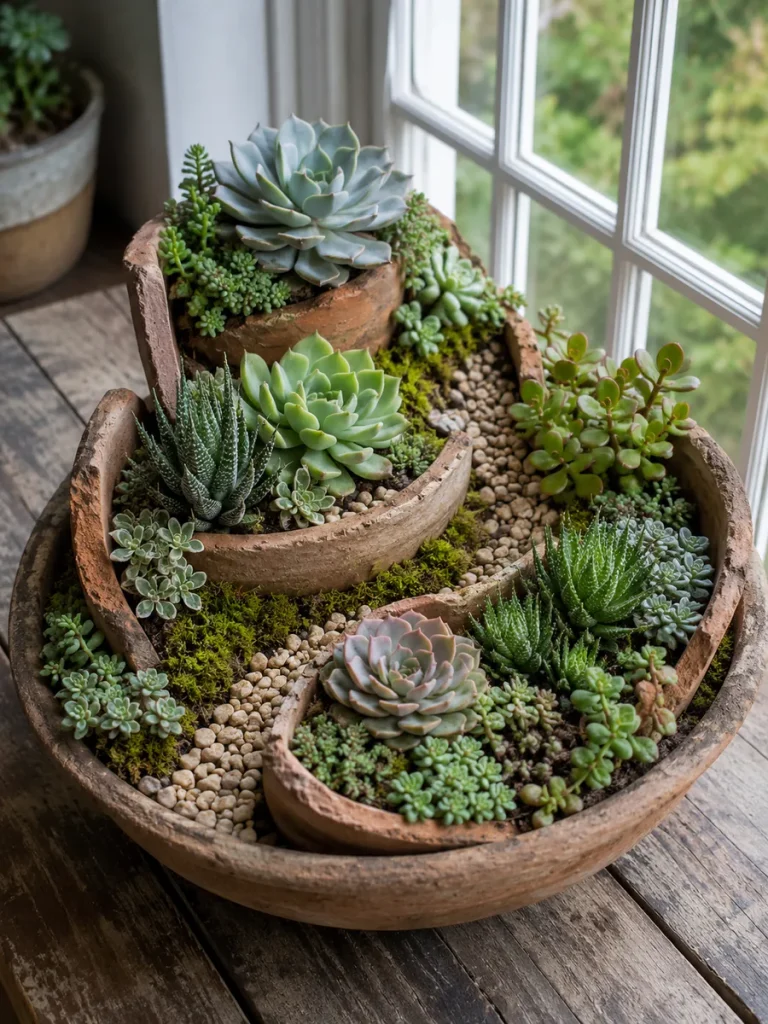
Broken terracotta pieces can become tiny retaining walls. Arrange curved fragments inside a larger dish to form two or three planting levels, making sure any sharp edges are buried or smoothed first.
Plant each terrace with compact succulents and fill the spaces between levels with gravel, moss, or small stones. Because the pottery already adds strong texture, keep the rest of the decoration simple. The layered structure will do most of the visual work.
17. Indoor Desert Canyon Bowl
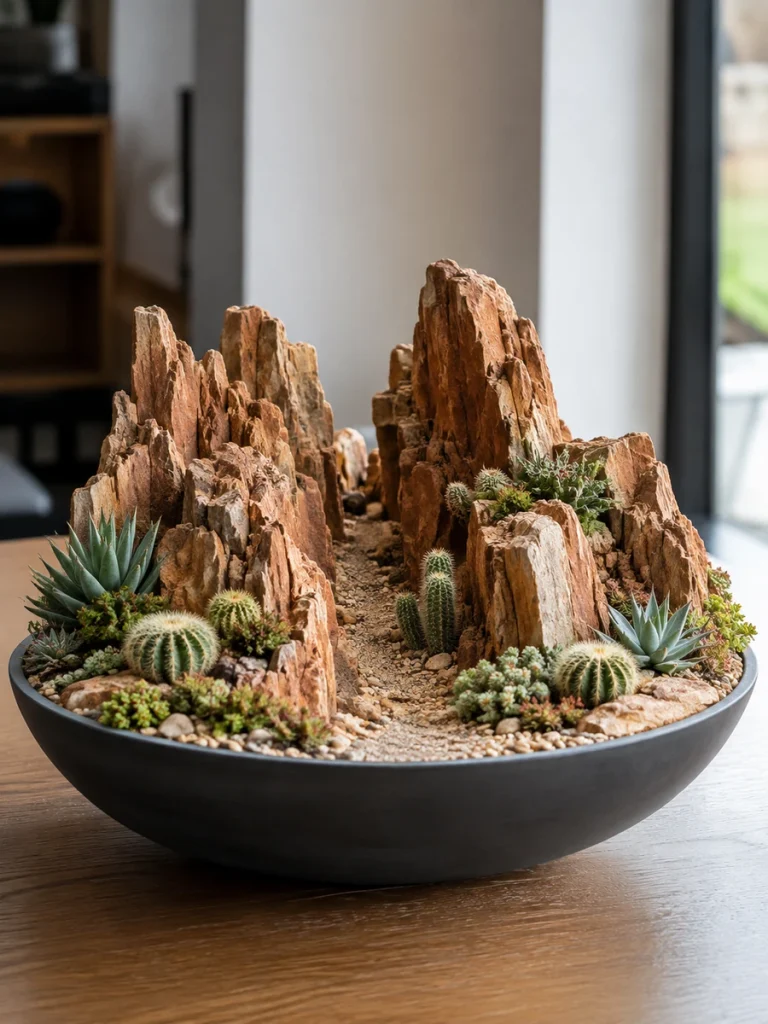
For a drier look, build a narrow canyon with warm rust, tan, and sandy-colored rocks. Keep a small passage between the stone walls and use pale gravel or sand as the ground layer.
Small cacti, agave-like plants, and compact drought-tolerant succulents fit the theme. Leave plenty of rock exposed. If you bury the canyon under plants, you lose the shape that makes this arrangement interesting in the first place.
18. Mossy Stone Bridge Scene
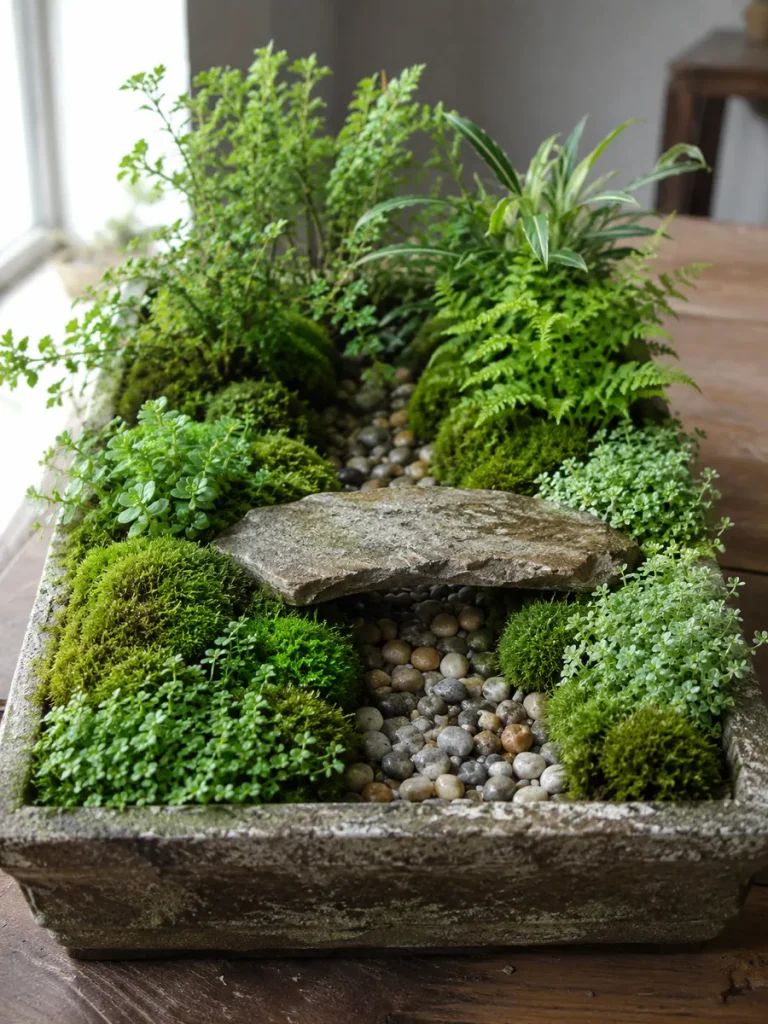
A single flat stone can become a bridge without needing a miniature bridge accessory. Set it across a narrow pebble stream, then plant moss and low greenery around both ends.
Tiny ferns, baby tears, and a few compact succulents can fill the banks. Keep the bridge wide enough to be obvious, but not so large that it dominates the container. The finished scene should feel like a small garden crossing rather than a toy display.
19. Large Rosette Garden with Stone Path
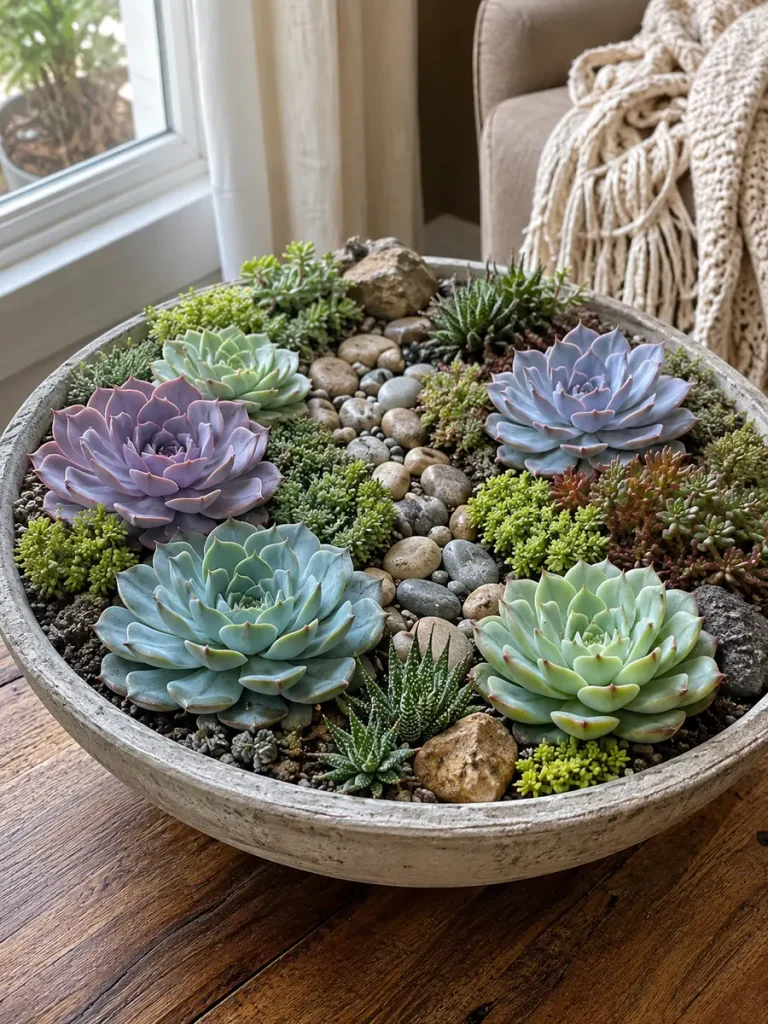
Echeverias are naturally dramatic, so let them lead the arrangement. Choose several large rosettes in slightly different tones such as blue-green, lavender-gray, mint, and soft green.
Place a curved stone path through the middle and use smaller sedums or haworthias to fill the gaps. Keep enough open space around the biggest rosettes so their shapes remain clear. This is one of the easiest ways to create a dish garden that looks full without feeling messy.
20. Mini Garden Beneath a Plant Tree
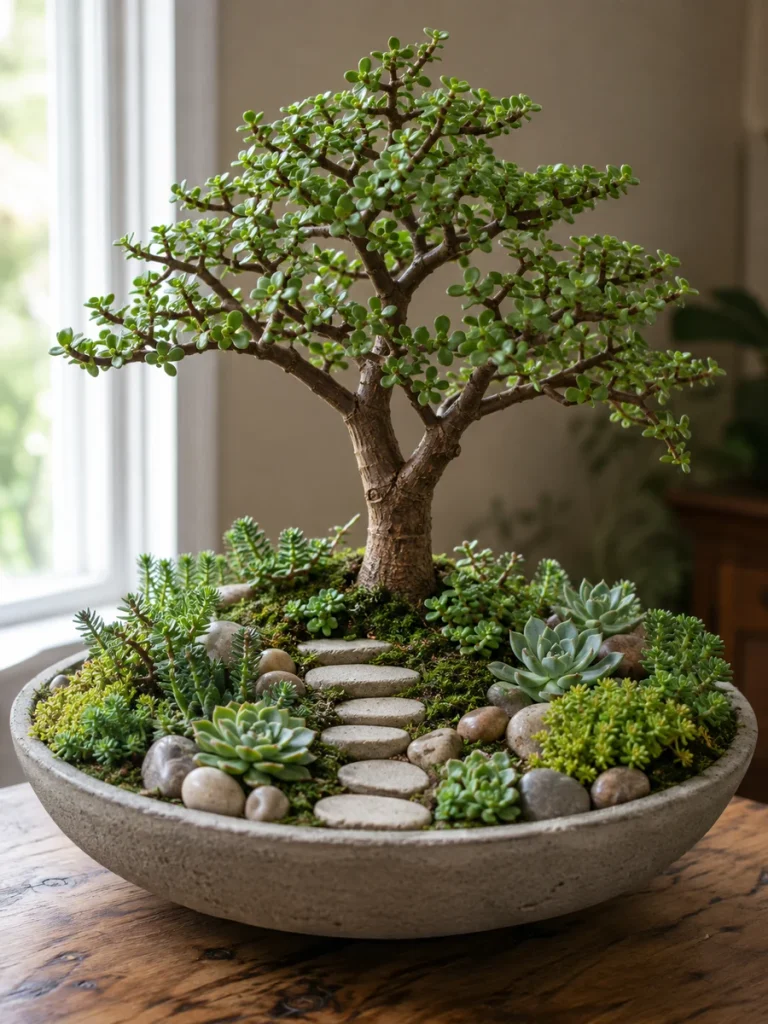
Choose a jade or portulacaria with a visible trunk and a spreading canopy. Plant it toward the back, then create a tiny garden beneath it using moss, stones, sedum, and low rosette succulents.
A short line of stepping stones leading toward the trunk gives the arrangement depth. The smaller plants should stay low enough that the tree still reads as the main feature when you look at the dish from across the room.
21. White Pebble Path Through a Green Garden
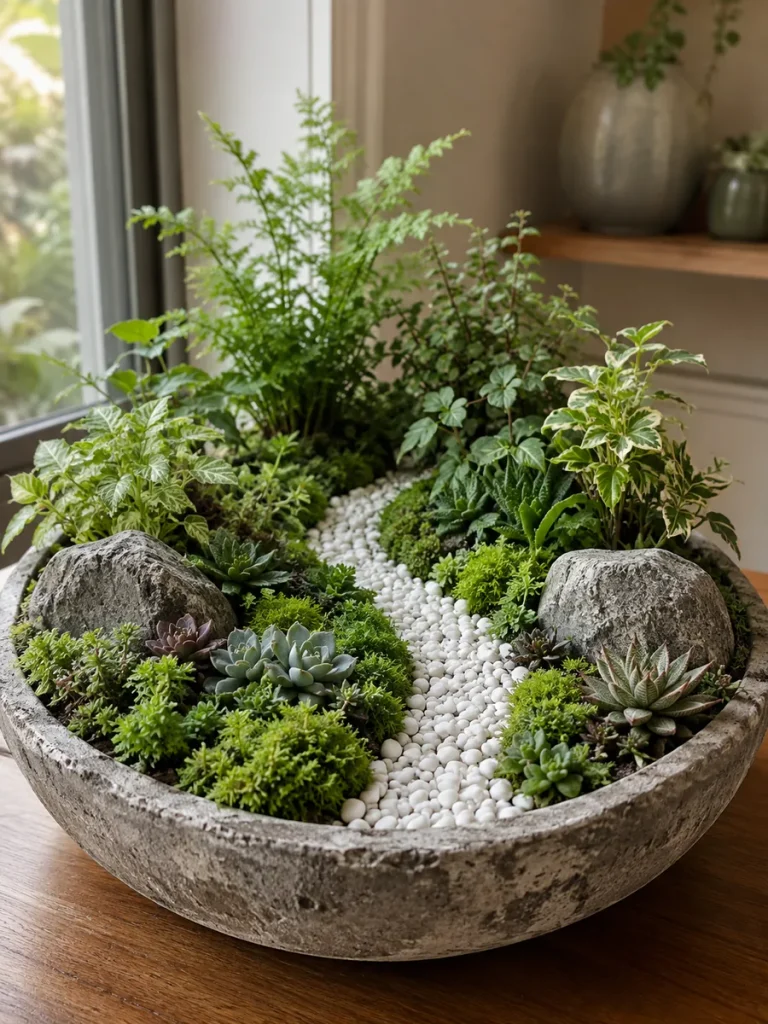
A bright white pebble path instantly gives a dish garden structure. Start the path at the front edge and let it curve toward the back, then build the planting along both sides as though you were landscaping a real garden walkway.
Use moss, sedum, haworthia, and compact green foliage, keeping the back slightly taller. A couple of larger gray stones stop the white path from looking too perfect. This one works beautifully when photographed or viewed from a slightly elevated angle.
22. Tiny Courtyard with Raised Stone Beds
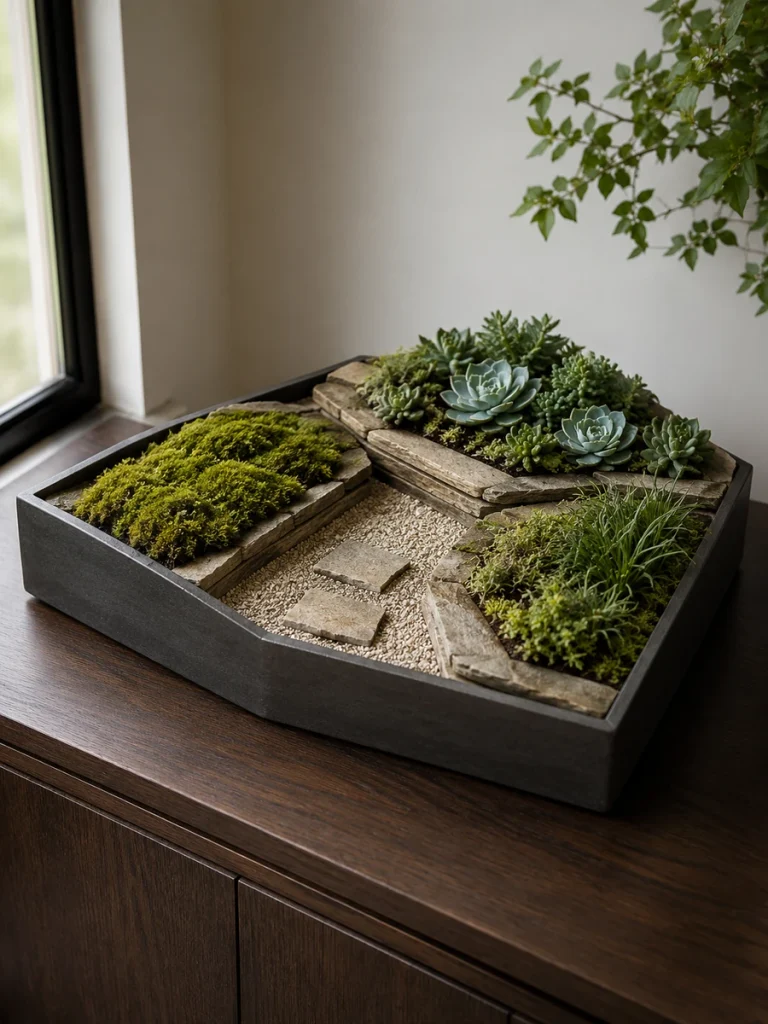
Flat stones can divide a rectangular planter into miniature raised beds. Create two or three sections at different heights, then give each bed its own texture: moss in one, rosette succulents in another, and fine grass-like foliage in the third.
Leave an open gravel courtyard between them. A few stepping stones make the layout feel architectural without adding clutter. This is a smart choice if you like neat garden design but still want the plants to feel natural.
23. Terracotta Spill of Succulents
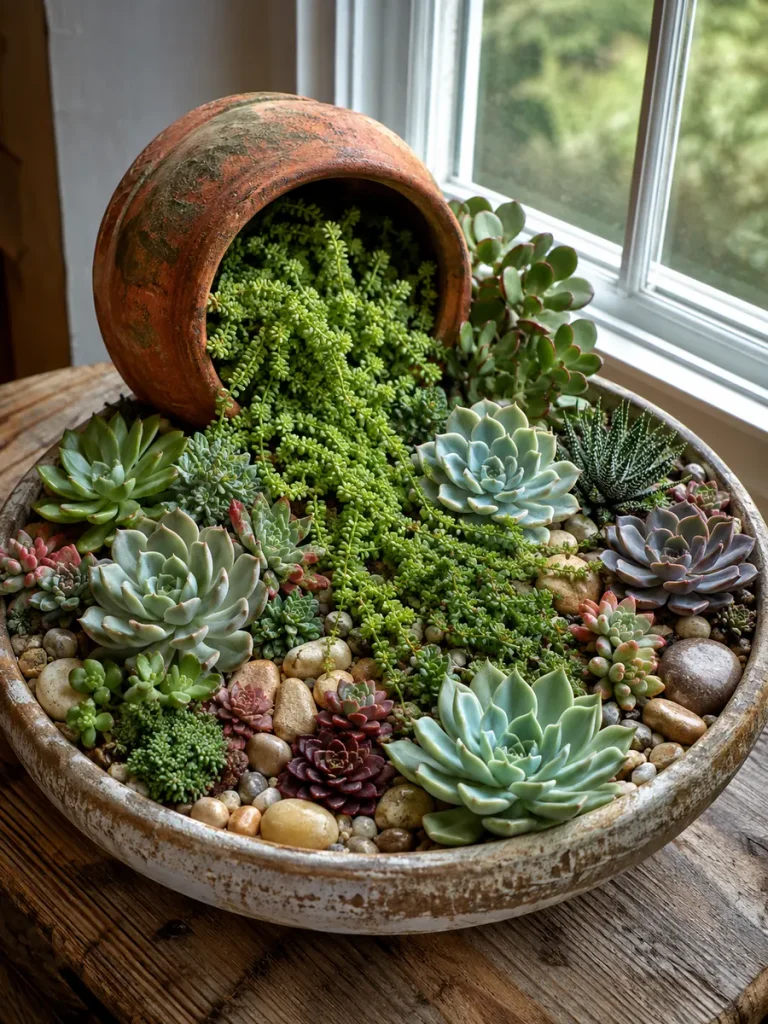
Instead of pouring stones from a tipped pot, let the plants do the spilling. Lay a small terracotta pot on its side and plant trailing sedum so it appears to flow naturally from the opening into the larger dish.
Surround the spill with echeveria, haworthia, jade, and a few muted red or purple rosettes. The tipped pot gives the display personality, while the dense green trail makes it feel grown-in rather than staged.
24. Mini Forest with Upright Plants
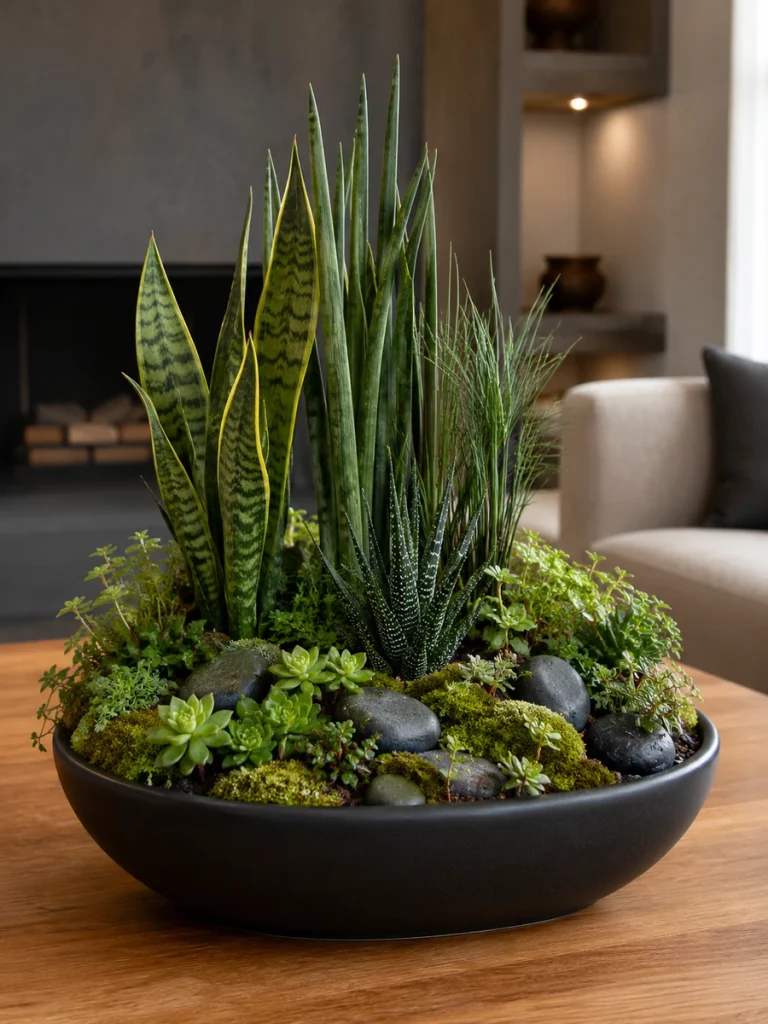
Group several narrow upright plants toward the back of a dark oval bowl to create the feeling of a miniature grove. Compact snake plants, cylindrical varieties, haworthias, and grass-like foliage all bring useful vertical shapes.
Keep the ground layer lower with moss, sedum, small rosettes, and dark stones. The taller plants should be clustered rather than evenly spaced. That small bit of irregularity makes the “forest” idea much more believable.
25. Stone-Centered Succulent Ring
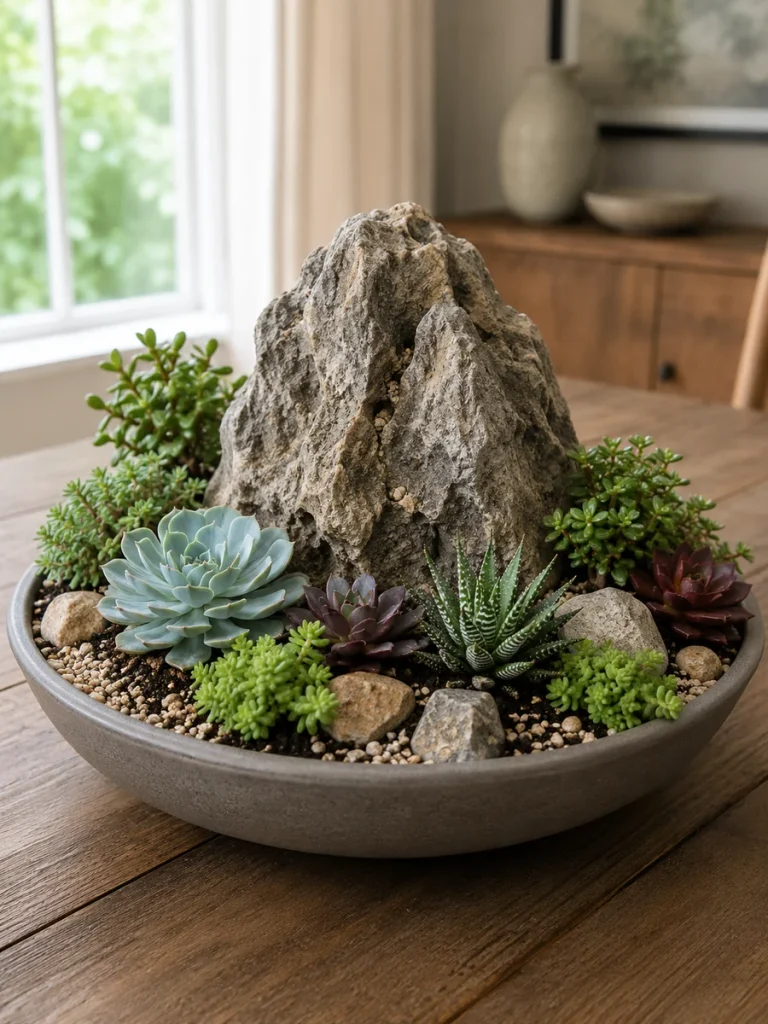
Choose one rock with an interesting shape and give it the center position. Plant a loose ring of succulents around it, mixing rosettes, haworthia, sedum, and compact jade.
Leave a little gravel and soil visible between plants. The open gaps help the main stone stand out and keep the display from turning into one solid mass of foliage. It is simple, but a strong focal point can make a basic bowl look thoughtfully designed.
26. Miniature Garden with a Hidden House
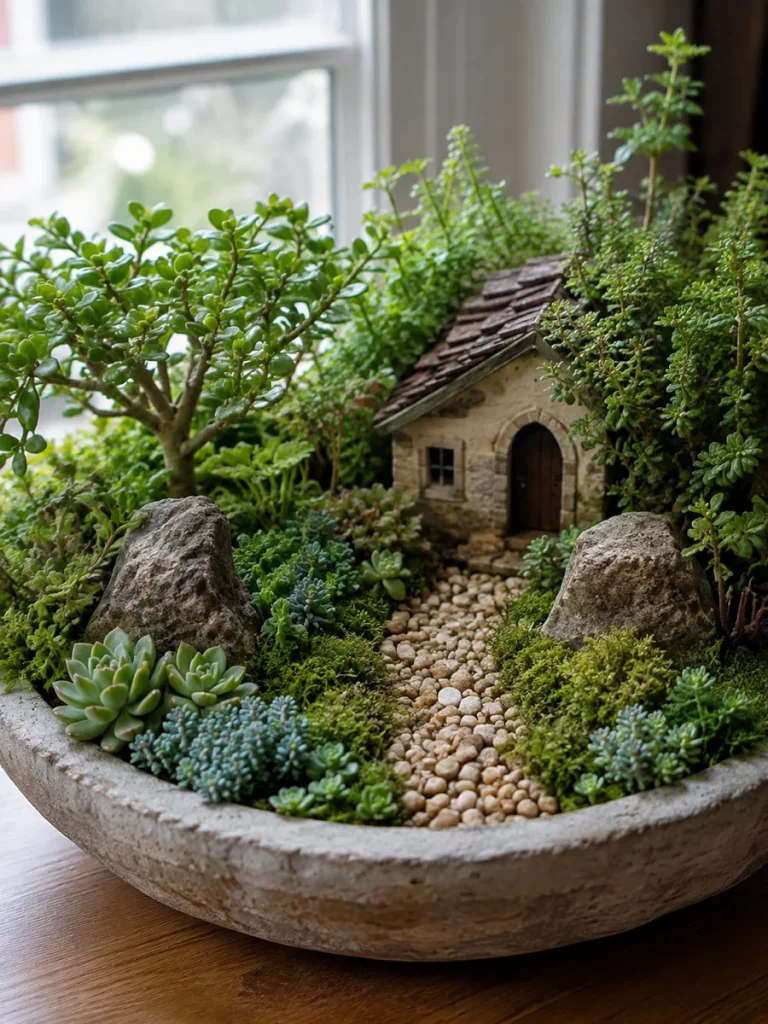
Rather than putting a cottage in the middle, hide part of it behind plants. Let only the roof, doorway, and part of the front wall show through the greenery.
A narrow stone path can lead toward the entrance, while jade, moss, sedum, and small rosette succulents fill the surrounding garden. This approach makes the house feel discovered rather than displayed. It is much more subtle, and that is exactly why it works.
27. Rock Wall Terrace Garden
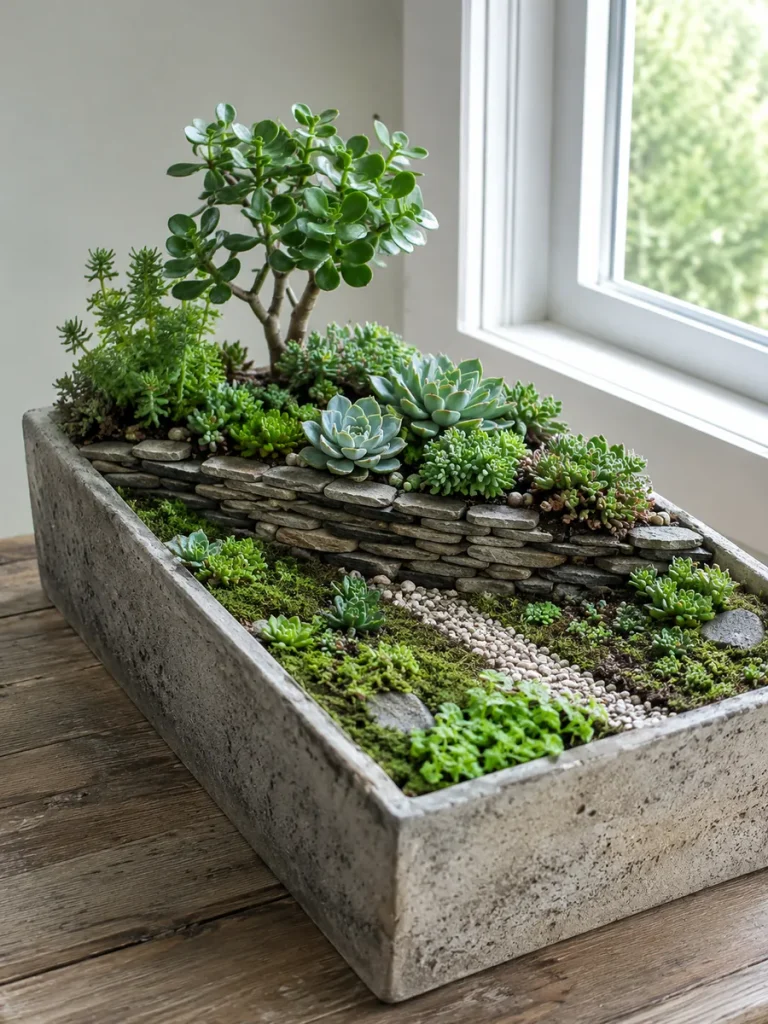
Stack flat stones across the middle of a long planter to build a low retaining wall. Raise the soil behind it, then plant the upper terrace with succulents and a small tree-like jade.
Keep the lower section softer with moss, fine gravel, and smaller plants. The difference in height gives the arrangement real depth, even when the planter itself is shallow. It also looks great on a console where you can view the layers from the front.
28. Mixed Green Dish Garden with Dark Pebbles
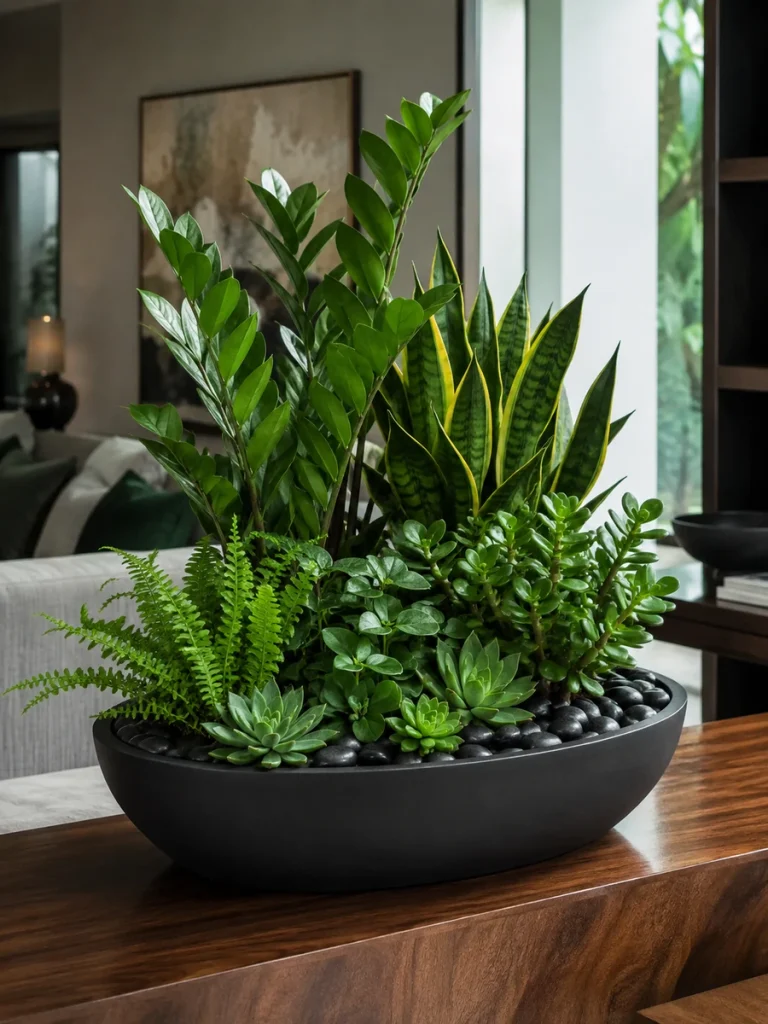
This idea is all about green-on-black contrast. Combine glossy ZZ stems, snake plants, ferns, peperomia, jade, and low green succulents in a deep charcoal bowl.
Cover the exposed soil with smooth black or dark gray pebbles. Because the plant palette stays almost entirely green, the different leaf shapes become more noticeable. It feels lush without becoming colorful, making it a strong option for modern or more formal rooms.
29. Curved Creek Through a Rock Garden
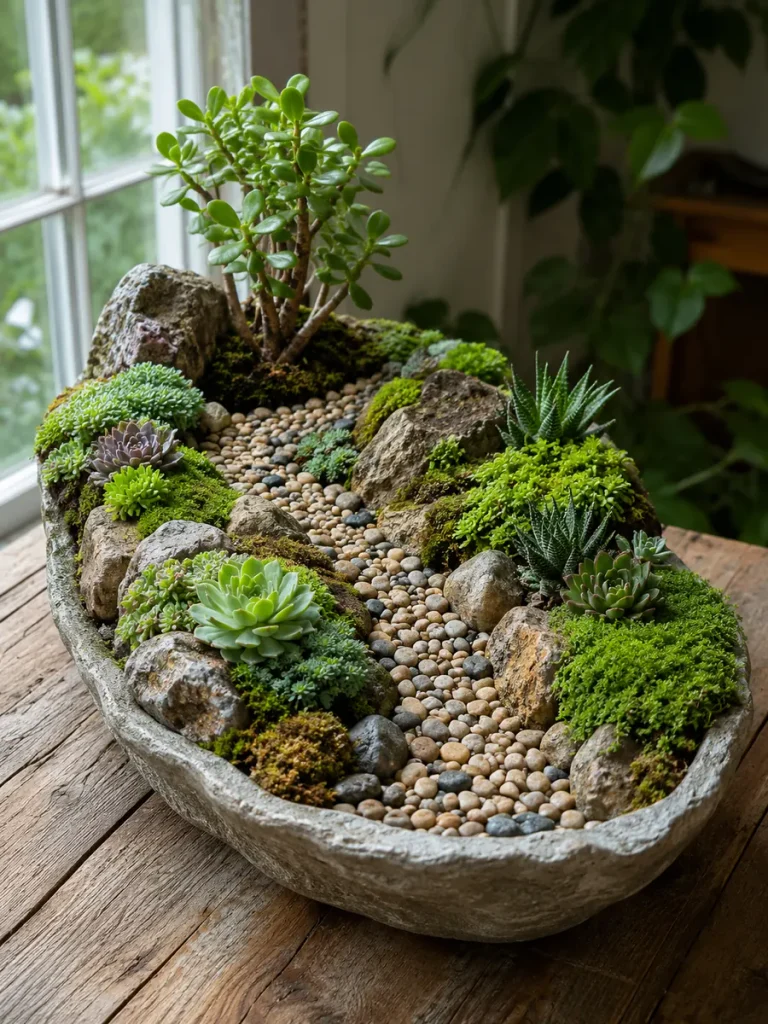
Create two uneven planted banks, then run a winding channel of small pebbles between them. Let the creek begin toward one back corner and curve toward the opposite side at the front.
Use rocks, moss, echeveria, haworthia, and low sedum along the banks. Keep the creek visible from end to end. The path does not need water to read clearly; a mix of cream, gray, and brown stones gives it enough texture on its own.
30. Succulent Garden Around a Boulder Cluster
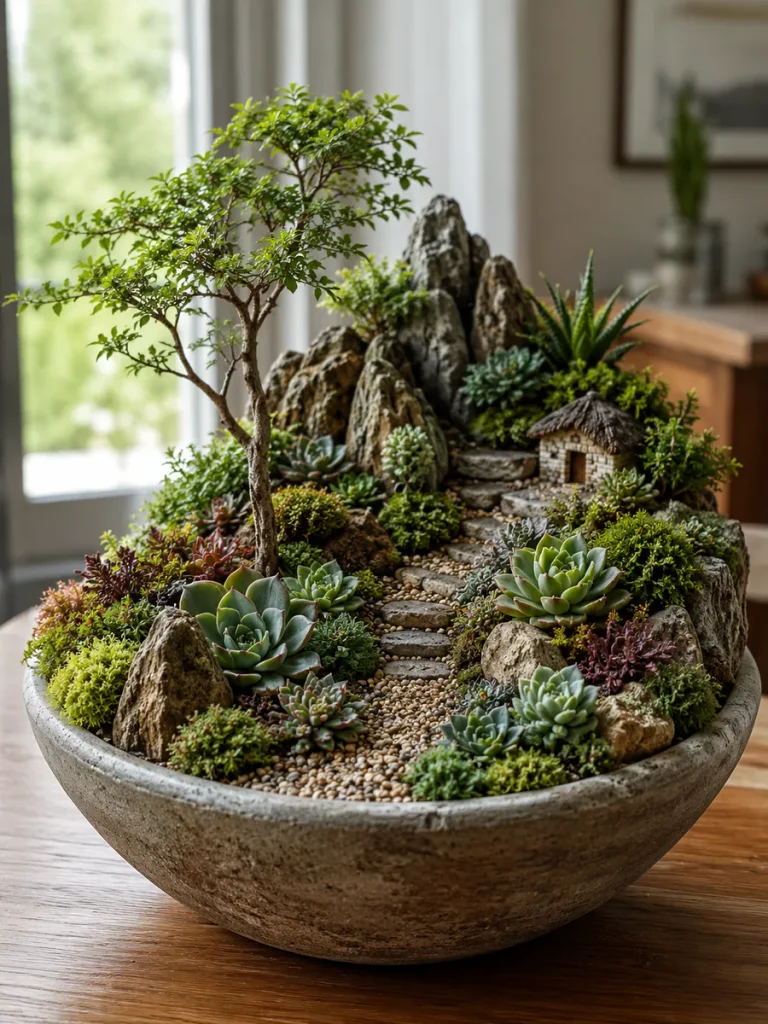
Group three or four larger stones toward one side of a broad dish and treat them like a tiny rock formation. Plant succulents around the base and tuck smaller plants into gaps between the boulders.
Keep the opposite side more open with gravel and just a few low plants. The asymmetry matters. If every rock and succulent is mirrored on the other side, the scene starts to feel arranged. Let one side be heavier and the other quieter.
Discover More Stylish Home Ideas

45 Stunning Christmas Interior Design Ideas for a Cozy Holiday Home

45 Vibrant Kitchen Decor Ideas for a Bright and Playful Interior

45 DIY Seashell Wall Art Ideas for Beautiful Coastal Home Decor

23 Handmade DIY Clock Ideas to Give Your Walls a Unique Look
20 Creative DIY Garden Decor Ideas Made From Recycled Materials

30 Handmade DIY Fall Decorations for Every Corner of Your Home
31. Tiny Pine-Like Mountain Garden
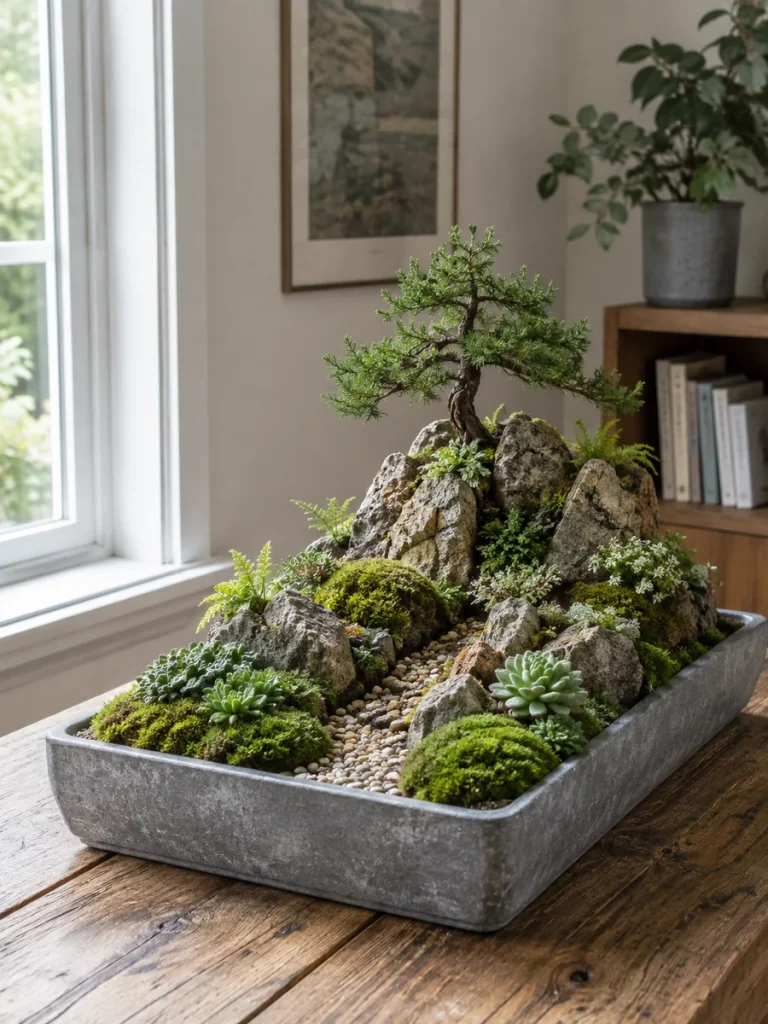
A fine-leaved, pine-like miniature tree makes a powerful focal point when it sits above a rocky ridge. Build the raised section first, using irregular stones and enough soil to give the tree a stable position.
Add moss, small succulents, and low alpine-looking plants around the base, then create a narrow pebble trail below. Keep the highest point toward the back so the whole landscape seems to rise away from the viewer.
32. Circular Garden with a Central Path
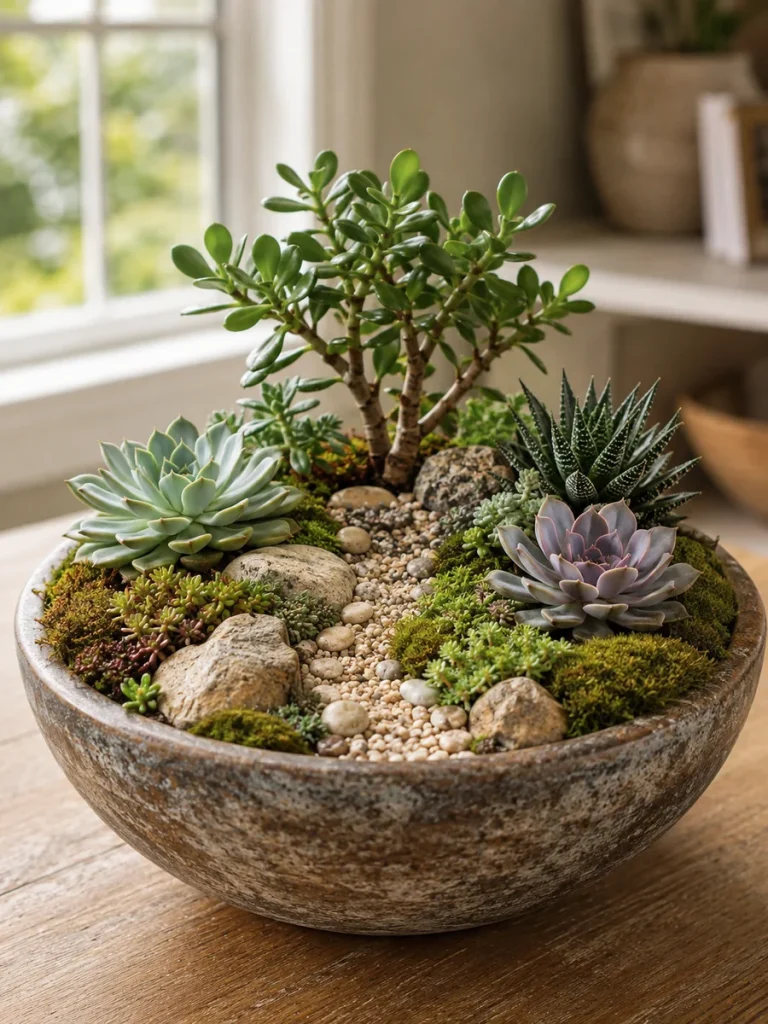
A round dish naturally encourages a circular planting pattern, but a central path can stop it from looking too predictable. Start the path at the front and curve it gently toward a taller jade or upright succulent at the back.
Place medium rosettes along the sides and use moss or sedum near the path edges. A few larger stones help break up the planting. The result feels balanced without becoming stiff.
33. Indoor Cottage Garden with a Tiny Bench
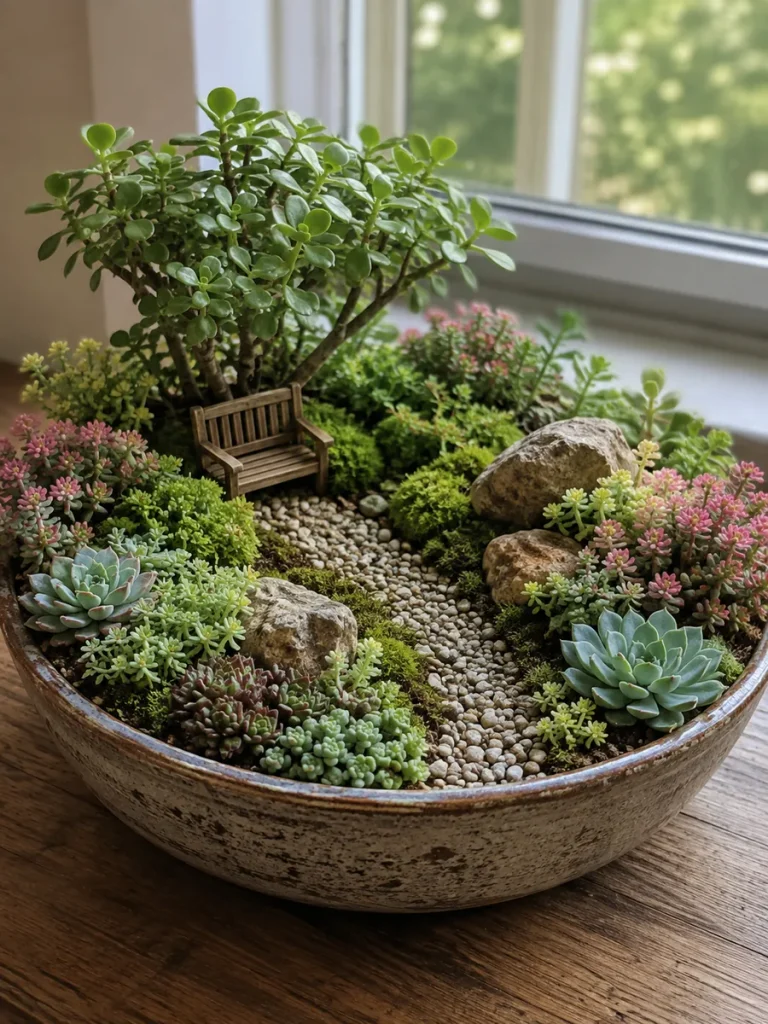
A miniature bench can add just enough character without turning the dish into a full fairy garden. Place it slightly off-center beside a gravel path, preferably beneath a small jade or shrub-like plant.
Surround the scene with moss, compact sedum, and a few soft-colored rosette succulents. Keep the bench simple and unpainted. The goal is to make it feel like a quiet resting spot hidden inside the planting.
34. Rocky Succulent Slope
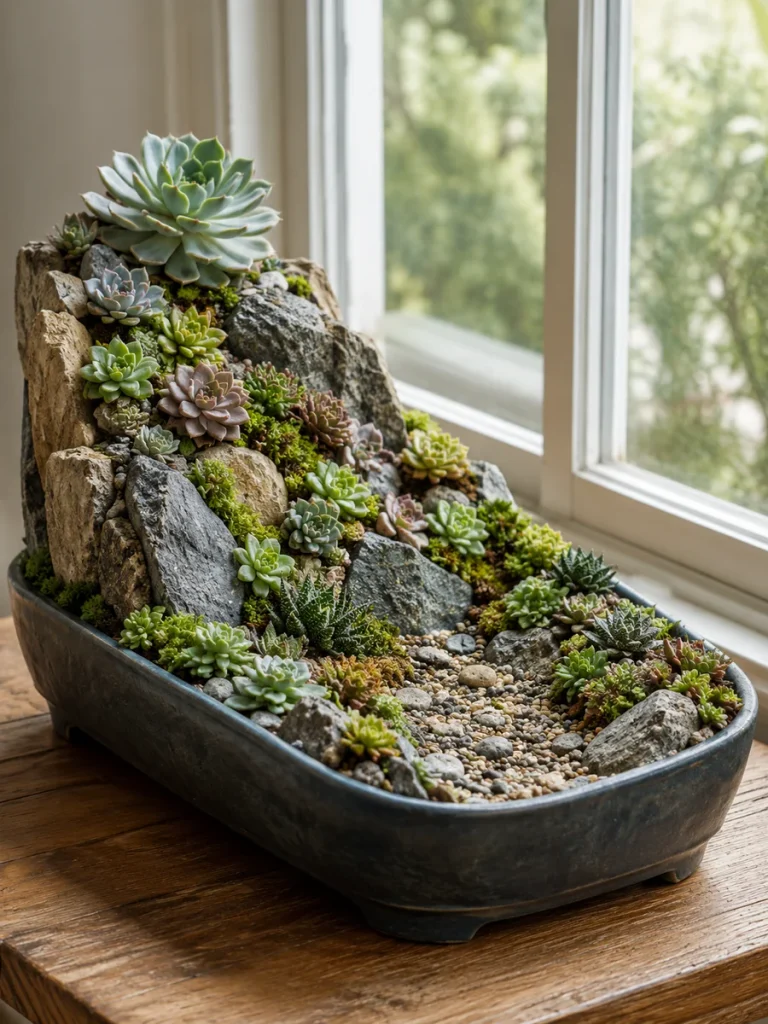
Raise one back corner of a rectangular or oval planter and let the ground slope gradually toward the opposite front side. Embed stones into the soil as you build so they look like part of the terrain rather than decorations placed afterward.
Plant larger echeverias near the top and smaller haworthia, sedum, and compact rosettes lower down. A gravel basin at the bottom gives the slope a clear ending point and adds useful open space.
35. Tropical Bowl with Variegated Foliage
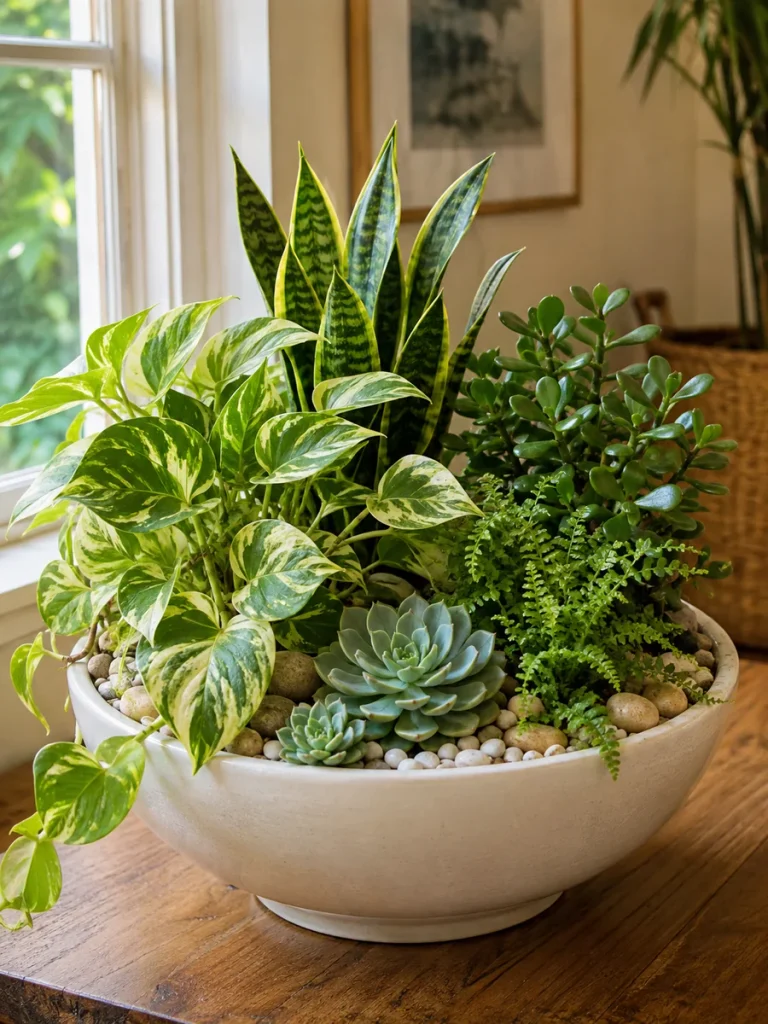
Variegated pothos brings brightness without needing flowers. Pair it with a compact snake plant, small fern, jade, and one or two blue-green succulents in a broad pale bowl.
Place the taller leaves toward the back and allow the pothos to soften one edge. Light stones around the base keep the arrangement fresh and airy. This design is especially good near a bright window where the pale leaf markings can catch the light.
36. Miniature Garden Around a Stone Hut
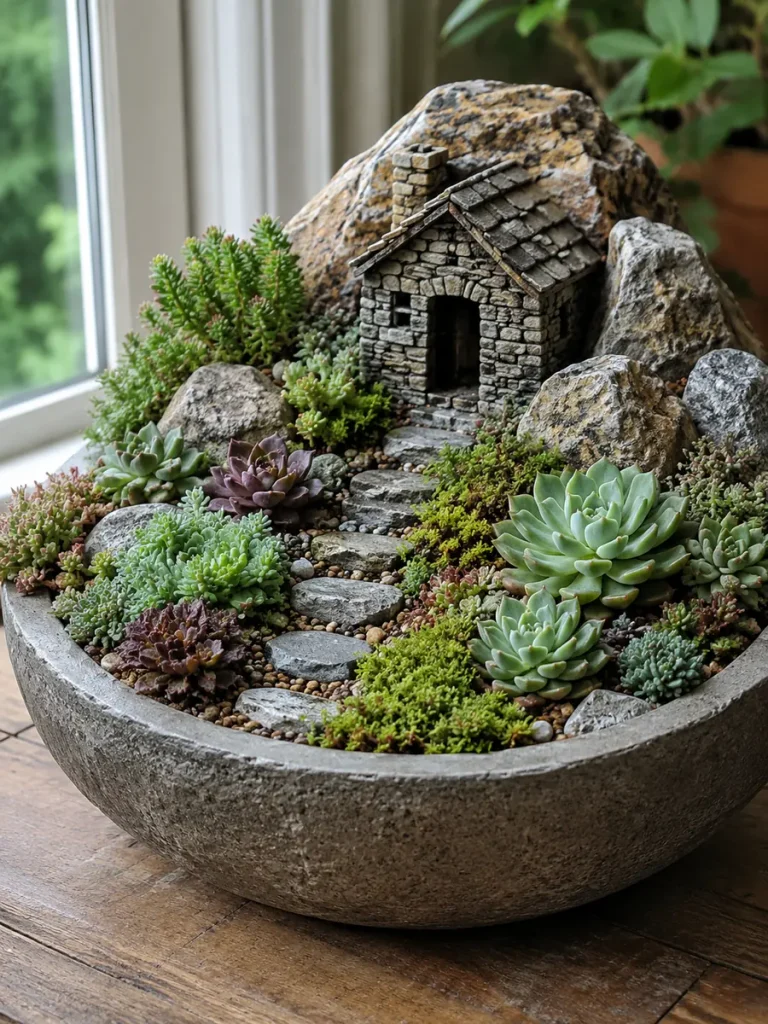
A small stone-look hut works best when it is built into the landscape rather than sitting alone. Tuck it against a rocky back section and lead a few flat stepping stones toward the doorway.
Use moss, sedum, echeveria, and muted burgundy succulents around the structure. Keep the colors natural and let some greenery overlap the base of the hut. It should feel like a tiny hillside home that has been there for years.
37. Moss Islands in a Pebble Sea
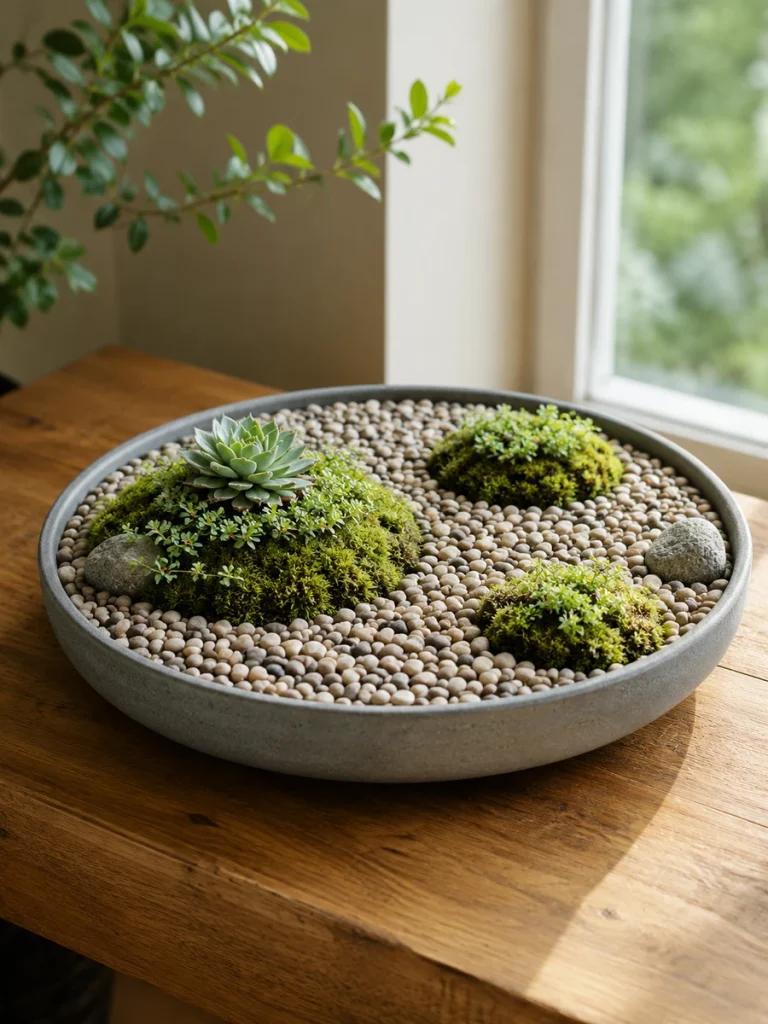
This is a good choice if you prefer open, calm compositions. Cover most of a shallow bowl with small smooth pebbles, then create three or four rounded islands of moss and low greenery.
Place one larger succulent on the biggest island and leave the others simpler. The empty pebble space is part of the design, so do not fill it later because the bowl looks “unfinished.” The restraint is what gives this arrangement its quiet character.
38. Succulent Village Garden
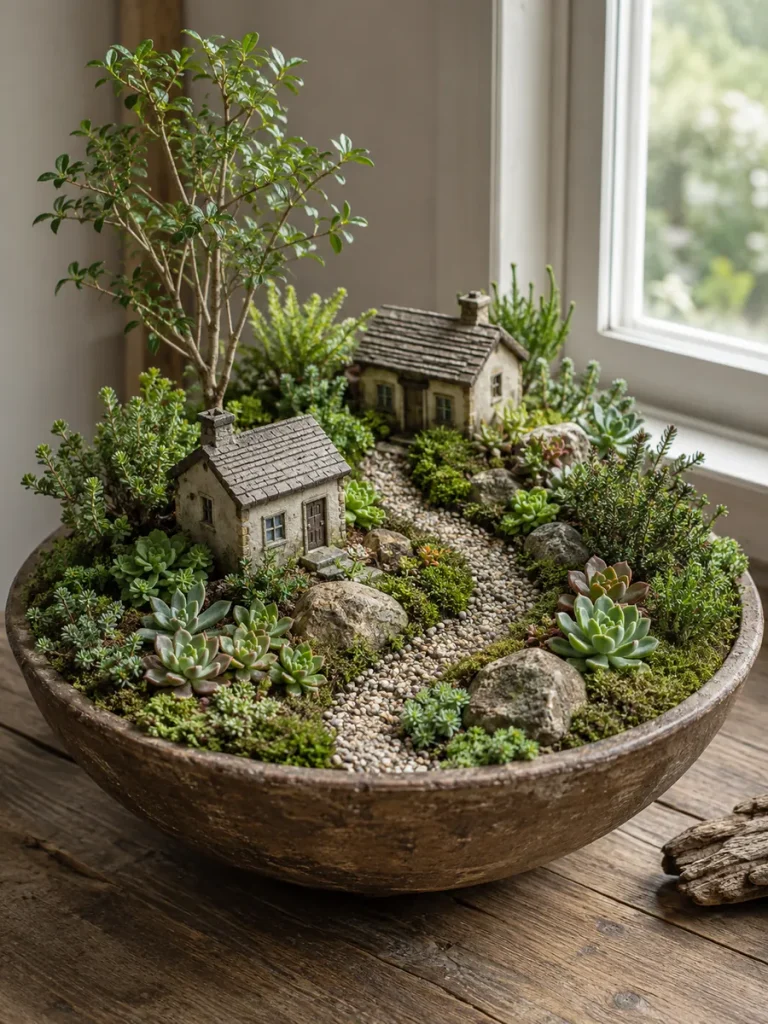
Use two very small neutral cottages placed at different heights, then connect them with a winding pebble path. The buildings should stay secondary to the planting.
Fill the bowl with moss, sedum, rosette succulents, miniature shrubs, and one slightly taller tree-like plant. A few natural stones help anchor the houses into the landscape. Avoid bright accessories; the village looks far more convincing when everything stays in earthy tones.
39. Multi-Level Rock Garden in a Wide Bowl
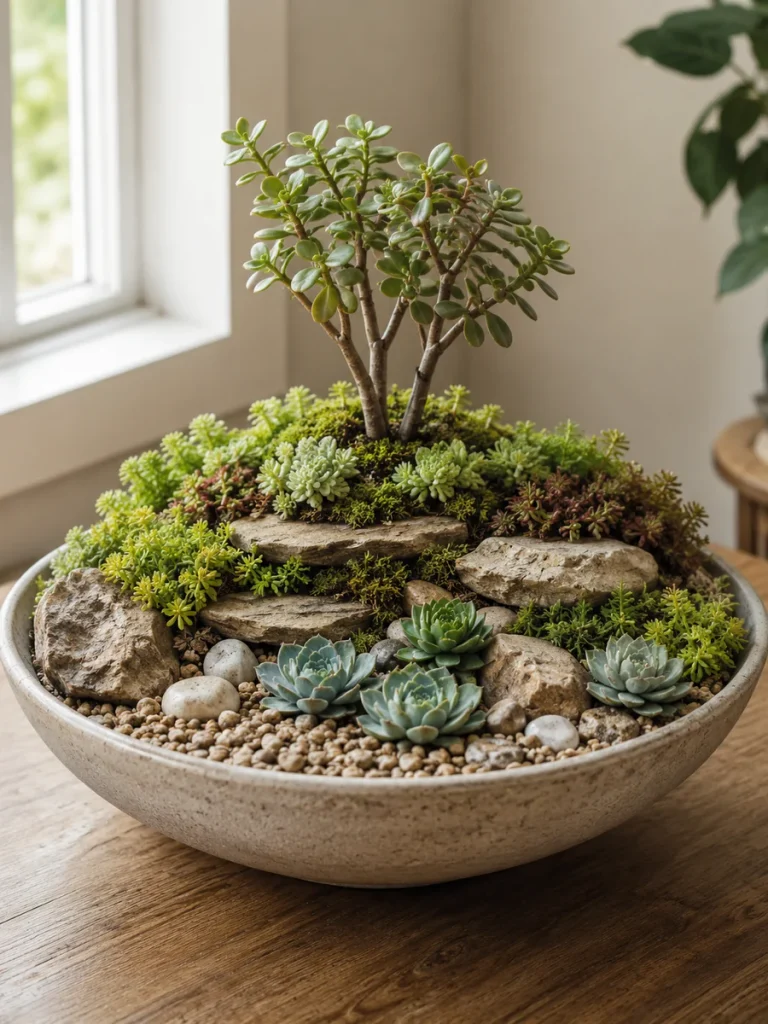
Divide the bowl into three gentle height levels rather than one steep slope. Keep the front low with gravel and small rosettes, raise the middle with rocks and sedum, and use the back level for a taller jade or upright succulent.
Flat stones can mark the transitions without looking like formal walls. This layout gives a large bowl a lot of depth and works especially well as a dining-table or console centerpiece.
40. Full Miniature Landscape Statement Garden
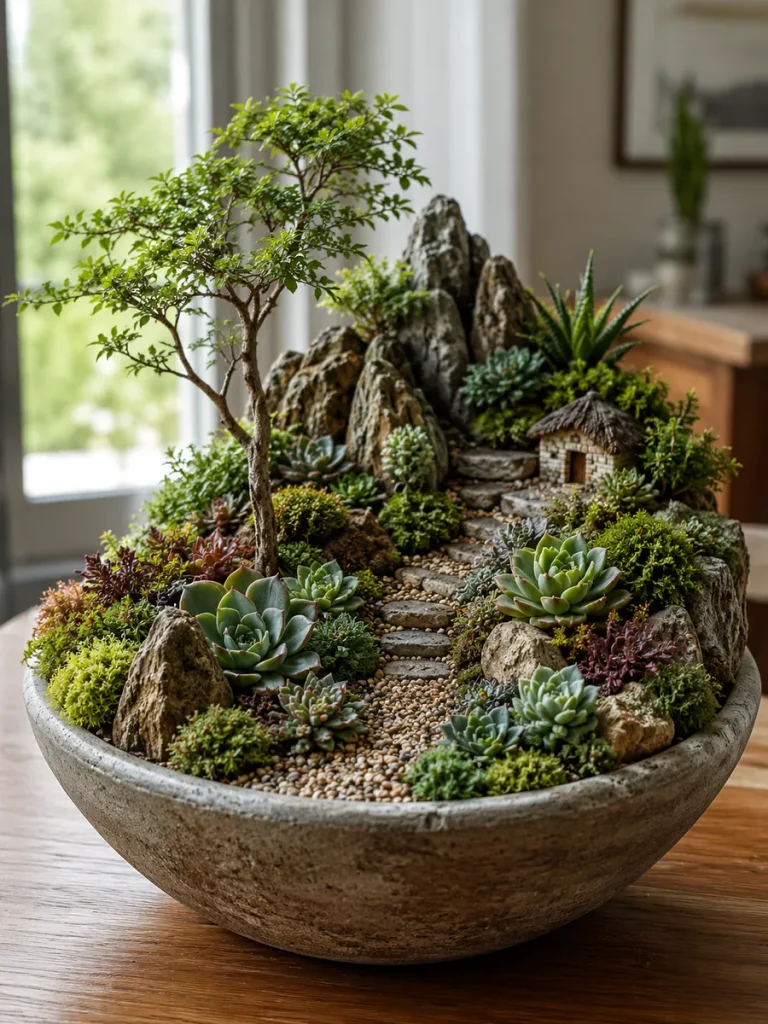
For a statement piece, combine several landscape ideas in one broad bowl. Build a rocky hill at the back, run a winding pebble path through the center, and keep the front lower with rosette succulents, moss, and small stones.
Add one tree-like plant for height. If you use a miniature hut, tuck it into the side rather than placing it in the center. The finished garden should feel layered and rich, but every area should still have enough breathing room to be seen.
How to Build a Dish Garden That Looks Natural
Start with the shape of the landscape, not the plants. Decide where the high point will be, where the open space will sit, and whether you want a path, creek, courtyard, or rock formation. Once that skeleton is in place, choosing plants becomes much easier.
A useful way to work is in three height zones. Use a small tree, snake plant, or tall rock for the upper layer. Add echeveria, haworthia, compact foliage, or medium stones in the middle. Finish with moss, sedum, gravel, and tiny groundcover at soil level.
Work slowly. Put a few plants in, step back, and look at the arrangement from the angle you will usually see it. You may find that one plant needs to move or one rock needs to turn slightly. Those small adjustments often make more difference than adding another decorative item.
Choosing a Container
Wide, shallow bowls are easiest for landscape-style arrangements because they give you enough surface area to create paths and open spaces. Rectangular planters are excellent for terraces, ravines, and mountain scenes. Oval bowls suit taller mixed foliage displays, while round dishes are ideal for central paths, islands, and ring-shaped plantings.
Look at the finish too. Terracotta feels warm and rustic. Matte black makes green foliage look sharper. Stone-effect containers blend naturally with rock gardens. Pale ceramic bowls help variegated and blue-green plants feel lighter.
If the container has no drainage hole, be careful with water. A dish can look dry on top while holding moisture at the bottom, so small, measured watering is safer than soaking the whole arrangement.
Match Plants Before You Mix Them
This is the part that saves you trouble later. Plants may look good together but still want very different care. Succulents such as echeveria, haworthia, sedum, jade, aloe, and small cacti are good partners because they generally prefer brighter light and drier soil.
Ferns, fittonia, moss, baby tears, and many tropical foliage plants prefer more even moisture. Keep those in their own arrangements instead of mixing them with cacti simply because the leaf shapes look nice together.
Mixed foliage bowls can work well when you choose plants with similar indoor conditions. Young ZZ plants, compact snake plants, peperomia, and some pothos combinations are forgiving, but watch the watering carefully and do not keep the soil constantly wet.
Use Rocks and Gravel Like Landscaping Materials
Stones are not just a finishing layer. They can shape the entire garden. One tall rock can act like a mountain. A row of flat stones becomes steps. Small gravel creates a path, while rounded pebbles can suggest a dry stream.
Try to keep your materials related. If you are using rough gray rocks, a gravel mix with similar gray and beige tones usually looks more natural than bright decorative glass. For rustic terracotta designs, warm tan and brown stones blend beautifully.
And leave some surfaces uncovered. When every rock disappears under plants, the landscape loses its structure.
How to Keep the Arrangement Looking Good
- Rotate the dish every week or two if the plants begin leaning strongly toward the window.
- Remove dry leaves from tight spaces before they build up around the plant bases.
- Brush stray soil off pale gravel after watering or repotting.
- Trim fast-growing trailing plants before they cover paths and stones completely.
- Replace moss if it dries beyond recovery rather than overwatering succulents beside it.
- Watch for plants outgrowing their position and move them before they crowd the whole bowl.
Dish gardens are meant to change a little. A sedum may spread, a jade may branch, and moss may creep over the edge of a stone. That slow change is part of the appeal. You are not trying to freeze the arrangement exactly as it looked on day one.
Where These Indoor Dish Garden Ideas Work Best
Low succulent bowls look great on coffee tables because you can see the pattern from above. Taller mixed-foliage arrangements are better on consoles, sideboards, or wide desks where their height will not block your view. Miniature landscapes with paths and tiny structures deserve a spot where people can get close enough to notice the details.
Windowsills are useful for brighter-light plants, but make sure the container is stable and not pressed against cold or extremely hot glass. A dining table can handle a wide, low centerpiece, while a bookshelf usually calls for something smaller and simpler.
Start with One Strong Idea
The easiest way to make an indoor dish garden look thoughtful is to give it one clear idea. Maybe it is the white path. Maybe it is a mountain rock, a tree-like jade, a tiny stone hut, or a spilling terracotta pot. Build around that one feature first.
Then stop before the dish becomes crowded. A little open gravel, exposed soil, or visible rock often makes the planted areas look richer. You can always add something later, but removing ten tiny decorations after the fact is much less fun.
Pick a bowl you genuinely like, match plants with similar needs, and treat the surface like a tiny piece of landscape. That is when a dish garden stops feeling like a container of plants and starts feeling like living home decor.

