 Skip to content
A Christmas tree usually gets all the attention. Then there’s the mantel, the front door, maybe the staircase. But a clock? That’s one holiday decorating spot most people never think about until they see a really good one.
And once you do, it makes perfect sense.
Clocks already belong to the story of Christmas. There’s the countdown to Christmas morning, the excitement of Christmas Eve, the idea of midnight getting closer, and that old-fashioned feeling you get from a beautiful Roman-numeral clock surrounded by winter greenery.
The fun part is that a christmas clock decoration doesn’t have to mean putting a strand of garland around an ordinary wall clock and calling it done. You can turn the clock into the center of a Christmas tree, build a wreath around it, place it inside a miniature village, frame it with gifts, or even make Santa himself into a working clock.
Some of the ideas below are big statement projects. Others are much easier to recreate with a clock you already have, a few branches, ribbon, and decorations from your Christmas storage boxes.
Use them as inspiration rather than strict instructions. Your clock may be larger. Your wall may be smaller. Your Christmas colors may be completely different.
That’s fine.
The best version is the one that looks as though it belongs in your home.
1. Giant Christmas Tree Clock Wall
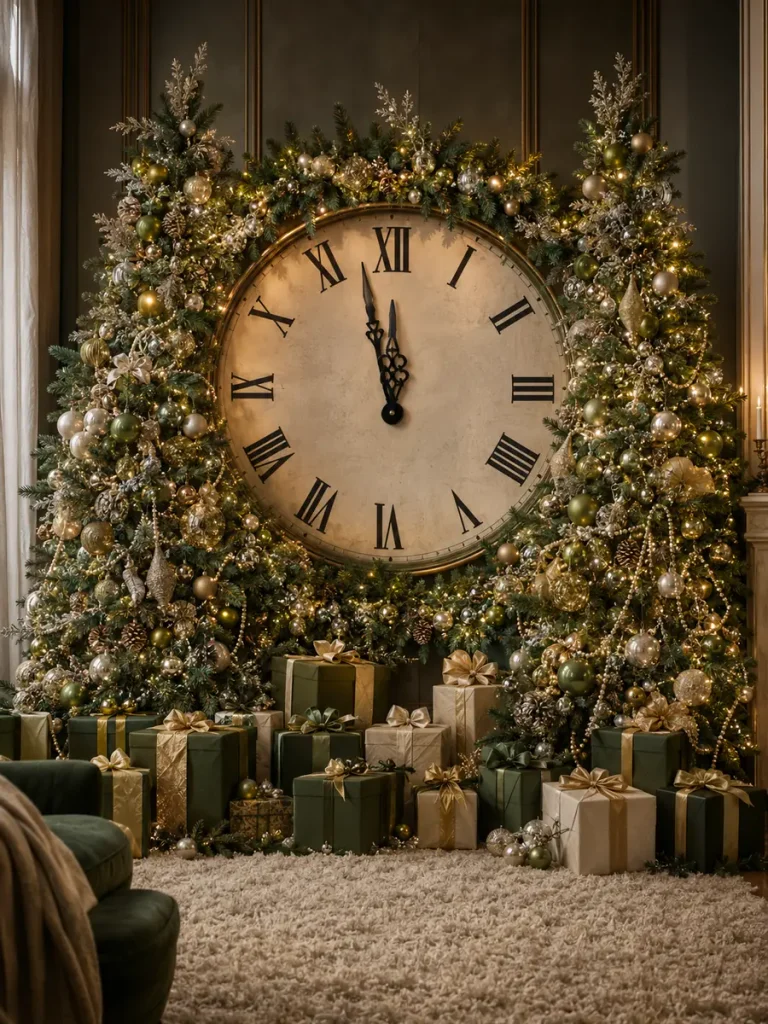
If you have a large empty wall, this is one of those decorations that can replace an entire traditional Christmas setup.
Start with an oversized clock in the center, then build thick evergreen sections up both sides. Instead of thinking of them as two separate trees, shape the inner branches toward the clock so the whole installation reads as one enormous Christmas tree surrounding a timepiece.
Olive green, champagne, antique gold, and clear glass ornaments give the arrangement a richer look without making it too colorful. Finish the bottom with wrapped boxes in different heights.
One tip: use empty boxes. You can build the display early without worrying about actual Christmas presents being moved or opened.
2. Living Greenery Wreath Clock
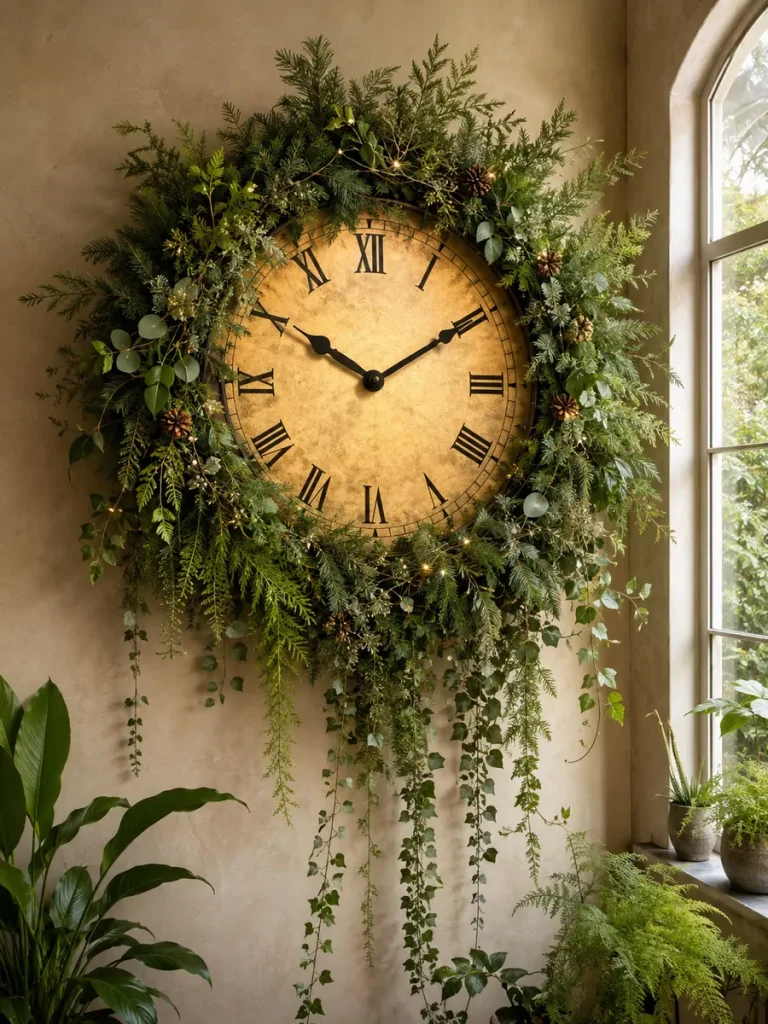
Not every Christmas clock needs red bows and shiny ornaments.
A clock surrounded by mixed greenery can look almost like a living wall installation. Combine pine or cedar with eucalyptus, fern-like foliage, and trailing vines. Keep the greenery loose instead of forcing it into a perfect round wreath.
Let a few stems fall below the clock.
That slight messiness is what makes the arrangement beautiful.
For Christmas, tuck in a few pinecones and tiny warm lights rather than covering the entire wreath with baubles. The finished piece feels fresh and botanical, so it also works well in homes where traditional red-and-green decorating feels too heavy.
3. Jeweled Red and Gold Christmas Clock
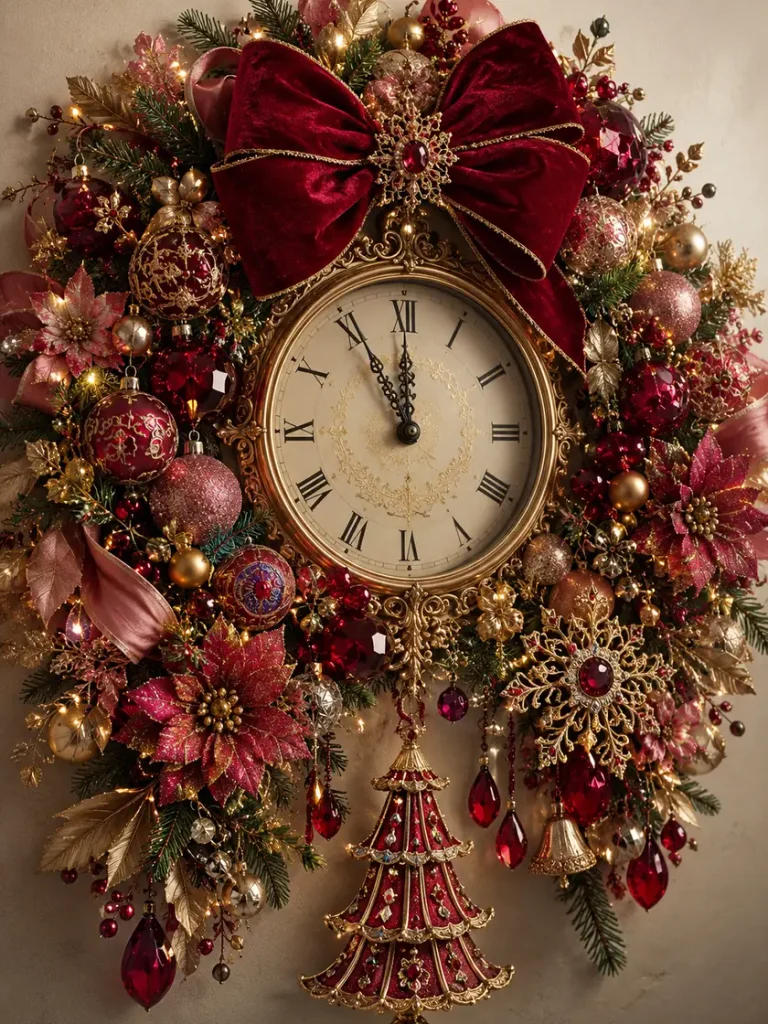
This is the opposite of minimal Christmas decorating, and sometimes that’s exactly what the room needs.
Use an ornate gold clock as your starting point, then build outward with ruby-red ornaments, champagne baubles, gold leaves, jeweled snowflakes, glittered flowers, berries, and rich velvet ribbon.
Layering matters here. Large pieces should go in first. Medium ornaments fill the next layer, and the tiny jeweled pieces finish the gaps.
Place an oversized burgundy or red bow above the clock to pull everything together.
There’s a lot going on, but the clock face should still have breathing room. If the decorations begin covering the hands or numerals, pull them outward rather than adding more toward the center.
4. Asymmetrical Evergreen Clock Swag
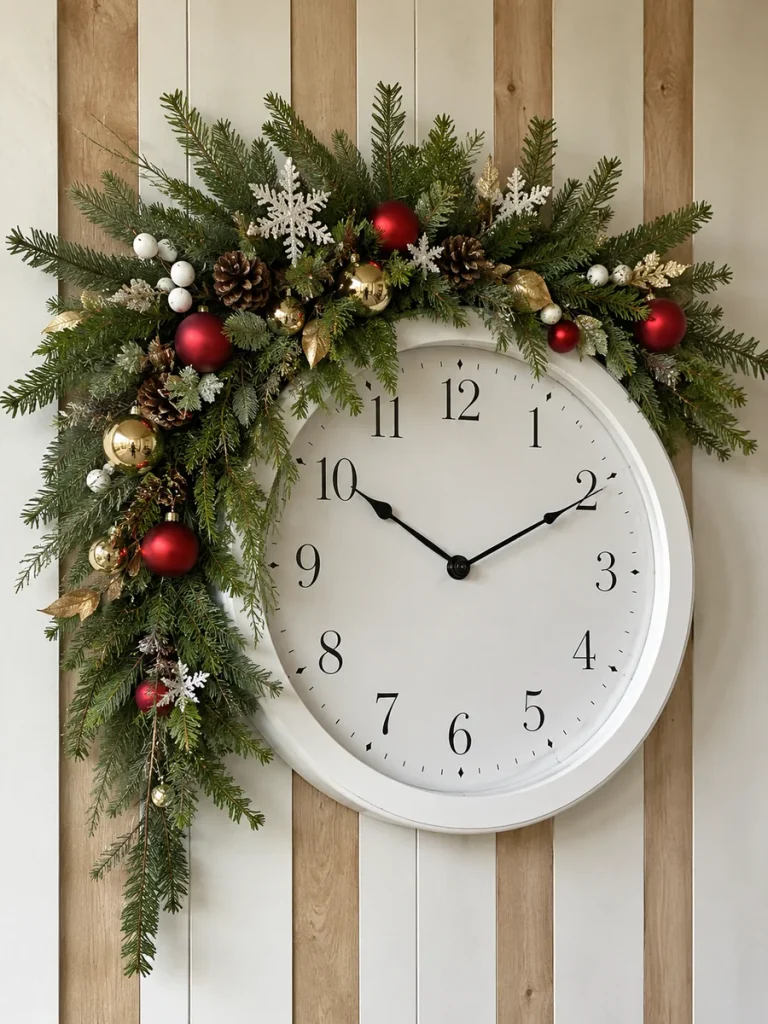
Here’s a good idea if you love decorated clocks but don’t want to build a complete wreath.
Concentrate your evergreen branches across the top and down one side of the clock. Add a handful of red ornaments, gold baubles, pinecones, berries, and white snowflake accents.
Then leave the other side alone.
That empty half is doing more work than you might think. It keeps the arrangement feeling light and makes the decorated side stand out.
It’s also an easier DIY because you’re decorating a much smaller area. A floral wire base can hold the greenery together, allowing you to remove the entire arrangement after Christmas without permanently changing your clock.
5. Cascading Botanical Christmas Clock
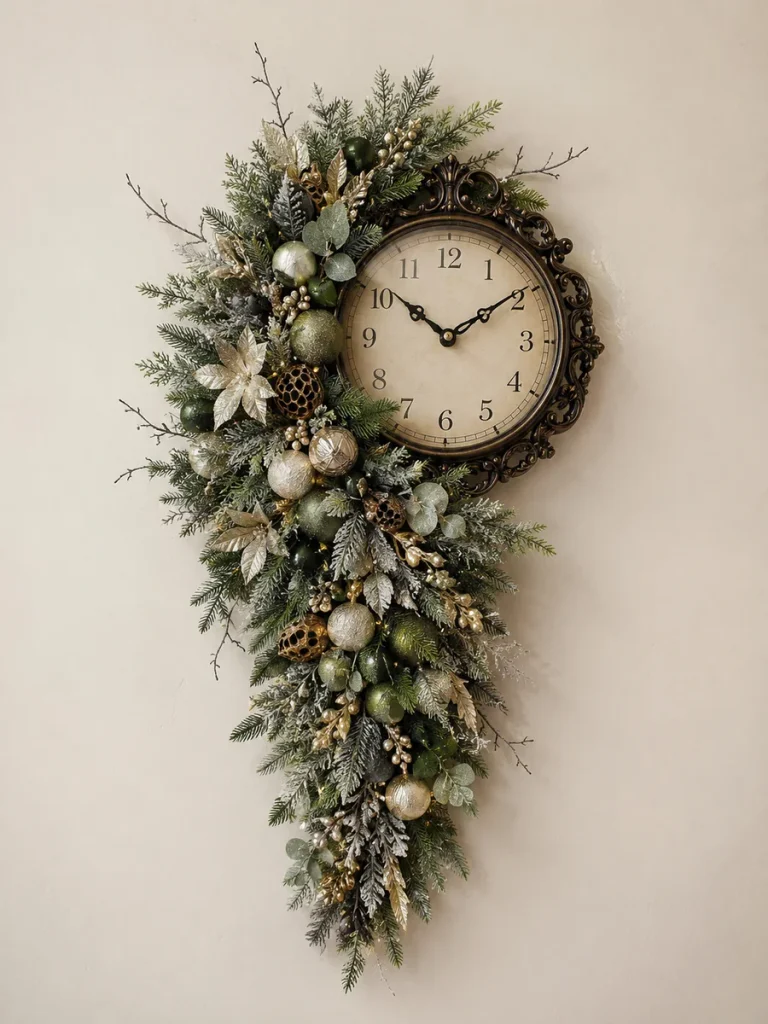
Instead of following the circular shape of the clock, let the decoration fall vertically.
Build a fuller cluster near the upper corner using evergreen, eucalyptus, metallic foliage, berries, ornaments, and winter branches. Continue the arrangement downward, gradually making it narrower until it ends in a loose point.
That creates movement.
It also makes a small clock look much more substantial on a tall wall.
Gold leaves mixed with dark green ornaments are especially pretty for this style because the metallic pieces brighten the deeper foliage. Don’t trim every branch to the same length. A few thin twigs sticking out from the main arrangement keep it from looking too manufactured.
6. Handmade Santa Body Clock
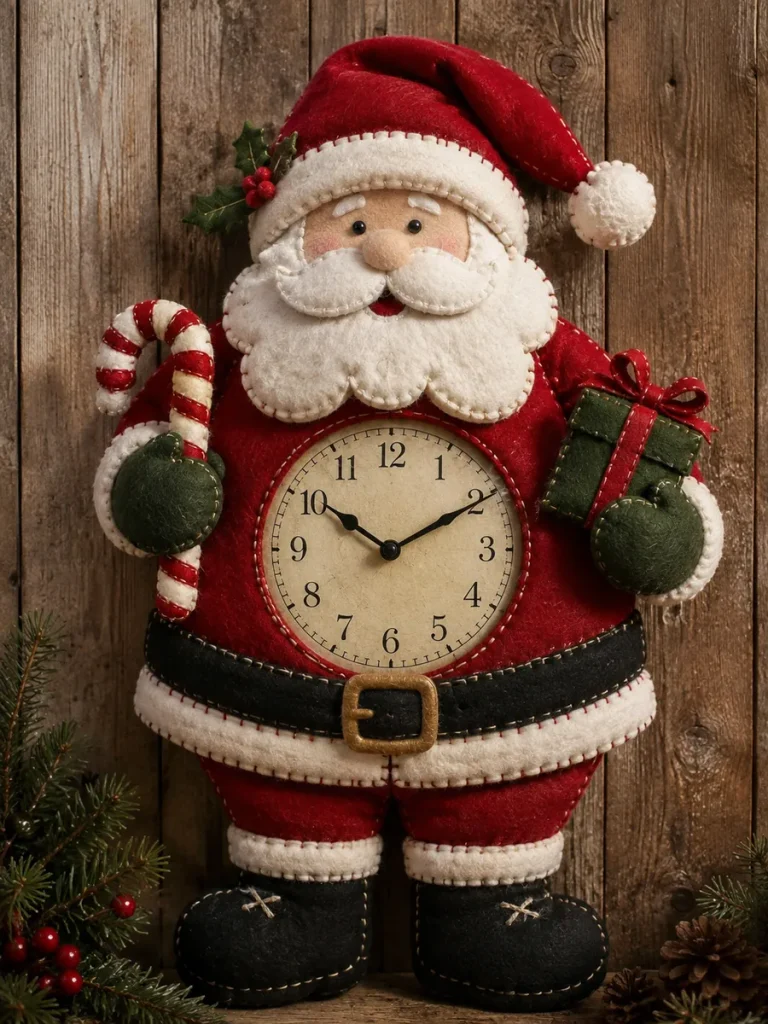
This one is completely different, which is why it’s so much fun.
Build or buy a padded Santa decoration and use the clock face as his round belly. A black belt underneath naturally frames the clock, while the red coat makes the whole design instantly recognizable.
Felt works especially well if you want to make one yourself. Visible stitching actually adds charm, so this isn’t a project where every edge has to look factory-perfect.
Give Santa a candy cane, a small present, and an oversized soft hat.
A decoration like this is great for a kitchen, family room, craft room, or covered porch where a formal wreath might feel too serious.
7. Kitchen Christmas Wreath Clock
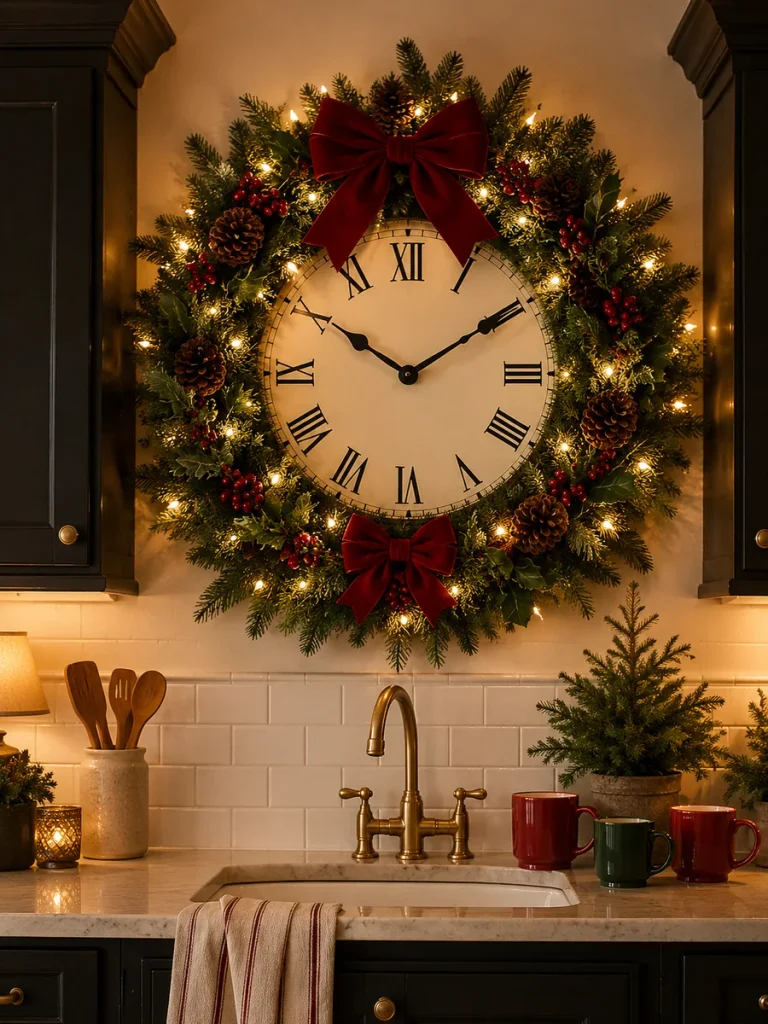
The kitchen is one of the most-used rooms during Christmas, yet it often gets the smallest share of the decorations.
Change that by turning the wall clock into a full Christmas wreath.
Surround it with pine, cedar, holly, pinecones, red berries, and warm lights. A velvet bow at the top gives the wreath a clear finish, while a smaller bow underneath can balance a particularly large clock.
Then repeat one or two colors elsewhere in the kitchen.
You might use red mugs, a miniature tree, or a bowl filled with ornaments.
Keep countertops practical. The clock can do most of the decorative work without taking away any preparation space.
8. Clock Built Between Two Half Christmas Trees
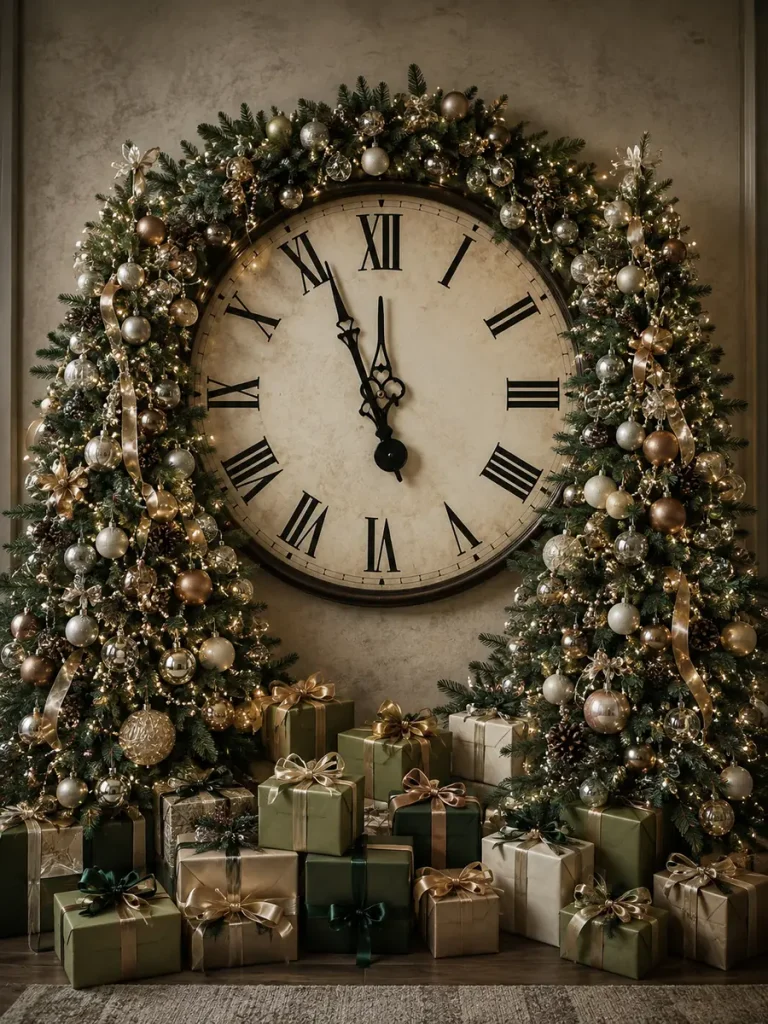
If an enormous wreath sounds difficult to build, use trees instead.
Place two narrow artificial Christmas trees on either side of a large wall clock. Angle or shape the branches closest to the clock inward until the two trees visually form a single frame.
Decorate both sides using the same ornaments and ribbon so they feel connected.
At the bottom, cover the tree stands with wrapped presents. It makes a huge difference because you no longer see where the installation technically begins and ends.
The result can look much more elaborate than the construction really is.
This christmas clock decoration idea works particularly well for a living room photo wall or wide entryway.
9. Frosted Woodland Clock
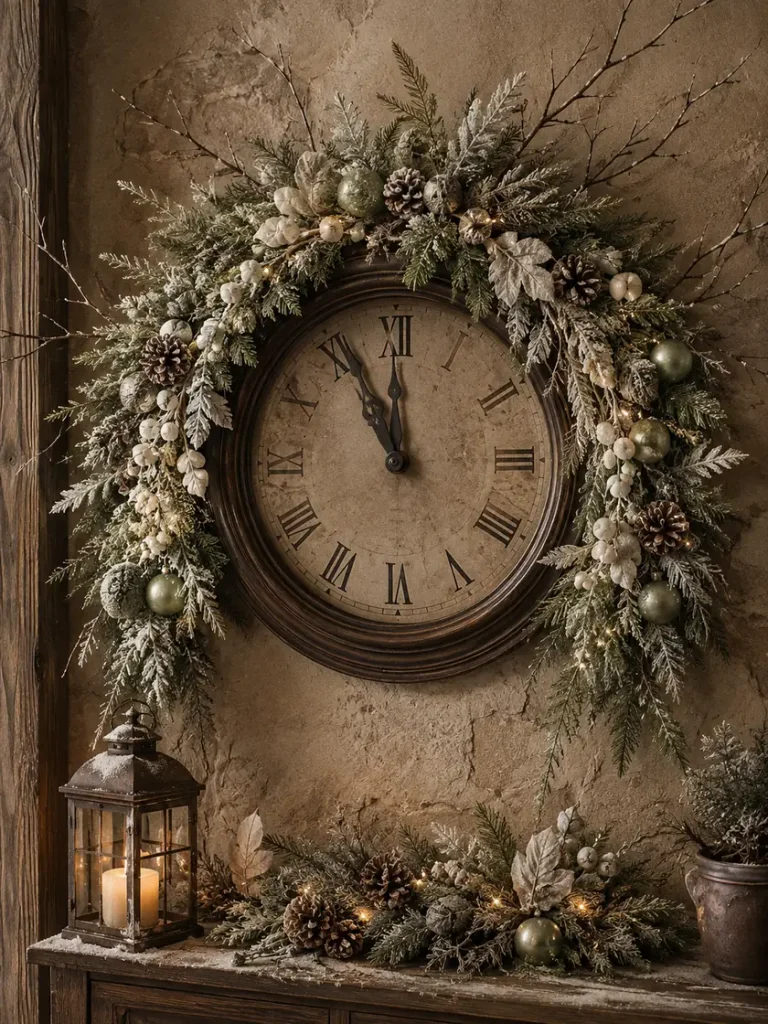
If bright red isn’t part of your Christmas palette, take the clock in a quieter direction.
Use a dark wood or bronze clock with lightly frosted fir branches, white berries, small pinecones, sage ornaments, silver foliage, and thin winter twigs.
Notice the word lightly.
When every branch is completely white, the arrangement can lose its natural texture. Leaving patches of green visible underneath the frost makes it look more like branches brought in from a cold winter forest.
Warm lights are the final piece. They stop the silver and white decorations from feeling chilly and bring out the texture of the clock frame.
10. Midnight Clock with Snowy Christmas Trees
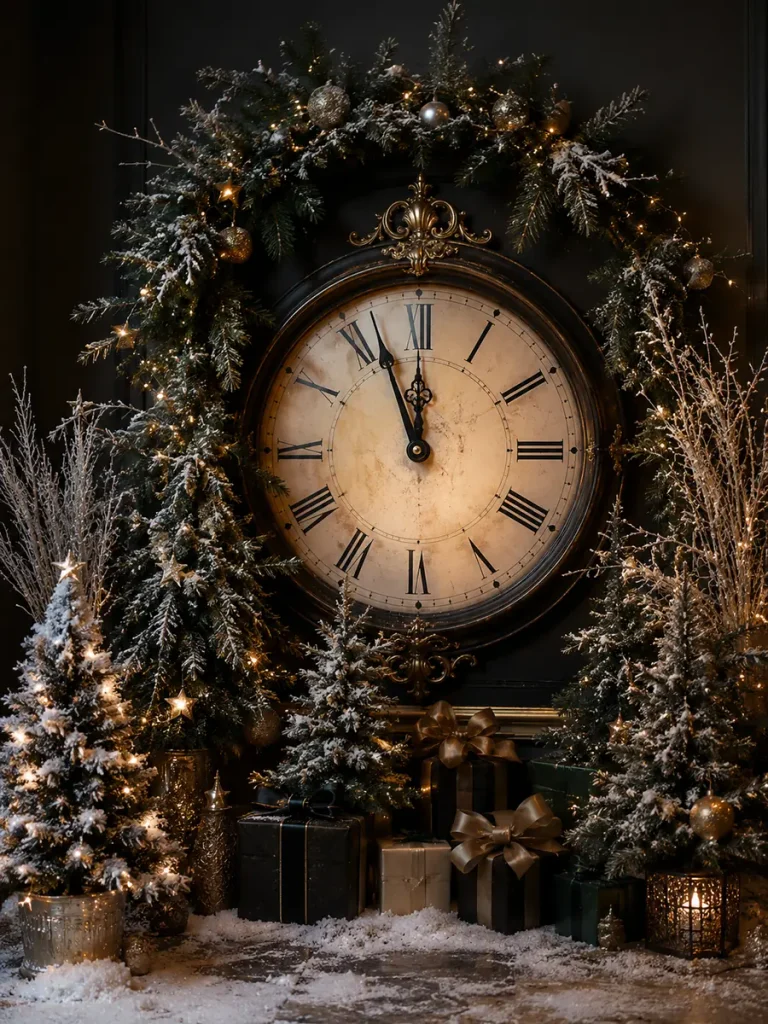
A clock becomes much more interesting at Christmas when you use the idea of time as part of the decoration.
Set the hands near midnight and surround the clock with snowy miniature trees, dark evergreen, white branches, gold stars, and softly glowing lights.
Keep the palette a little darker than usual.
Deep green, charcoal, antique black, champagne, and soft gold help create the feeling of late Christmas Eve rather than Christmas morning.
Add several wrapped presents underneath, but don’t make the scene too busy.
You want the clock to feel like the moment everyone is waiting for.
11. Oversized Roman Numeral Christmas Wall
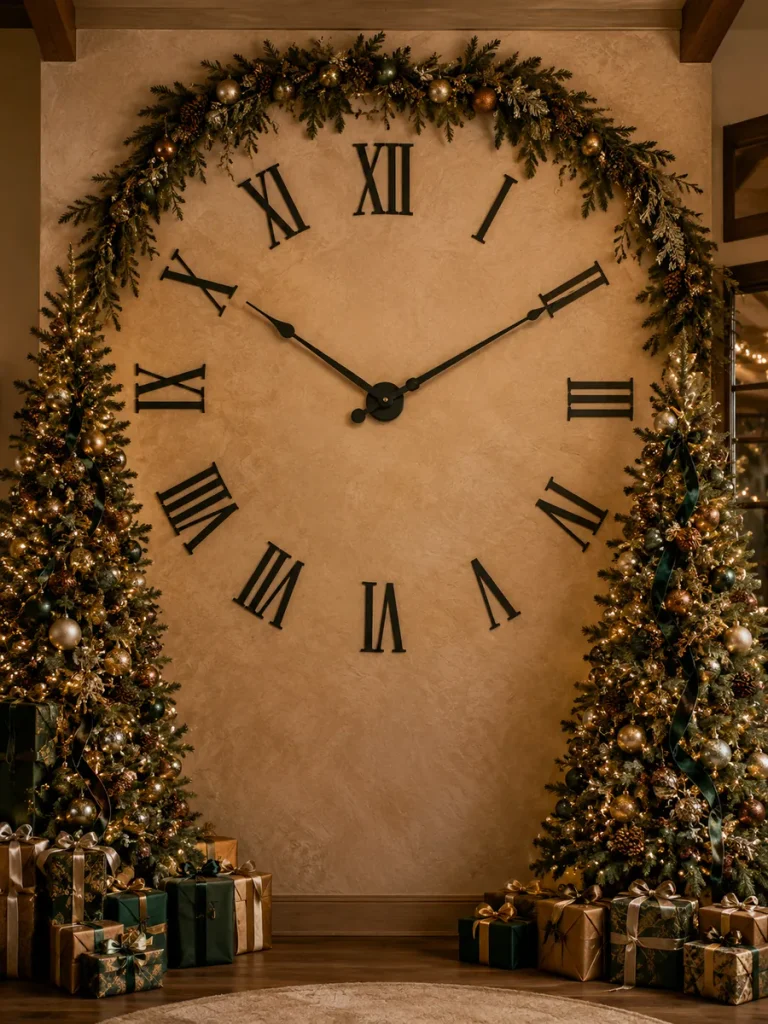
Why hang a clock when the entire wall can become the clock?
Mount large Roman numerals directly onto the wall in a wide circle, then install extra-long hands in the center. There’s no traditional frame, so the architecture of the room becomes part of the design.
Use garland around the upper edge and two decorated trees at the sides to define the outer shape.
This needs space.
But if you have a blank wall in an entryway, living room, event space, or Christmas party area, it makes an incredible backdrop.
Choose removable numeral decals or lightweight mounted numbers if you only want the display for the season.
12. Christmas Gift Pile Clock Display
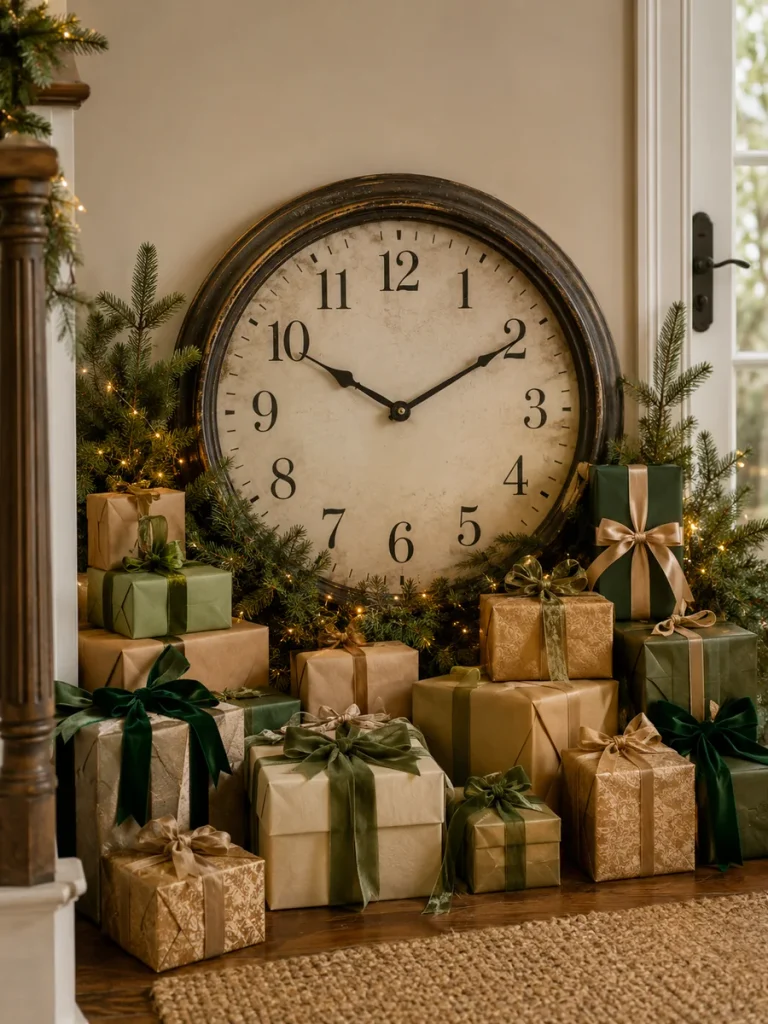
Most wall clocks are hung around eye level. Try breaking that rule.
Position a large decorative clock lower than usual and build a pile of wrapped Christmas boxes around its base. Vary the sizes so some boxes sit close to the lower frame while others spread outward across the floor.
Keep your gift wrap coordinated.
Forest green, kraft brown, cream, champagne, and gold work beautifully together without looking overly matched.
Tuck evergreen branches between the boxes to connect everything.
It’s an excellent solution for an empty corner where a normal floor decoration feels too short and a full Christmas tree would take up too much room.
13. Victorian Floral Christmas Clock
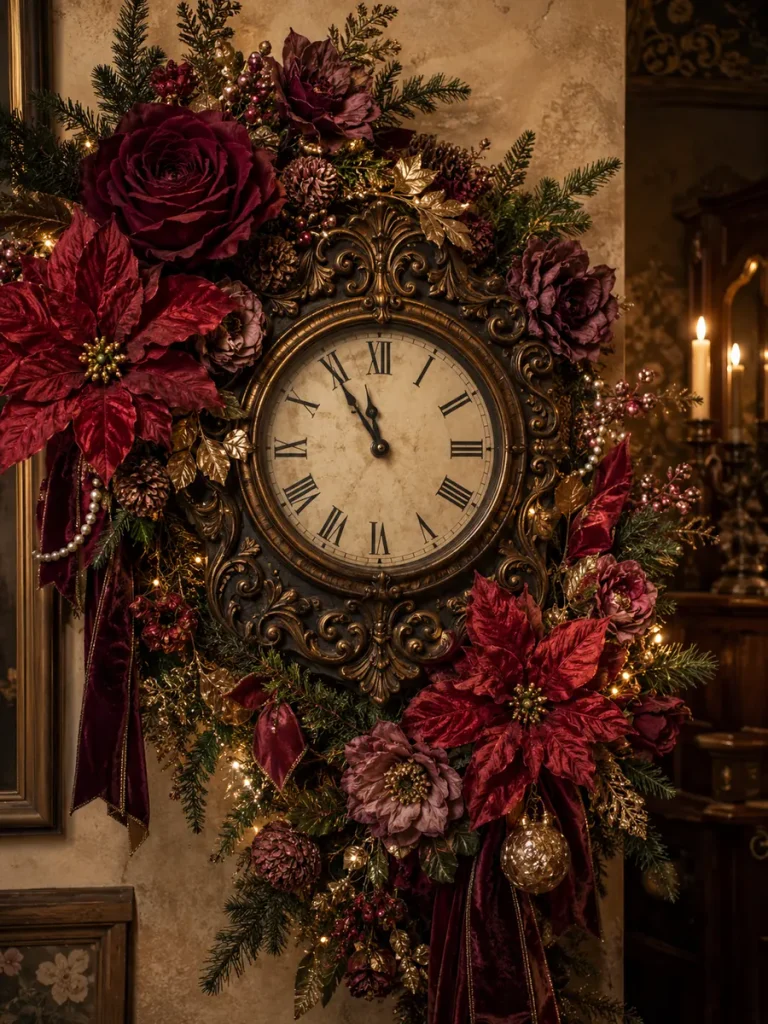
Christmas flowers can go far beyond poinsettias.
For a more romantic clock arrangement, mix burgundy roses, dark red flowers, muted plum blooms, evergreen branches, antique-gold leaves, pinecones, and strands of pearls.
An ornate bronze or gold clock suits the look perfectly.
The flowers shouldn’t form a perfectly even ring. Group a few large blooms together, then let smaller flowers and greenery travel outward from them.
Velvet ribbon adds another soft texture.
The result has that old-house-at-Christmas feeling—warm, slightly dramatic, and collected rather than newly bought from one decor aisle.
14. Christmas Clock with Ornament Cascade
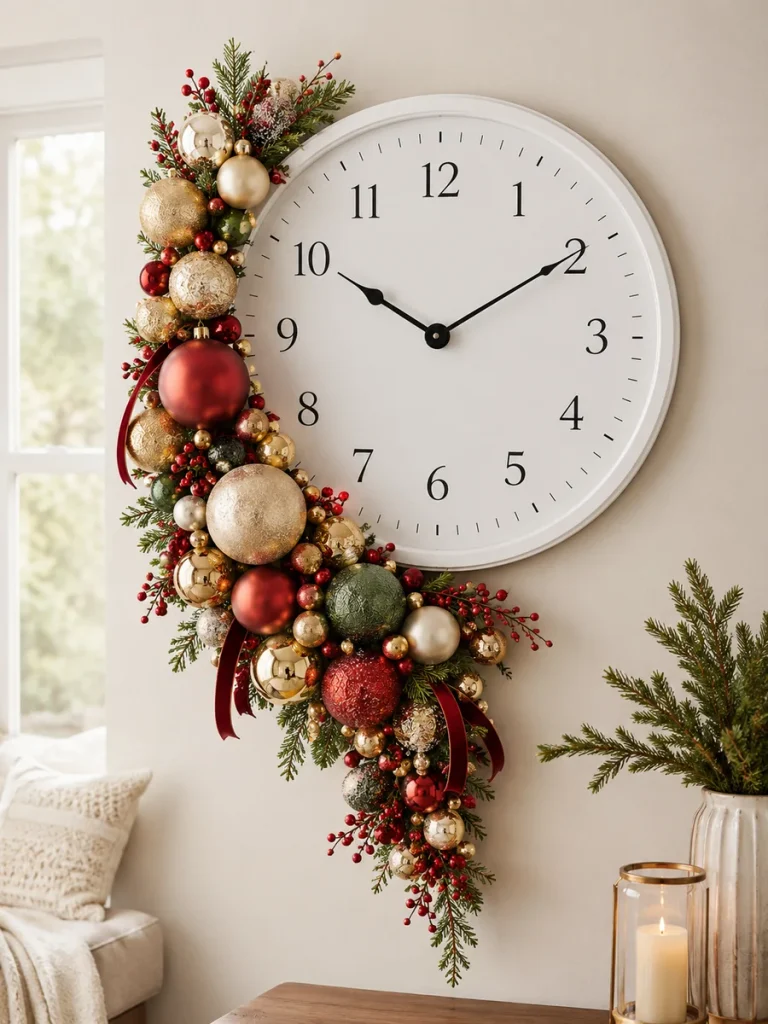
Instead of spacing ornaments around the entire clock, pile the visual weight into one flowing section.
Start with larger baubles near an upper corner. Continue diagonally downward with smaller ornaments, berries, evergreen, and ribbons until the arrangement tapers off beneath the clock.
It should look like the decorations are spilling downward.
A white clock is especially useful because the clean face contrasts beautifully with red, green, and metallic ornaments.
Mix finishes too. Matte beside glossy. Glitter beside velvet. Clear glass beside brushed gold.
Those little differences keep a large ornament arrangement from looking flat.
15. Snowflake Crown Clock
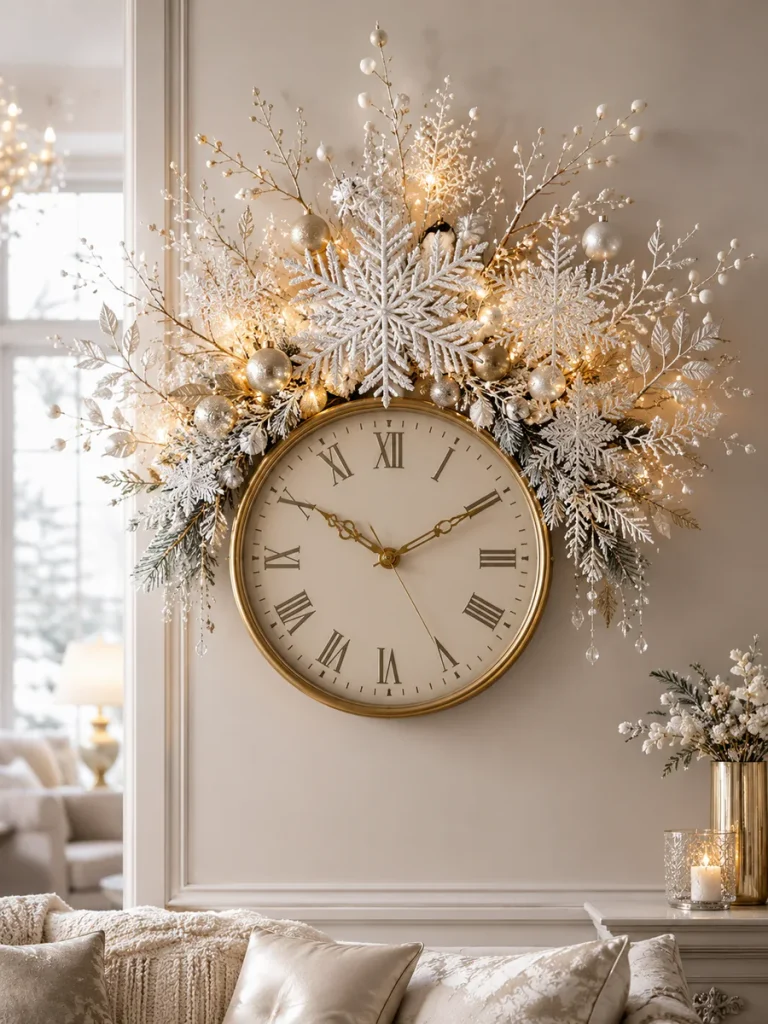
This idea gives the clock a completely different shape without covering it.
Build a wide winter crown above the top edge using snowflakes, icy branches, white berries, champagne ornaments, crystal-style drops, and frosted leaves.
Let it rise upward instead of wrapping around the sides.
The clock stays simple underneath, which makes the snowy arrangement appear even more dramatic.
Warm lights hidden behind the branches are worth adding. Without them, silver and white decorations can look a little cold once the sun goes down.
This is a beautiful option for a light, neutral living room where traditional evergreen wreaths might feel too dark.
16. Gold Leaf Christmas Clock Swag
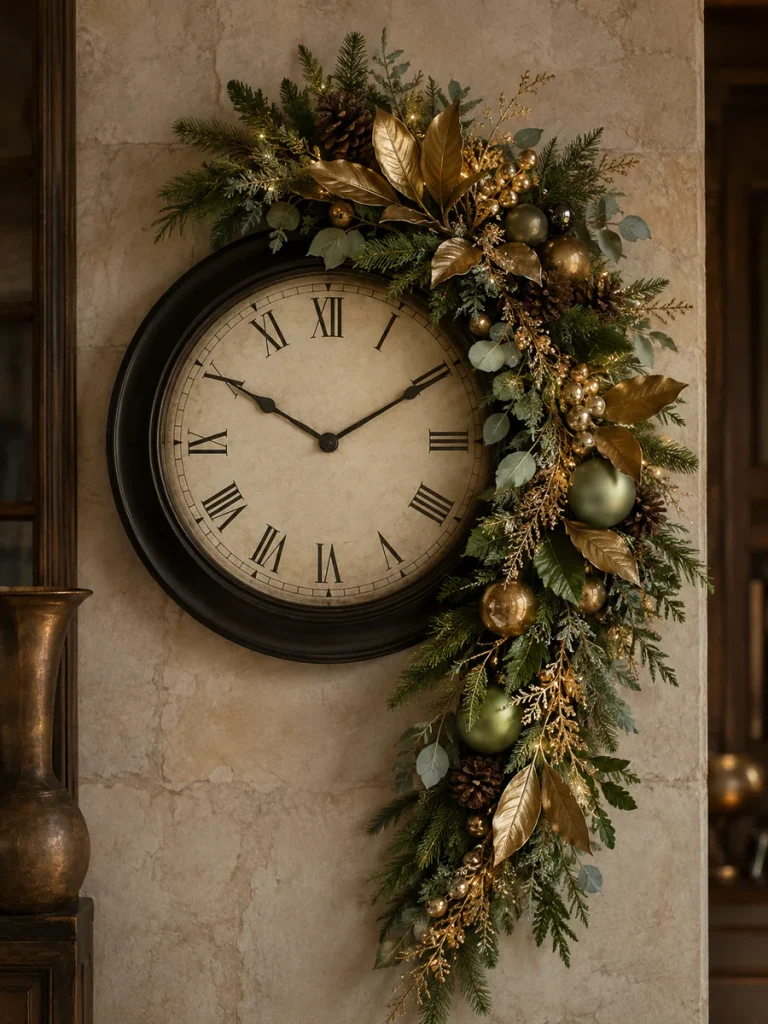
Metallic foliage can dress up an ordinary clock faster than dozens of ornaments.
Start with real-looking evergreen branches, then add antique-gold magnolia leaves, champagne berries, bronze ornaments, olive baubles, eucalyptus, and a few pinecones.
Keep most of the gold on one side.
A dark clock frame gives the metallic leaves something to stand against, while a cream face keeps the center bright.
Matte gold usually looks more convincing than heavy glitter. Use shiny pieces sparingly, especially if there are fairy lights nearby.
The goal is richness, not sparkle everywhere.
17. Santa’s Countdown Workshop Clock
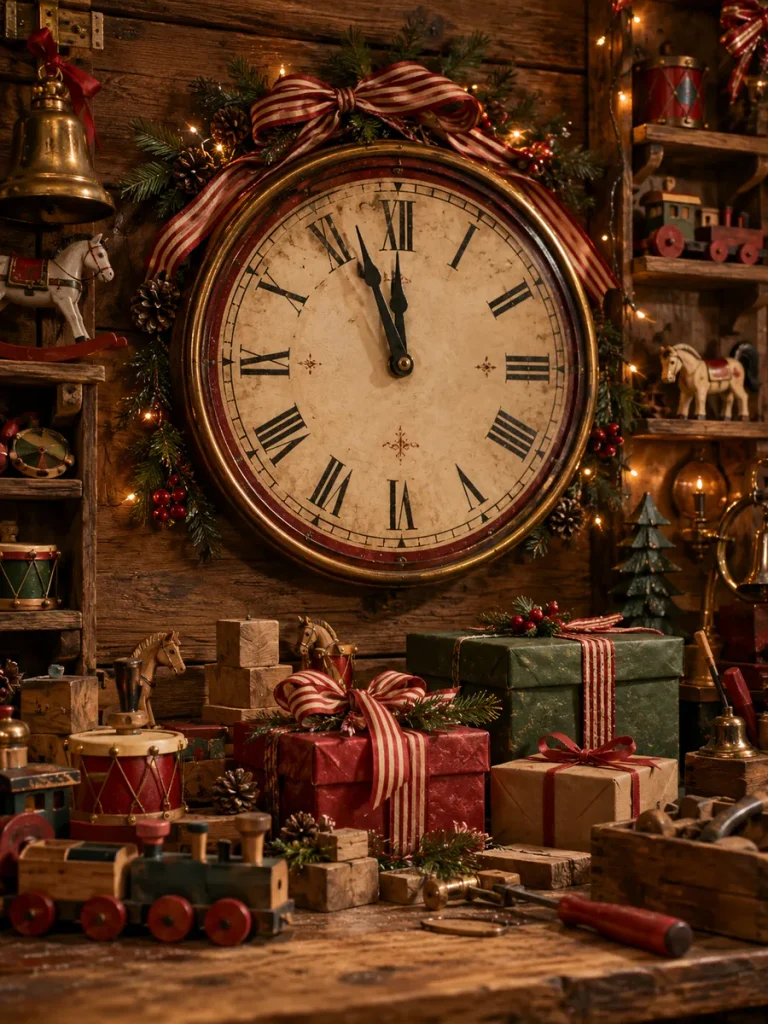
Build a little story around your clock.
Imagine that this is the main clock inside Santa’s workshop, ticking down while the last toys and packages are being prepared.
Place old-fashioned wooden trains, drums, toy horses, wrapped packages, bells, pinecones, and greenery around the clock. A wooden shelf underneath gives you room to arrange the larger pieces.
Keep the toys traditional rather than plastic and modern.
Natural wood, deep red, green, brass, and cream fit the idea beautifully.
And set the clock hands close to midnight. That tiny detail turns a decorated clock into an actual Christmas scene.
18. Candy Cane Spiral Clock
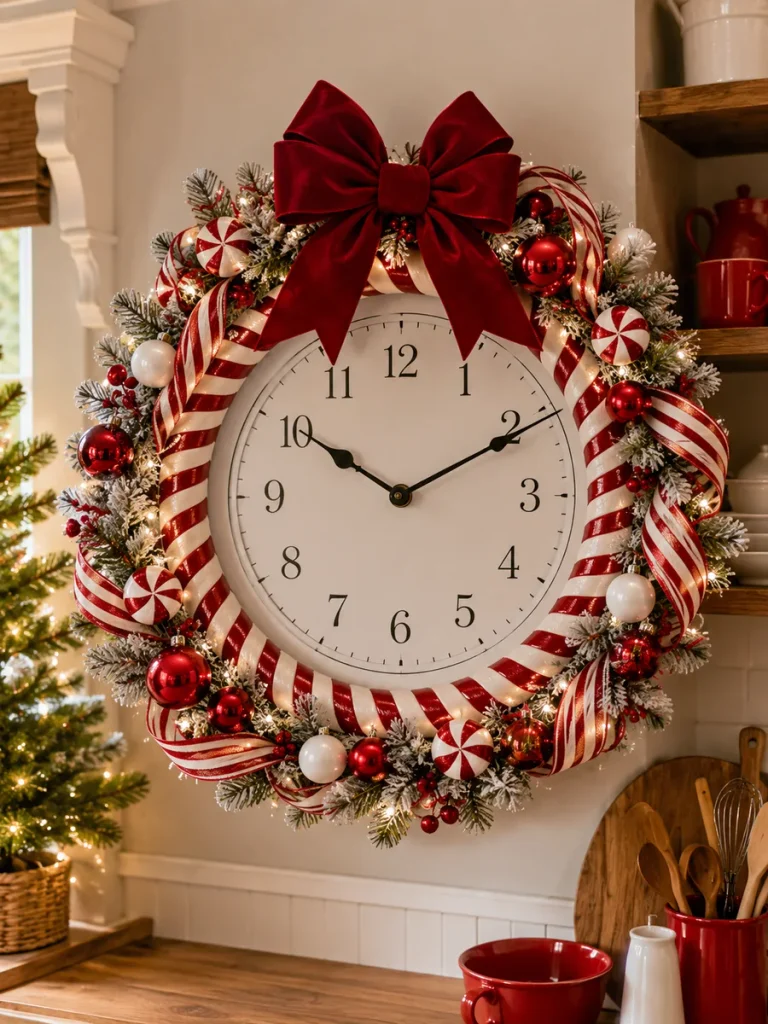
Red and white can get busy quickly, so give the pattern somewhere clear to go.
Wrap striped ribbon around the outer edge of a white clock, almost like one enormous candy cane. Add flocked greenery, glossy red baubles, white ornaments, peppermint-style accents, berries, and one big red bow at the top.
Keep the clock face plain.
That clean center gives the eye a break from the striped border.
This playful design works especially well in kitchens and breakfast rooms where candy-inspired decorations already make sense.
You can also simplify it by using ribbon and greenery only, skipping the peppermint ornaments altogether.
19. Nutcracker Guard Clock
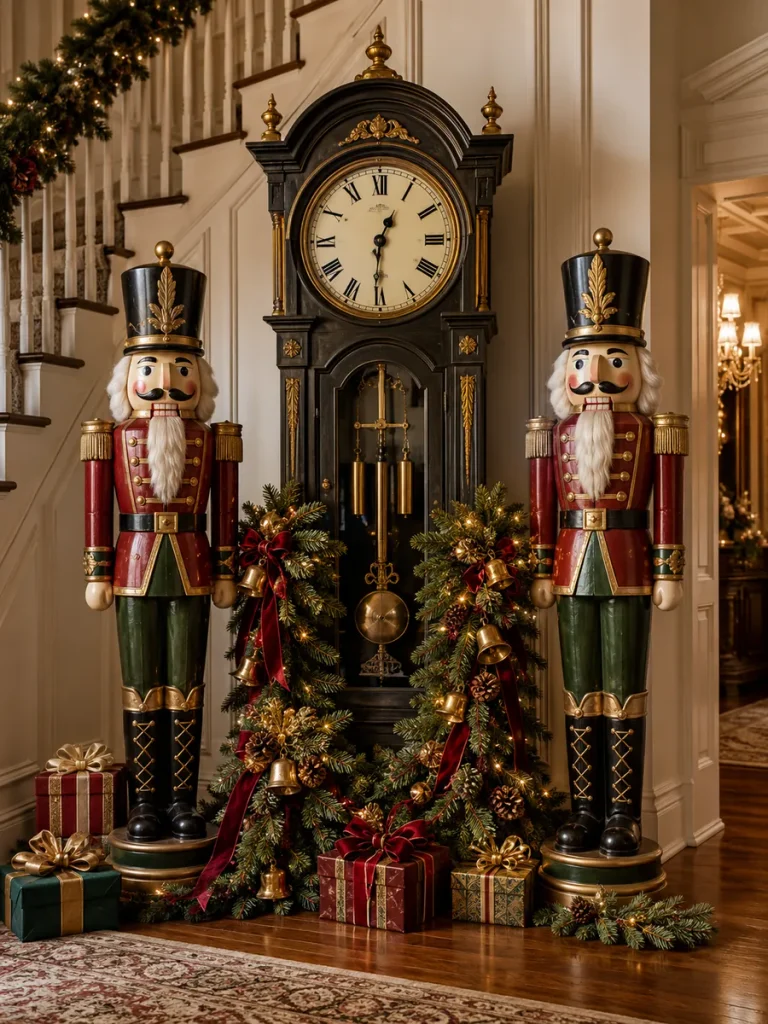
Some Christmas decorations look better when they have a little ceremony to them.
Place a tall clock between two matching nutcrackers so they appear to be standing guard. The clock should be slightly taller; that keeps it firmly at the center of the arrangement.
Decorate the base with evergreen branches, brass bells, burgundy ribbon, pinecones, and gift boxes.
A staircase or entry hall is a natural home for this setup.
The nutcrackers bring height without requiring another Christmas tree, and the symmetry makes the display feel grand even if the floor arrangement underneath is fairly simple.
20. Clock Inside a Giant Christmas Wreath
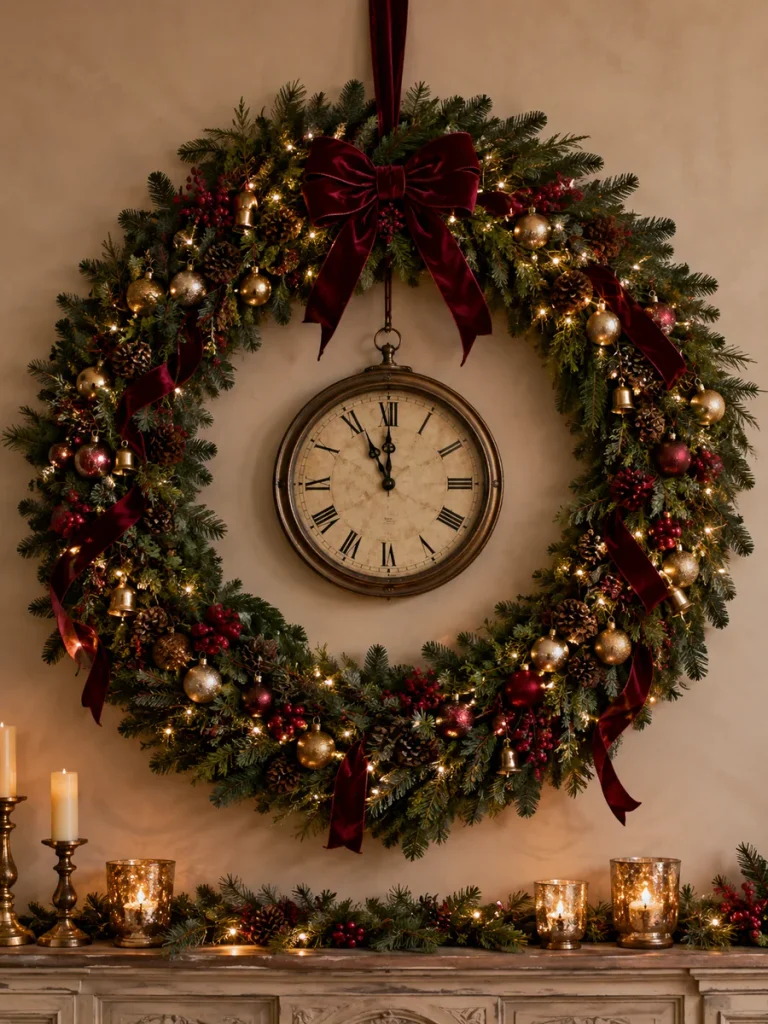
There’s an important difference between decorating around a clock and placing a clock inside a wreath.
For this idea, make the wreath noticeably larger than the clock. Leave a visible gap between the greenery and the clock frame.
That open space frames the timepiece.
Fill the wreath with cedar, fir, pinecones, burgundy ornaments, champagne baubles, bells, berries, and rich velvet ribbon. One substantial bow near the top is plenty.
Hanging the wreath from a wide ribbon makes the entire arrangement feel more intentional, especially on a tall feature wall.
21. Christmas Tree Shaped Clock Arrangement
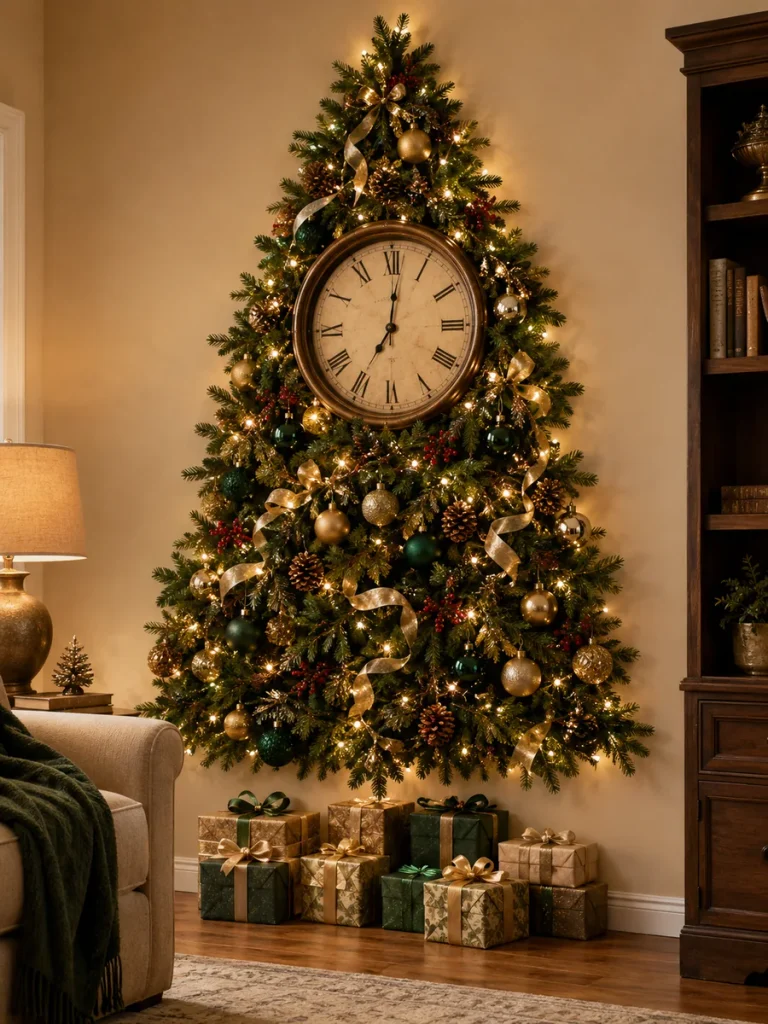
No floor space for another tree?
Build one on the wall.
Arrange evergreen garland into a tall triangular Christmas tree shape, starting narrow at the top and growing wider toward the floor. Place the clock inside the upper-middle area as though it were one enormous ornament.
Decorate the greenery with warm lights, pinecones, gold ornaments, berries, and ribbon.
Place gift boxes underneath to complete the tree illusion.
This is one of the smartest christmas clock decoration options for apartments, hallways, and narrow rooms because all the visual impact happens vertically.
22. Grandfather Clock Christmas Makeover
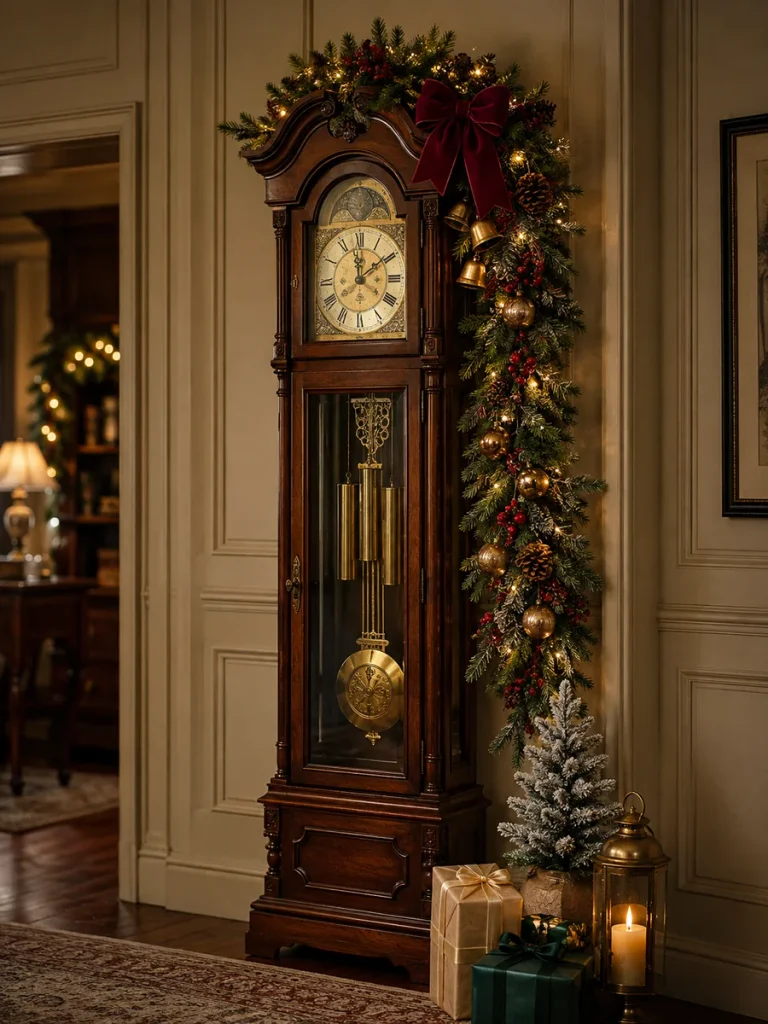
A grandfather clock already has enough character. You don’t need to bury it.
Attach greenery around the top and allow it to travel down just one side. Add a burgundy bow, brass bells, berries, pinecones, and a handful of metallic ornaments.
Leave the wood, glass door, pendulum, and carved details visible.
That’s the beauty of this style.
At floor level, a small tree, lantern, and two or three presents are enough to finish the composition.
The clock itself provides the height and structure, so the Christmas decorations can remain surprisingly restrained.
23. Cuckoo Clock Winter Cottage
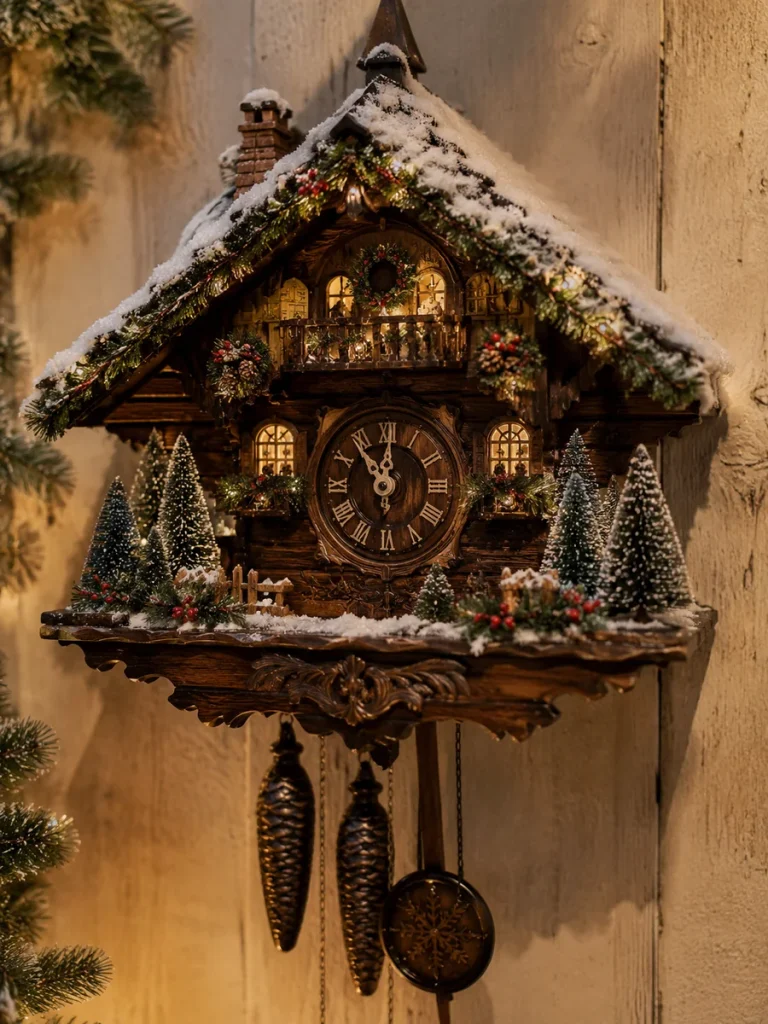
A cuckoo clock is already halfway to becoming a miniature Christmas house.
Add faux snow along the roof, tiny greenery around the windows, small wreaths, berries, and warm lights. Bottle-brush trees placed along the base make the whole thing feel like a snowy mountain cottage.
Keep the hanging weights visible.
They’re part of what makes a cuckoo clock charming in the first place.
Tiny decorations work better than oversized ornaments here. This is the kind of piece people walk closer to inspect, so pay attention to little details rather than trying to make it impressive from across the room.
24. Christmas Clock Lantern Display
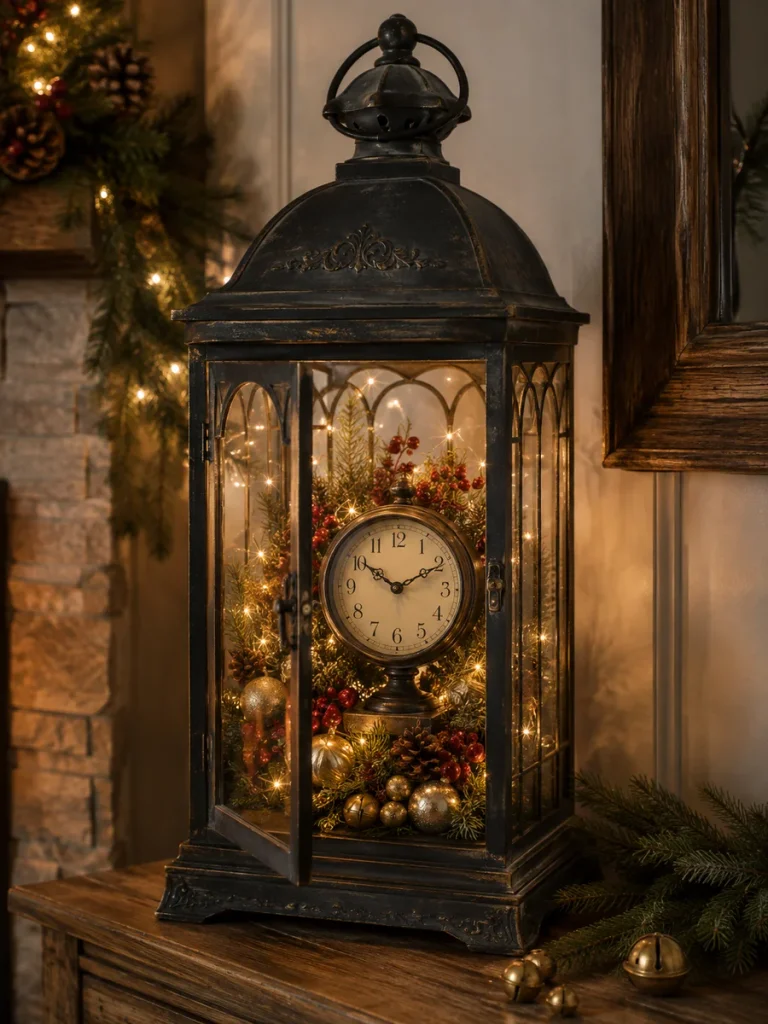
For a tabletop version, place a small vintage clock inside an oversized glass lantern.
Raise the clock slightly so it isn’t hidden behind greenery, then fill the base with pine branches, red berries, miniature ornaments, pinecones, and warm micro lights.
Leave the lantern door slightly open.
It makes the arrangement feel styled rather than sealed away.
Place it on a console, side table, fireplace hearth, or wide shelf. The entire display moves as one piece, which is handy when you need to clear the table temporarily or rearrange decorations during the season.
25. Clock Surrounded by Mini Christmas Houses
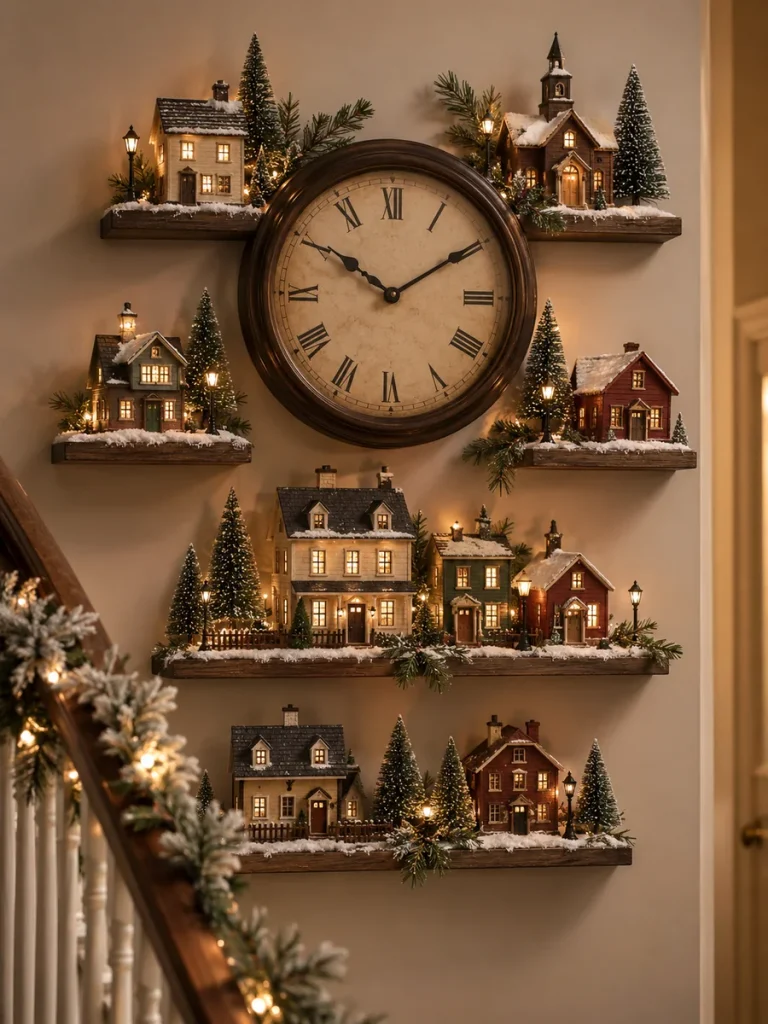
Turn your wall clock into the town clock of a Christmas village.
Install narrow shelves around and underneath it, then arrange miniature houses, bottle-brush trees, tiny lampposts, evergreen sprigs, and faux snow.
Keep the clock slightly higher than most of the houses.
That little bit of hierarchy makes the idea believable.
Warm lights inside the houses are worth the effort. At night, the entire wall starts to feel like a snowy village rather than a shelf full of miniatures.
It’s particularly lovely on a stair landing where people see the display up close as they pass.
26. Birch Branch Winter Clock
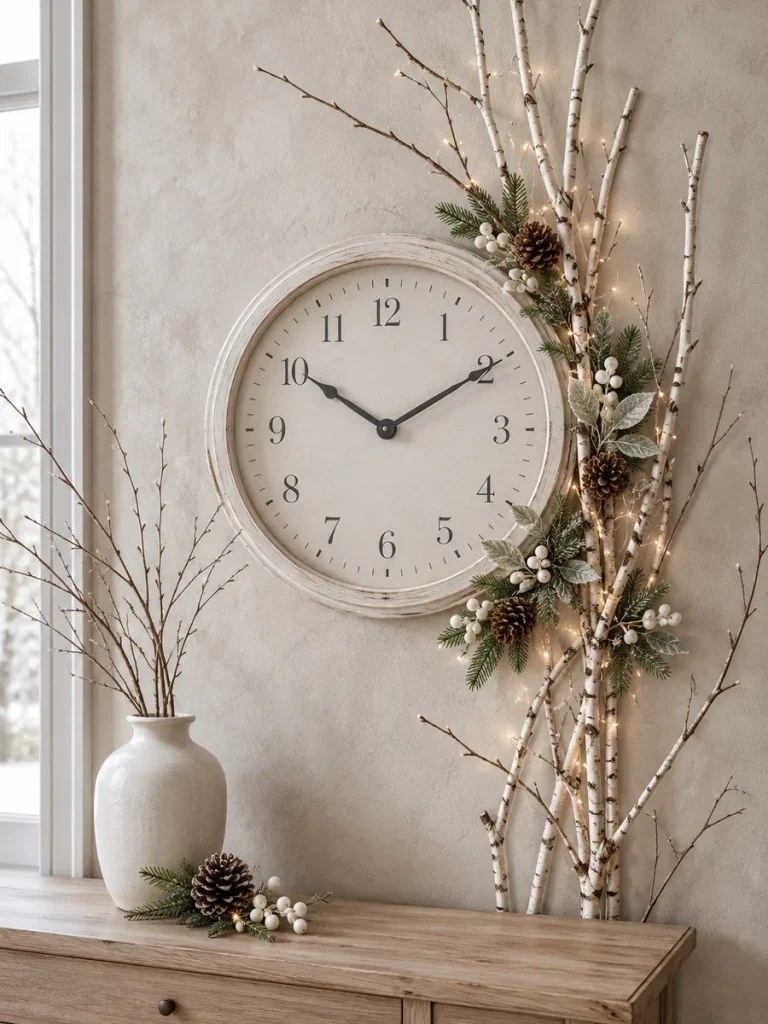
If your Christmas decorating leans Scandinavian or rustic, you don’t need many ornaments at all.
Place pale birch branches alongside the clock, leaving plenty of wall visible between them. Add small pine sprigs, white berries, a few pinecones, and delicate warm lights.
That’s enough.
A distressed white clock or pale wood frame keeps the whole arrangement quiet and wintry.
Use a simple vase filled with additional bare branches underneath if the wall needs more balance.
This idea is especially good for rooms where a full garland would feel too heavy.
27. Christmas Bell Wreath Clock
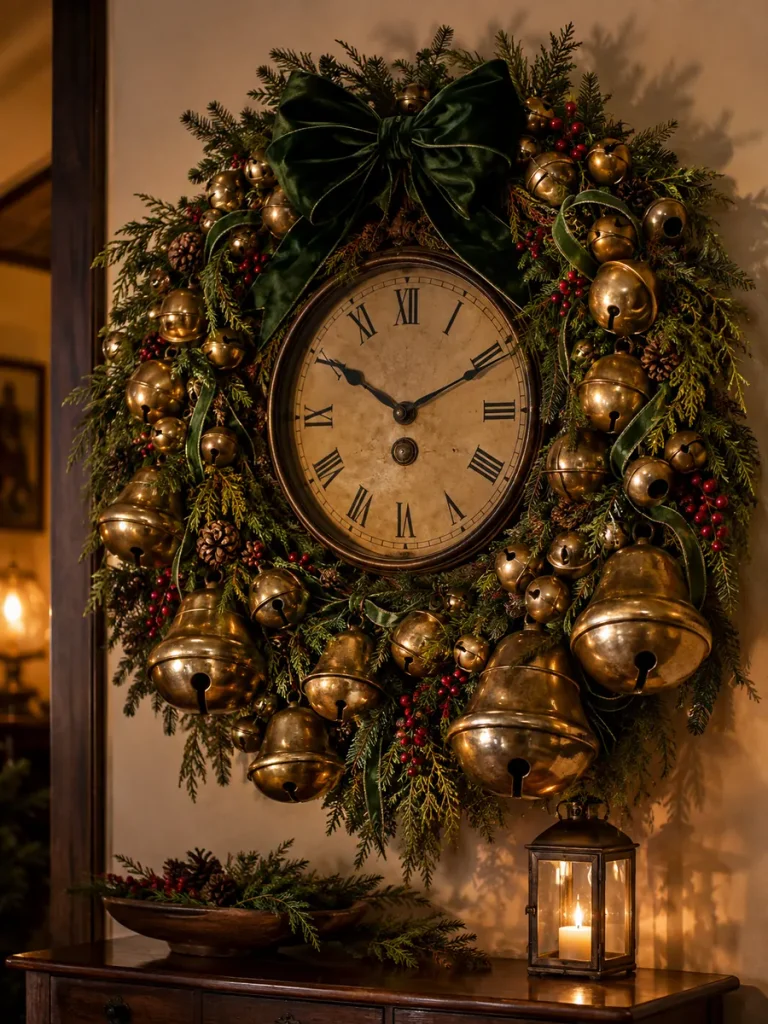
Let bells become the decoration instead of just another accessory.
Build an evergreen wreath around the clock and mix aged brass bells throughout it, beginning with smaller bells near the upper half and gradually adding larger ones toward the bottom.
A dark green velvet bow feels more interesting here than red.
Some bells can be polished. Others can have an older, slightly tarnished finish.
That variation keeps the wreath from feeling too new.
Placed in an entryway, this clock has a traditional Christmas feeling without relying heavily on ornaments or bright colors.
28. Poinsettia Burst Clock
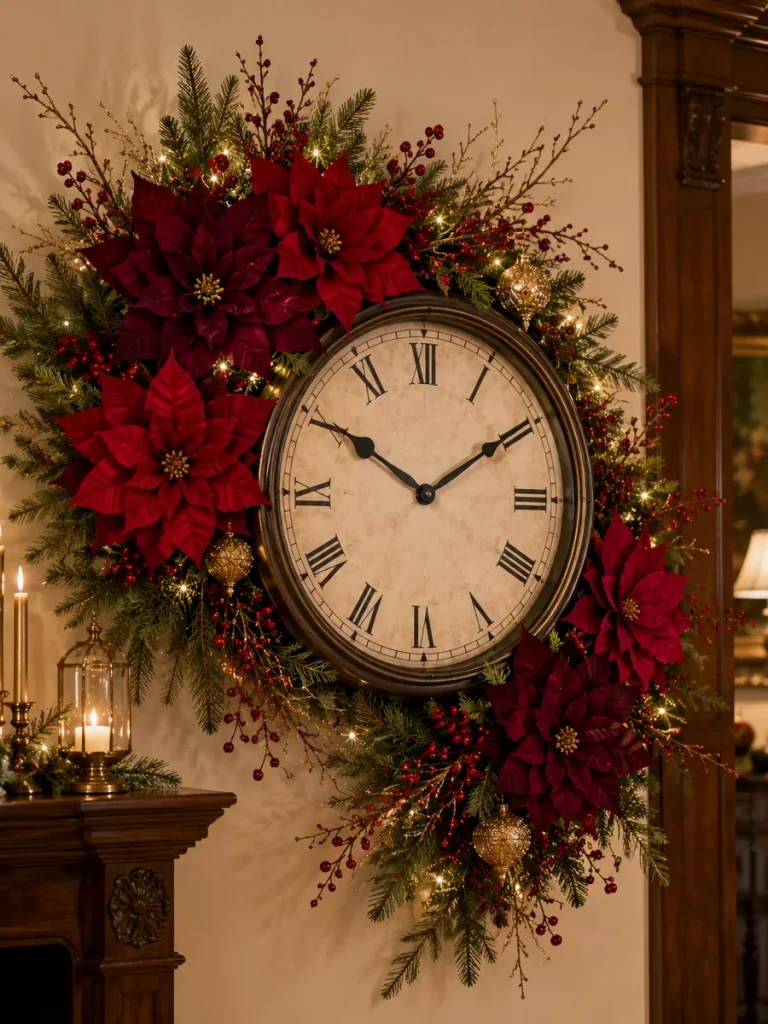
Large poinsettias can completely change the shape of a clock display.
Cluster deep red and burgundy flowers around selected areas of the frame rather than placing them evenly. Push fir branches, berry stems, and thin metallic twigs outward between the blooms to create a loose starburst effect.
The flowers should dominate.
Only add a few small gold ornaments and lights around them.
If you’re using artificial poinsettias, choose ones with realistic centers and fabric that doesn’t look overly glittered. Good flowers make this arrangement feel sophisticated; cheap shiny petals can take it in a very different direction.
29. Clock with Cascading Ribbon Tails
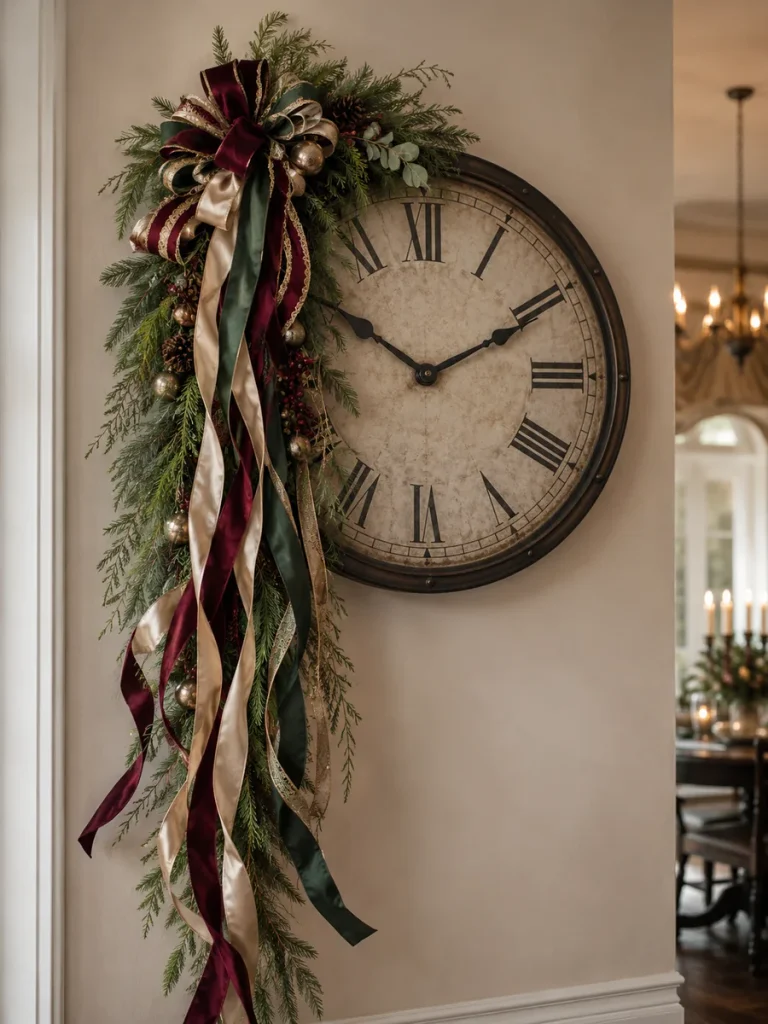
Ribbon is often treated as a finishing touch. Here, it becomes the main feature.
Attach several long strands at the top of the clock and allow them to fall naturally down one side. Mix burgundy velvet, forest-green satin, champagne ribbon, and a thin gold-edged piece.
Different widths create more movement.
Put evergreen behind the ribbons so they have some visual weight, then tuck in pinecones and a few small ornaments.
Don’t straighten every tail.
A bend, twist, or loose curl makes the arrangement feel much softer and more natural.
30. Gingerbread House Clock
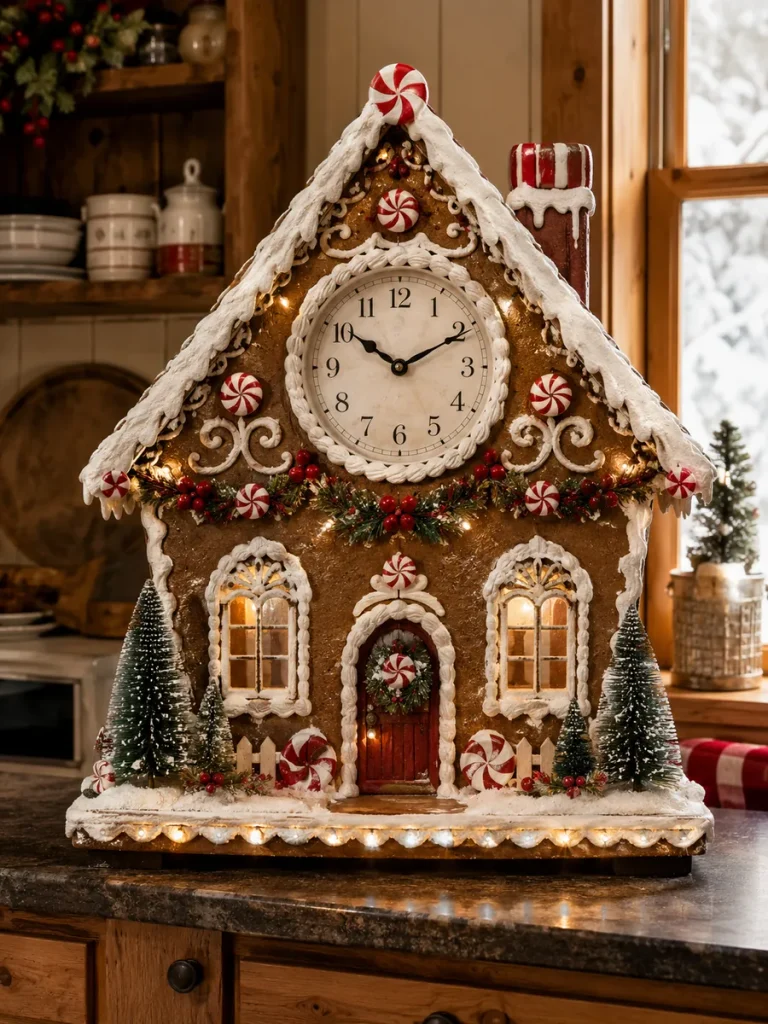
A clock can become the attic window of a giant gingerbread house.
Build the decorative house from faux gingerbread-colored wood, foam, or resin so you can reuse it every year. Add white icing-style trim, peppermint decorations, evergreen pieces, berries, lights, and miniature snowy trees.
Place the clock high on the front facade.
Suddenly it doesn’t look like a clock with gingerbread around it. It looks like a gingerbread house that happens to tell time.
A kitchen counter or breakfast-room sideboard is the perfect location because the baking-inspired theme feels completely at home there.
31. Vintage Sleigh Clock Display
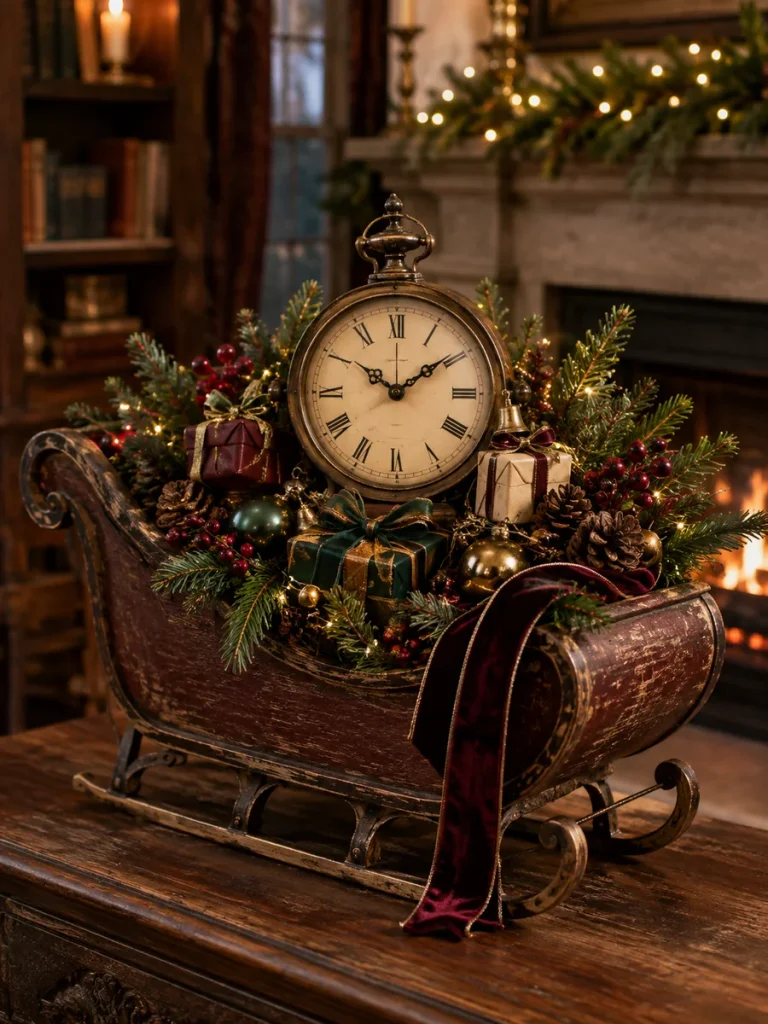
An old wooden sleigh makes an unexpected base for a tabletop Christmas clock.
Place the clock toward the back of the sleigh so it sits above the other decorations. Fill the lower area with evergreen, berries, small presents, pinecones, bells, and ornaments.
Let a velvet ribbon spill over one side.
The sleigh should look aged rather than glossy. Scratches and worn paint actually make this version better.
Place the arrangement on a hearth or wide console where you can see the full curved profile of the sleigh.
It feels festive without looking like another standard centerpiece.
32. Christmas Moon Clock
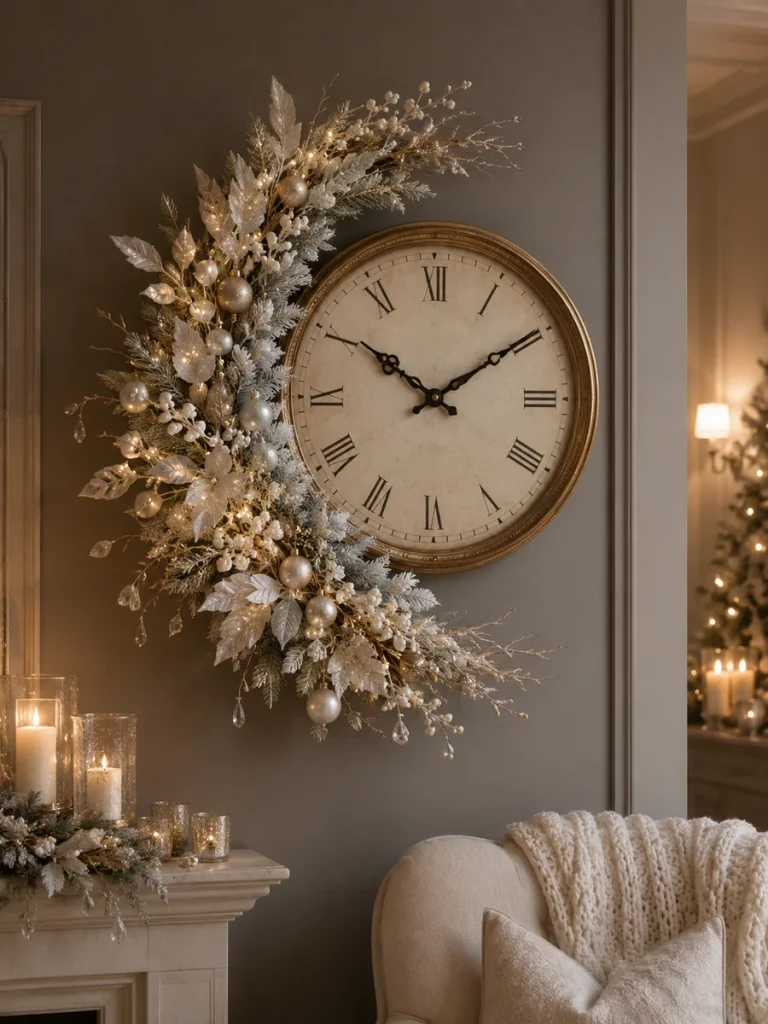
A crescent arrangement gives a round clock a completely new silhouette.
Build frosted foliage along one side, curving from above the clock down toward the lower edge. Use white berries, silver leaves, champagne ornaments, crystal-style drops, and thin winter branches.
Leave the other half exposed.
That contrast is what creates the crescent shape.
A little warm light woven into the frosted branches keeps the decoration soft rather than icy.
This style is especially pretty in bedrooms, sitting rooms, and quieter spaces where a full traditional wreath might be more Christmas decor than the room needs.
33. Oversized Bow and Ornament Clock
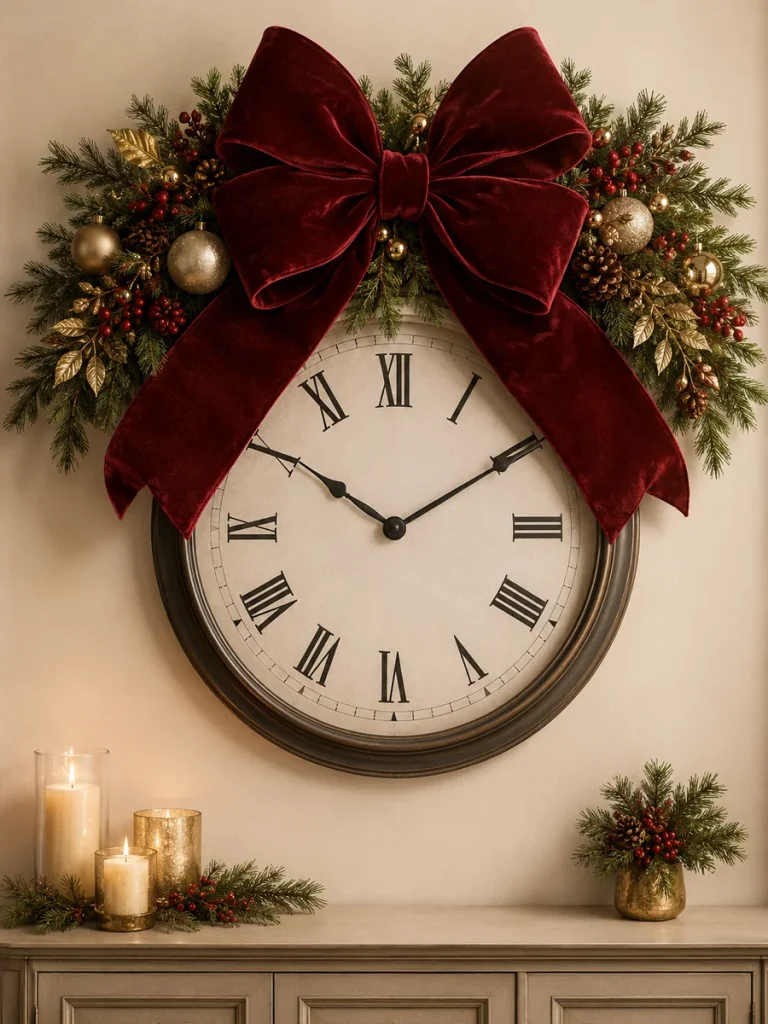
Sometimes one enormous bow is enough to make the whole clock feel decorated.
Choose thick velvet ribbon and make the bow intentionally oversized. Let the tails overlap the upper edge of the clock, then add greenery and ornaments only across the top.
Stop there.
Leaving the bottom half undecorated keeps the bow from fighting with too many other details.
Deep burgundy looks beautiful with antique gold and greenery, but plaid ribbon can give the same idea a more relaxed farmhouse feel.
Scale is what makes this design memorable, not the number of decorations you use.
34. Clock Inside a Christmas Arch
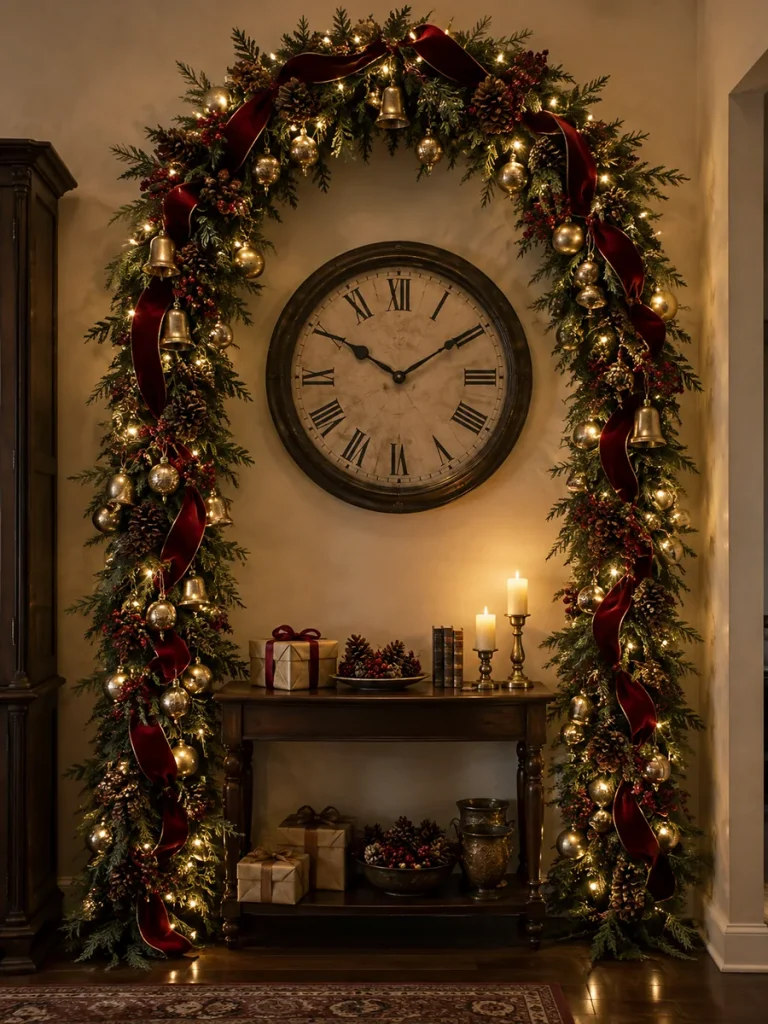
Instead of framing the clock in a circle, build a Christmas doorway around it.
Run thick evergreen vertically up both sides of the wall and curve the greenery across the top. Add velvet ribbon, bells, pinecones, berries, ornaments, and warm lights.
The clock sits in the open space at the center.
A console table below helps anchor the design and gives you room for candles or several small wrapped gifts.
Keep the arch fairly narrow. If it spreads too far away from the clock, the two pieces can start to feel unrelated.
35. Woodland Animal Christmas Clock
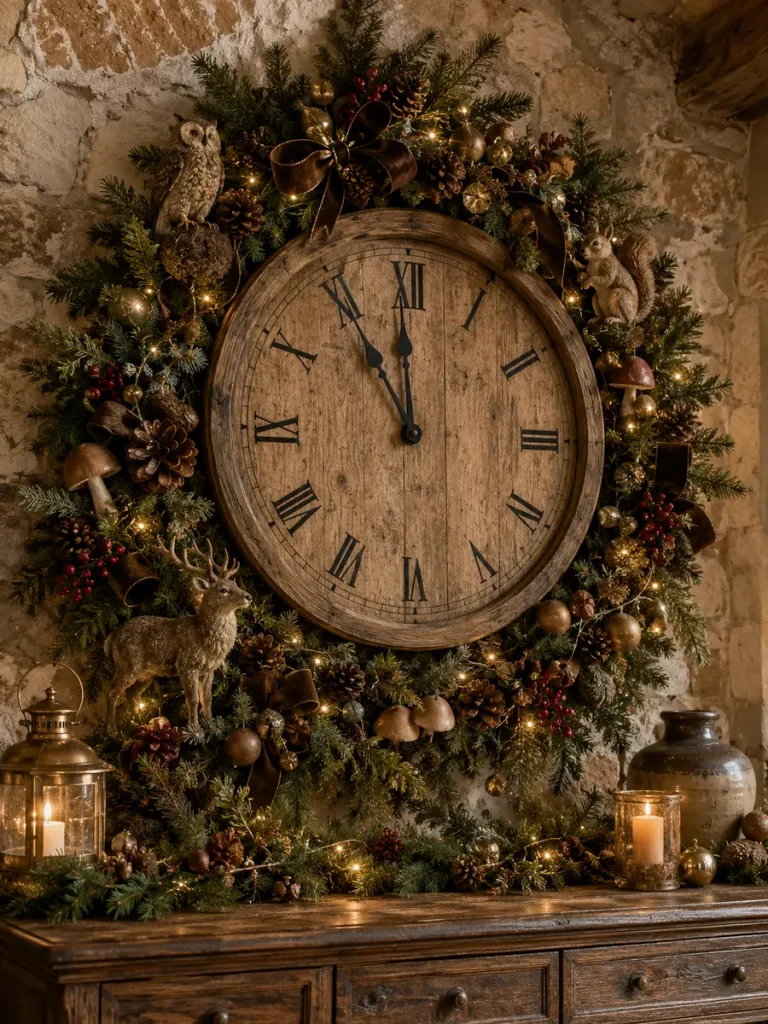
A woodland arrangement can be playful without turning into children’s decor.
Start with evergreen, pinecones, acorns, dried pods, brown ribbon, and muted gold ornaments. Then add just a few animal figures—perhaps a deer, owl, squirrel, or rabbit.
Three is usually plenty.
Place them inside the greenery as though they’ve wandered into the arrangement rather than lining them up around the clock.
Warm lighting and natural materials help.
This design looks especially comfortable on a stone wall, inside a cabin-inspired room, or anywhere that already uses lots of wood and earthy textures.
36. Vintage Toy Clock Wall
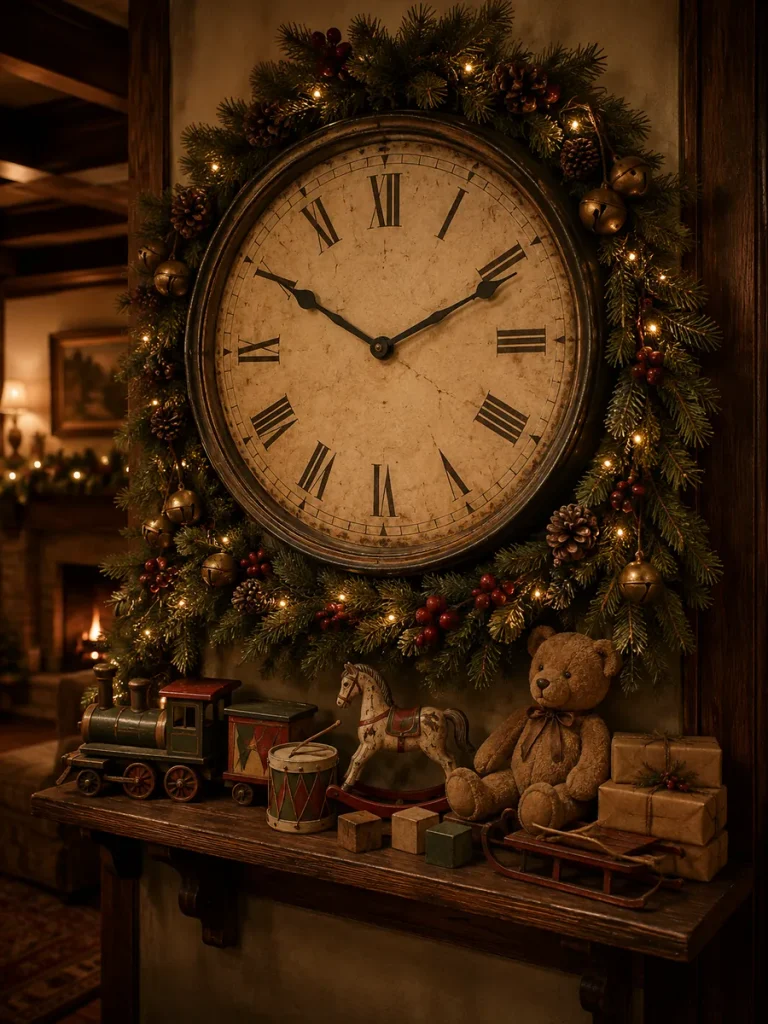
There’s something wonderfully nostalgic about old toys at Christmas.
Place a narrow shelf underneath your clock and arrange a wooden train, drum, rocking horse, teddy bear, sled, and a few small packages.
Then connect the shelf to the clock using evergreen garland and warm lights.
Keep the colors faded and traditional rather than bright primary shades.
Natural wood, burgundy, dark green, brass, and cream make the toys feel collected over generations.
The scene becomes even better in the evening when the lights are glowing and the toys sit quietly beneath the clock.
37. Pearl and Champagne Clock Wreath
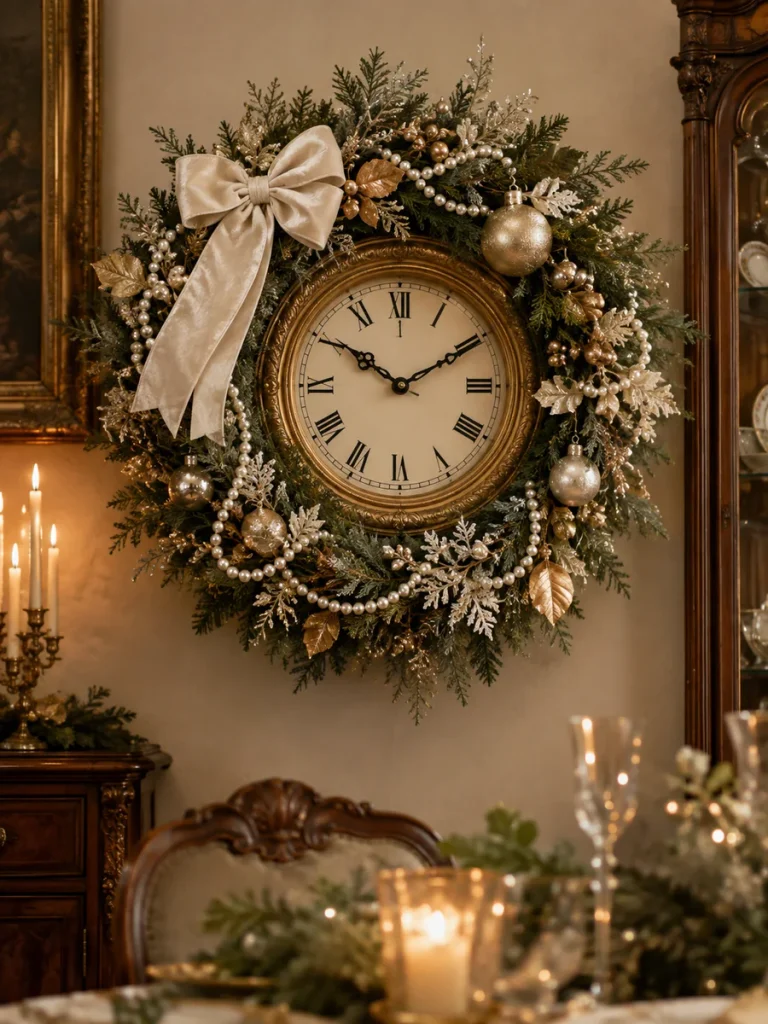
For a softer formal look, skip strong red altogether.
Use evergreen branches, champagne ornaments, cream ribbon, frosted leaves, pale gold berries, and loose strands of faux pearls.
Don’t pull the pearl garland tight. Let it dip gently between sections of greenery.
An antique-gold clock naturally suits the palette.
A cream velvet bow placed slightly off-center makes the wreath feel less predictable than one sitting directly at twelve o’clock.
This is a beautiful choice for a dining room where candles, glassware, and warm metallic details are already part of the Christmas table.
38. Clock with Wrapped Gift Frame
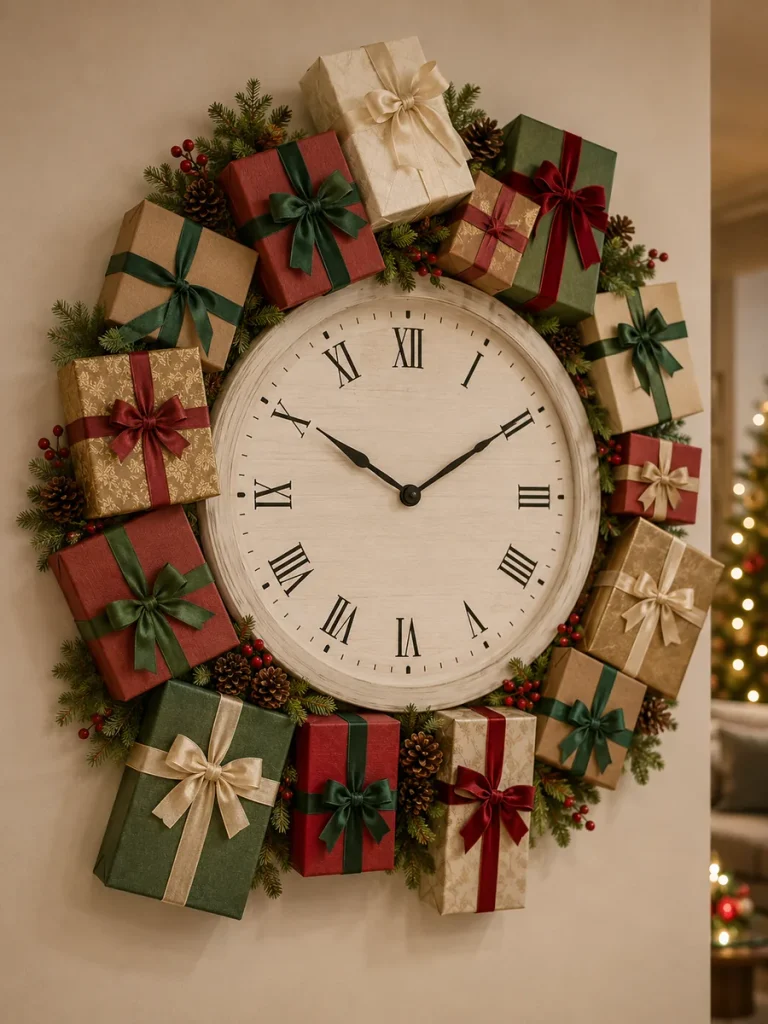
This might be one of the most unexpected ideas in the whole collection.
Use lightweight empty boxes as the frame around your clock. Wrap them in coordinated green, red, cream, kraft, and gold papers, then attach them around the outside in different sizes.
Don’t create a perfectly even circle.
A slightly irregular arrangement looks more playful.
Tuck small evergreen branches, berries, and pinecones into the gaps between packages.
The empty boxes keep the installation light enough for a wall while still creating the impression of a clock literally surrounded by Christmas presents.
39. Santa Hat Clock
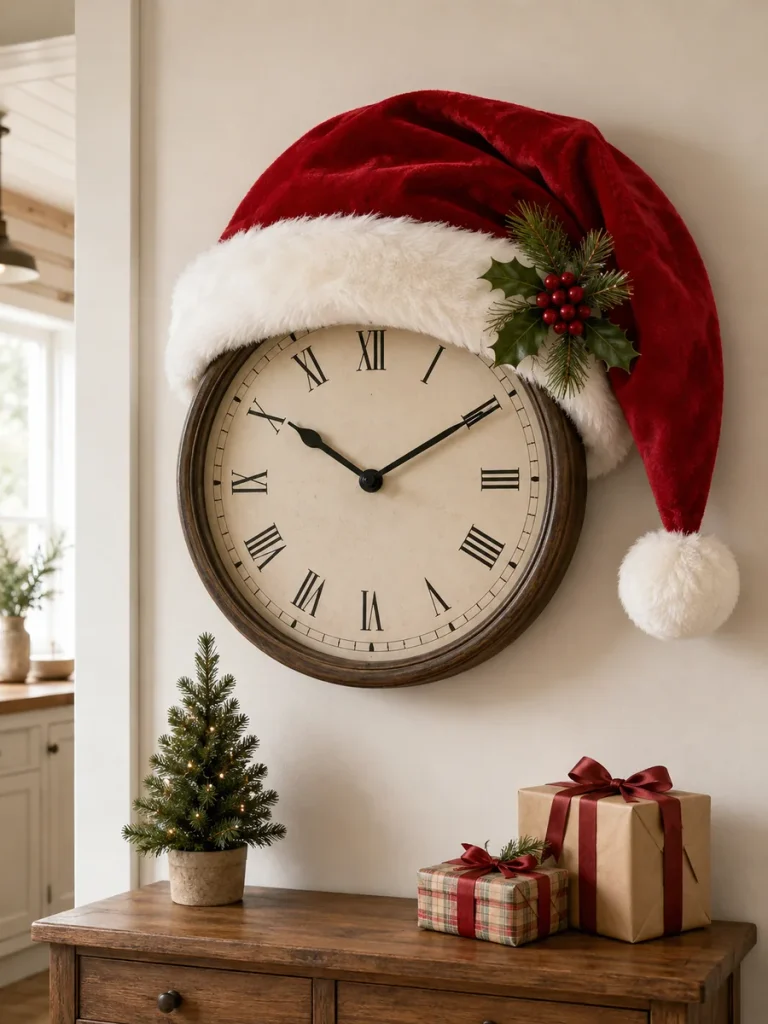
You don’t always need an elaborate DIY.
Place one oversized Santa hat over the upper portion of a round wall clock. Add a little evergreen and holly beside the white fur trim, then leave everything else alone.
Simple. Funny. Festive.
Because the idea is so clear, adding more decorations can actually make it weaker.
A small Christmas tree and a couple of presents on the console underneath are enough to connect the clock to the rest of the room.
This is also one of the easiest ideas to remove once Christmas is over.
40. Grand Christmas Countdown Installation
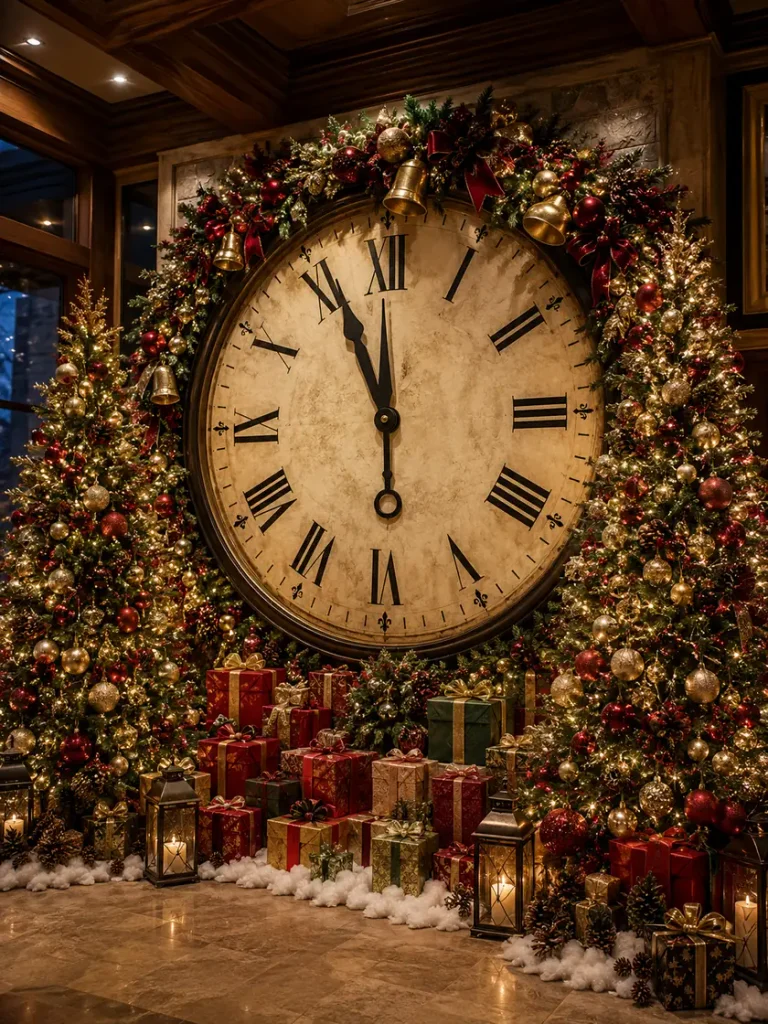
If you have one wall you want to turn into the showpiece of the house, this is where you go big.
Use a massive clock as the center and set the hands close to midnight. Frame it with thick evergreen garland, oversized bells, burgundy ribbon, gold ornaments, berries, and lights.
Add a decorated Christmas tree on each side.
Then fill the lower area with packages in several sizes, lanterns, pinecones, and a touch of faux snow.
The key is scale. Tiny decorations can disappear beside a huge clock, so choose fewer pieces in larger sizes.
And don’t add a sign explaining the countdown.
The clock already says everything.
How to Make Christmas Clock Decorations Look Better at Home
Seeing a large finished arrangement can make the project look more complicated than it really is. Most of these displays come down to a few decisions made before you start attaching anything.
Work With the Clock You Already Have
Look at the clock before choosing the decorations.
A dark wooden clock naturally suits traditional reds, antique gold, bells, pinecones, and velvet. A clean white clock can handle brighter candy-cane colors or snowy decorations. Gold clocks pair beautifully with champagne, pearl, burgundy, and botanical arrangements.
Trying to disguise the clock completely usually creates more work.
Let its existing style help choose the direction.
Pick the Shape Before the Decorations
This makes a surprising difference.
Decide whether your arrangement is going to be a full wreath, half wreath, crescent, tree shape, vertical cascade, crown, arch, or oversized wall installation.
Then build that silhouette with greenery first.
Only after the main shape looks right should you start adding ornaments.
Otherwise, it’s very easy to keep adding pretty pieces without ever getting a clear overall design.
Use More Than One Type of Greenery
A single artificial garland can look flat, especially around a large clock.
Mix textures.
Pine gives you long needles. Cedar hangs more softly. Eucalyptus provides rounded leaves. Holly gives you a darker glossy surface. Bare winter twigs create height and movement.
Even inexpensive greenery usually looks much better once two or three different varieties are layered together.
Start With the Largest Decorations
If you’re adding ornaments, flowers, bells, or gifts, place the biggest items first.
They determine the balance.
After that, add medium pieces and use your smallest berries, pinecones, beads, or ornaments to fill awkward gaps.
Doing it in reverse usually leads to removing half the small decorations later because there’s nowhere left for the statement pieces.
Repeat Colors Instead of Using Everything
You probably have enough Christmas ornaments to create ten different color schemes.
That doesn’t mean they all belong around one clock.
Choose two dominant colors and one smaller accent.
For example, dark green and champagne with burgundy accents. Or white and silver with touches of gold.
Repeating those colors around the arrangement makes even inexpensive decorations look more intentional.
Keep the Clock Face Clear
This sounds obvious until the garland gets bigger.
Step away from the display every so often and make sure you can still read the time.
Branches can overlap the outer frame. Ribbon can fall nearby. An ornament can even sit slightly in front of the edge.
But the hands and most of the numerals should remain visible.
The contrast between the clean clock face and the busy Christmas decorations is part of what makes these displays so attractive.
Add Lights Deeper Than You Think
Fairy lights look better when you can see the glow but not every wire.
Push them inside the greenery rather than laying them across the surface.
The light will illuminate pine needles, glass ornaments, metallic leaves, and ribbon from behind. It produces much more depth, especially at night.
Warm white is the safest choice for traditional, rustic, gold, red, and woodland arrangements.
Don’t Decorate Every Inch
Empty space can feel strange while you’re working close to the display.
From across the room, it usually looks better.
You can see this clearly with crescent, asymmetrical, cascade, and oversized-bow designs. The bare section of the clock makes the decorated portion look stronger.
So before you fill an empty area, walk several steps away.
You may discover that the empty spot is exactly what the arrangement needed.
Where to Use a Christmas Clock Decoration
A mantel is the obvious place, but it’s far from the only option.
Large wall clocks work brilliantly in entryways because guests see them as soon as they arrive. Kitchen clocks can become wreaths or candy-inspired displays. Smaller clocks fit inside lanterns, sleighs, villages, and tabletop arrangements.
A staircase landing is another underrated location. There’s often a large blank wall there, and people pass close enough to notice the details.
For bedrooms and quieter sitting rooms, try lighter ideas such as a crescent arrangement, birch branches, or champagne-and-pearl greenery.
And if you have one awkward blank wall that never seems to look finished during Christmas?
That may be exactly where the giant countdown clock belongs.
The nicest thing about christmas clock decoration is that it turns an object you already use every day into something connected to the season. You can go huge with trees and gift boxes or keep it almost ridiculously simple with one Santa hat.
Either way, the clock stops being background decor.
For a few weeks, it becomes part of Christmas itself.

