
Retirement doesn’t always mean the end of earning. Many older adults look for flexible remote work to stretch a fixed income, stay mentally sharp, or simply keep busy. Working from home makes sense: no commute, no standing for long shifts, and hours that fit around family and health.
Unfortunately, scammers know this too. Fake job offers are one of the fastest-growing types of fraud, and people over 60 report losing billions of dollars each year to scams, according to the FBI and the Federal Trade Commission (FTC). Job scams are designed to look professional, sound friendly, and move quickly, so even careful, intelligent people get caught.
This guide explains the most common work-from-home scams targeting seniors, the warning signs to watch for, how to check whether a job is real, and exactly what to do if you’ve already been targeted.
Quick takeaways
- A real employer will never ask you to pay to start a job.
- Never deposit a check from an employer and send part of the money back.
- Don’t share your Social Security number or bank details until you’ve verified the company and received a written offer.
- Pressure to act fast is a red flag. Real jobs can wait a day while you check them out.
- If you’ve been targeted, call your bank first, then report it at ReportFraud.ftc.gov.

Why Scammers Target Retirees
Scammers aren’t picking on seniors because they’re less capable. They target retirees for practical reasons:
- Savings and steady income. Many retirees have savings, home equity, or reliable Social Security deposits.
- A real need for extra income. Rising living costs make a remote job offer genuinely appealing, and scammers use that hope.
- Newer to online job searching. If you last applied for a job before online hiring was common, it’s harder to know what a normal process looks like today.
- Politeness and trust. Many older adults were raised to answer the phone, reply courteously, and give people the benefit of the doubt.
- Less likely to report. Embarrassment keeps many victims quiet, which lets scammers keep going.
Knowing the tactics is the best protection. Once you can recognize the patterns, these scams become much easier to spot.
9 Common Work-From-Home Scams Targeting Seniors
1. The Fake Check Scam

You’re “hired” quickly, often for a personal assistant, secretary, or mystery shopper role. Your new employer mails you a check and asks you to deposit it, keep a portion as pay, and send the rest elsewhere to buy equipment, pay a “vendor,” or purchase gift cards.
The check looks real and your bank may make the funds available within a day or two. Days or weeks later, the check bounces. By then you’ve sent your own money away, and the bank will expect you to repay the full amount.
The rule: No legitimate employer sends you money and asks you to send part of it back.
2. The Reshipping Scam
This one is often called a “package inspector,” “quality control,” or “logistics coordinator” job. You receive packages at home, repackage them, and mail them to new addresses, usually overseas.
The items are typically bought with stolen credit cards. You become the middleman that hides the criminal’s location, and the promised paycheck never arrives. You could also be pulled into a law enforcement investigation.
3. Upfront Fee Scams
The job sounds easy: data entry, envelope stuffing, assembling crafts, or processing rebates from home. There’s just one catch. You must first pay for a “starter kit,” training, certification, software, or a background check.
Once you pay, the work either never appears or is impossible to complete to the company’s “standards,” so you’re never paid. Legitimate employers cover their own hiring and training costs.
4. Task and App-Based Job Scams
One of the most common scams today often starts with an unexpected text or WhatsApp message from a friendly “recruiter.” You’re offered easy online work, such as rating products, liking videos, or “optimizing” apps, for a commission.
At first, you see small earnings on a dashboard and may even withdraw a little money to build trust. Then you’re told you need to deposit your own money, often in cryptocurrency, to unlock bigger tasks or withdraw your balance. The more you deposit, the more the scammer asks for. The money is never returned.
5. Fake Recruiters and Interview Scams
Scammers copy real company names and logos, post jobs on legitimate job boards, or contact you through LinkedIn, Facebook, or email. The “interview” often happens only by text chat or messaging apps, with no video or phone call.
Shortly after, you receive an offer and onboarding forms requesting your Social Security number, bank account details for direct deposit, and a copy of your driver’s license. That’s everything a criminal needs for identity theft.
6. Mystery Shopper Scams
Real mystery shopping jobs exist, but they don’t pay you in advance and they don’t involve wiring money. Fake versions ask you to “evaluate” a money transfer service or buy gift cards and send the numbers. It’s the fake check scam wearing a different hat.
7. Pyramid Schemes Disguised as Business Opportunities
These pitches promise you can “be your own boss” and earn a full-time income working a few hours a week. The real money comes from recruiting other people and buying inventory, not from selling products to actual customers.
Not every direct-sales company is a scam, but be cautious if you’re pushed to recruit friends and family, buy large amounts of product upfront, or pay ongoing fees to stay “active.”
8. Equipment Purchase Scams
You’re hired for a remote customer service or administrative job and told you must buy a laptop, software, or office equipment from a specific “approved vendor.” Sometimes they send a check to cover it, which links back to the fake check scam. The vendor is part of the scheme, and the equipment never arrives.
9. Government and Grant “Job” Scams
Some scammers pose as government agencies offering remote positions or “senior employment grants.” They may ask for a processing fee or your Medicare and Social Security details. Government agencies don’t charge fees to apply for jobs and don’t contact you out of the blue with job offers.
Red Flags Checklist: How to Spot a Work-From-Home Scam
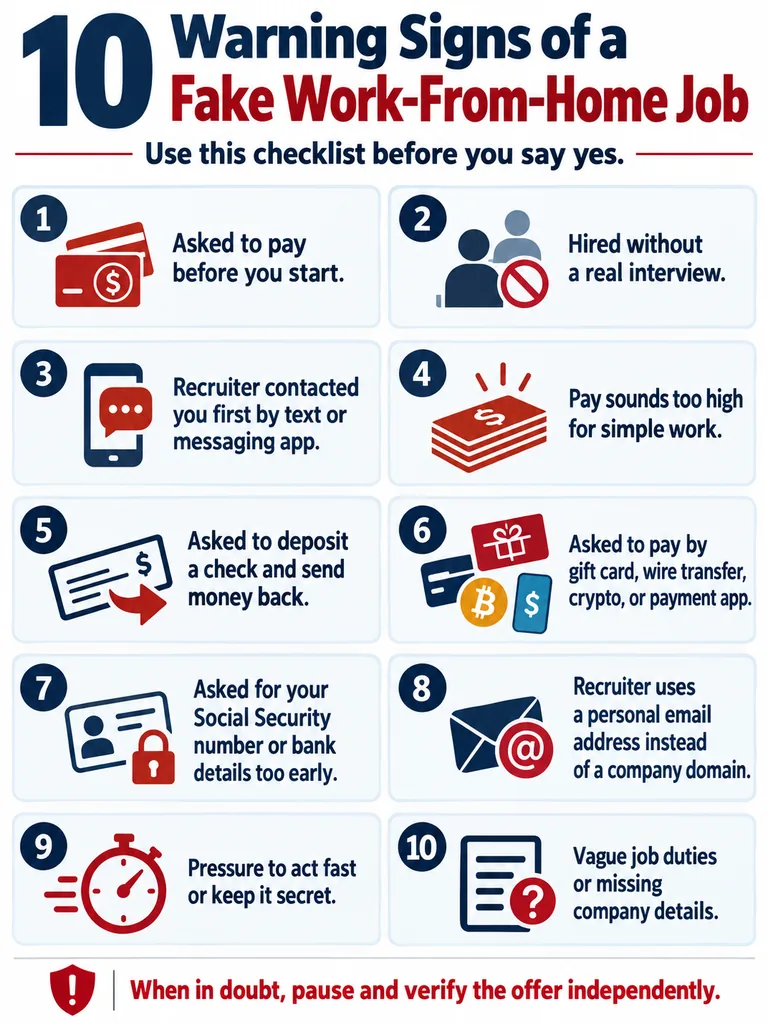
Keep this list handy whenever you review a job offer. One red flag is a reason to slow down. Two or more is a strong sign of a scam.
| Red flag | Why it matters |
|---|---|
| You’re asked to pay before you start | Real employers pay you. They don’t charge for training, kits, or equipment. |
| You’re hired without a real interview | Legitimate employers speak with you by phone or video before hiring. |
| The recruiter contacted you first by text or messaging app | Unsolicited job texts are one of the most common scam openers. |
| The pay is unusually high for simple work | “$40 an hour for data entry, no experience needed” is too good to be true. |
| You’re asked to deposit a check and send money back | This is the core of the fake check scam. |
| Payment is requested by gift card, wire transfer, crypto, or payment app | These methods are hard to trace and nearly impossible to reverse. |
| They want your SSN or bank details before a written offer | This information should only go to a verified employer after you’ve accepted a job. |
| The email address is a free account (Gmail, Yahoo, Outlook) | Real companies use their own email domain. |
| You feel rushed or pressured | Scammers create urgency so you don’t have time to think or ask anyone. |
| The job description is vague | If you can’t tell what you’d actually be doing, be wary. |
How to Verify a Job Offer Before You Say Yes
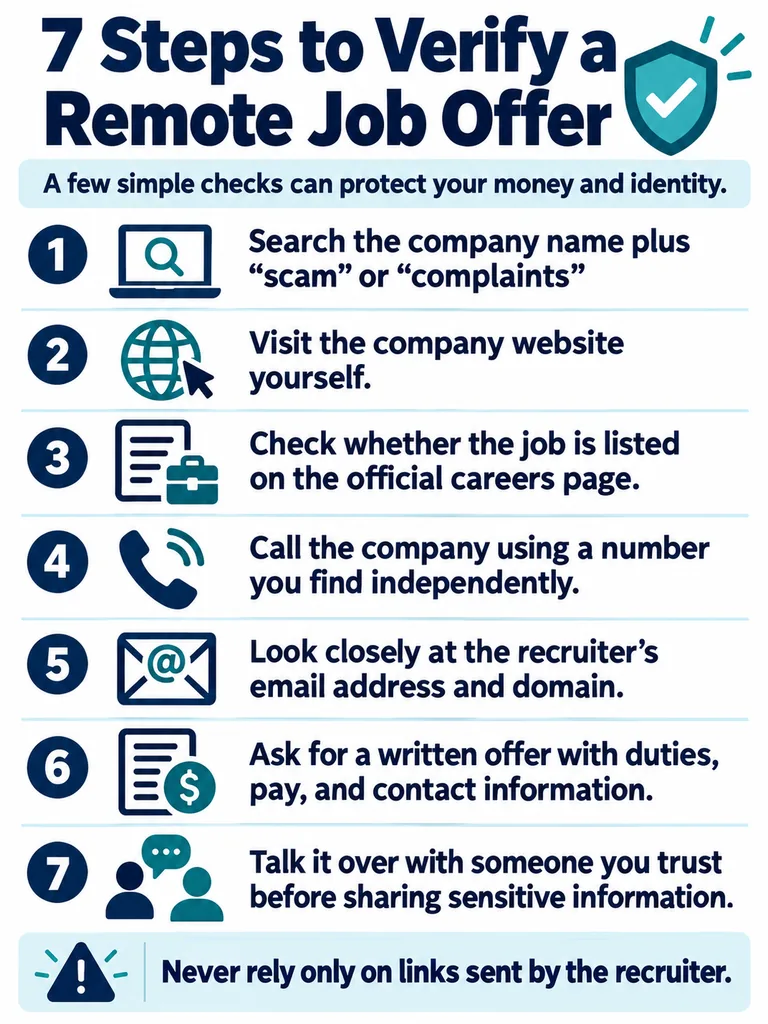
A few simple checks can save you a great deal of money and stress. Take your time with each step.
- Search the company name plus “scam” or “complaints.” Others may have already reported the same offer.
- Find the company’s official website yourself. Don’t rely on links in the message. Check whether the job is listed on the company’s own careers page.
- Call the company using a number you find independently. Ask whether the recruiter and position are real.
- Check the email address carefully. Look for small misspellings in the domain, such as “arnazon” instead of “amazon.”
- Look up the business with the Better Business Bureau and your state attorney general’s office.
- Ask for a written job offer showing the company’s address, your job title, pay rate, and duties.
- Talk it over with someone you trust. A family member, friend, or financial advisor can offer a calm second opinion. Scammers often tell you to keep the job secret. That alone is a warning sign.
What a Legitimate Work-From-Home Job Looks Like

It helps to know what normal looks like. A real remote job usually involves:
- A clear job description with specific duties and requirements
- A phone or video interview with a real person
- A written offer letter on company letterhead
- Paperwork, such as a W-4 or I-9, requested only after you accept the offer
- Pay through direct deposit or payroll, never through checks you must partly return
- No fees of any kind to apply, train, or start
Good places to look for genuine remote work include established job boards, local senior employment programs, the AARP job board, and your state’s workforce or employment office. Retired teachers, nurses, accountants, and office professionals can often find honest part-time remote work using the skills they already have. [Internal link: 30 Part-Time Jobs for Seniors] [Internal link: Work-From-Home Jobs for Retirees]
What to Do If You’ve Been Scammed
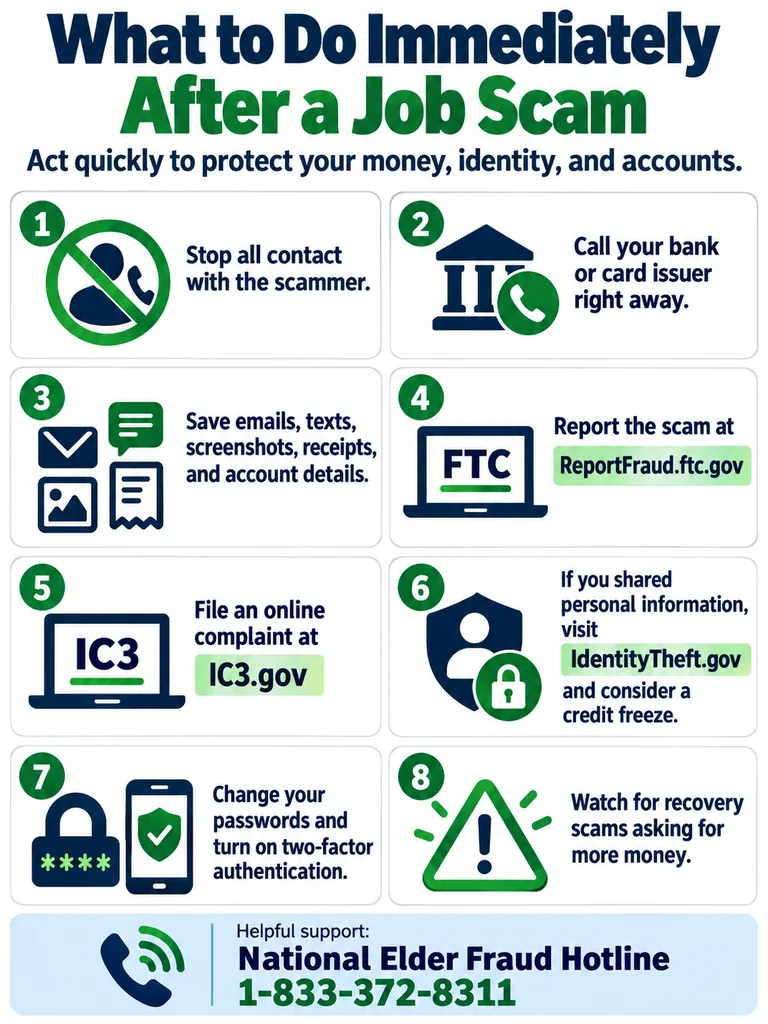
If you think you’ve fallen for a job scam, act quickly. Speed can make the difference in recovering money or stopping further damage. And remember: this is a crime committed against you. There’s no shame in reporting it.
- Stop all contact. Don’t reply, send more money, or try to negotiate with the scammer.
- Call your bank or card issuer right away. Ask them to stop payments, reverse transactions if possible, and watch your accounts.
- Contact the gift card company if you paid with gift cards. Some can freeze funds if you act fast. Keep the cards and receipts.
- Report the scam to the FTC at ReportFraud.ftc.gov.
- File a report with the FBI at IC3.gov, especially if money was lost online or through cryptocurrency.
- Call the National Elder Fraud Hotline at 1-833-FRAUD-11 (1-833-372-8311). Case managers can guide you through reporting and next steps.
- Protect your identity. If you shared your Social Security number, visit IdentityTheft.gov and consider freezing your credit with Equifax, Experian, and TransUnion. A credit freeze is free.
- Change your passwords for email, banking, and any accounts you used to communicate with the scammer.
- Watch for recovery scams. Scammers sometimes contact victims again, posing as investigators who can “recover” money for a fee. Legitimate agencies don’t charge to help you.
Helpful resource: The AARP Fraud Watch Network Helpline (877-908-3360) offers free support from trained volunteers, whether or not you’re an AARP member.
How Families Can Help
If you have an older parent or relative looking for remote work, a supportive conversation goes much further than a lecture. Share articles like this one, offer to review job offers together, and agree on a simple rule: any job that asks for money gets talked over first. Most importantly, make it clear they can come to you without feeling embarrassed. Scams thrive on secrecy.
Frequently Asked Questions
Are there legitimate work-from-home jobs for seniors?
Yes. Many real companies hire remote workers for customer service, tutoring, bookkeeping, writing, transcription, and virtual assistant roles. The key difference is that real jobs never require you to pay to start and always involve a proper hiring process.
Can a job offer through LinkedIn or Indeed be a scam?
Yes. Scammers post fake listings on trusted job sites and create fake recruiter profiles. Always verify the company independently, even if you found the job on a well-known platform.
Is it safe to give my Social Security number to an employer?
Only after you’ve verified the company is real and accepted a written job offer. Employers need it for tax forms, but they don’t need it during the application or interview stage.
What if the check from my new employer cleared?
Funds becoming available doesn’t mean a check is genuine. Fake checks can take days or weeks to bounce, and you’ll be responsible for the full amount. Never send money back to an employer.
Will I get my money back if I report a scam?
Not always, but reporting quickly gives you the best chance, especially with banks and card issuers. Your report also helps authorities track scammers and warn others.
The Bottom Line
Working from home can be a wonderful way to earn extra income in retirement, as long as you know how to separate honest opportunities from clever traps. Remember the simple rules: never pay to get a job, never send money back from a check, and never let anyone rush you. When something feels off, pause, verify, and talk to someone you trust.
Your experience, reliability, and judgment are valuable to real employers. Protect them, and the right opportunity will be worth the wait.
This article is for general information only and isn’t legal or financial advice. If you’ve been the victim of fraud, contact your bank and the agencies listed above for help specific to your situation.
