A credit card can be your best friend or your worst enemy when paying for Christmas. Used wisely, it can earn cash back, help protect purchases from fraud, and make holiday spending easier to track. Used carelessly, it can turn a joyful season into months of expensive debt.
Plenty of shoppers reach for plastic in December. According to Bankrate’s 2025 Holiday Spending Report, 57% of holiday shoppers planned to use credit cards: 35% planned to pay their balance in full, while 21% expected to carry a balance. TransUnion’s Q4 2025 U.S. Consumer Pulse survey found that 42% named credit cards as their preferred holiday payment method, up from 38% the previous year.
For 2026, Bank of America’s October 29 holiday survey found that 49% of respondents preferred credit cards for holiday shopping, versus 32% in its 2025 survey. These surveys use different samples and questions, so their figures should not be treated as one continuous trend.
The real question is not simply whether you should use a credit card for Christmas. It is how to collect the benefits without paying for them in interest. This guide explains the advantages and risks, shares 12 practical rules, compares credit cards with debit cards and buy now, pay later, and includes a holiday checklist you can print or pin.
Quick answer: A rewards credit card can be a good choice for planned holiday purchases when you already have the money and can pay the full statement balance by the due date. If you are likely to carry a balance, cash or debit may fit your budget better.
Financial disclaimer: This article provides general U.S.-focused educational information, not personalized financial advice. Credit card rates, grace periods, rewards, dispute rights and protections depend on your account and applicable law. Check your card agreement and consult a qualified professional for individual guidance.
Why Use a Credit Card for Holiday Shopping?
Credit cards have a poor reputation around the holidays when unpaid balances linger into the new year. For disciplined shoppers who avoid interest, however, they may offer advantages that cash or debit cards cannot always match.

Rewards and cash back
Some cards offer flat-rate cash back; others offer points, miles, or higher rewards in categories such as groceries, online shopping, dining or travel. A card with 2% cash back would return $20 on $1,000 in eligible purchases. That is a useful bonus on money you were already prepared to spend, but it is not a reason to buy additional gifts or exceed your budget.
Fraud protection
Holiday shopping means more online orders and more chances to encounter fraudulent sellers or stolen payment information. With a credit card, a disputed transaction usually does not remove funds directly from your checking account while it is investigated. Debit card protections also exist, but a fraudulent withdrawal may temporarily reduce the cash available for everyday bills. Report suspicious transactions to your issuer or bank promptly.
Purchase protection, warranties and return benefits
Some credit cards provide benefits such as purchase protection against theft or accidental damage, extended warranties on eligible products, or limited return assistance. Others do not. Before shopping, check your specific benefits guide, coverage limits, exclusions and claim deadlines—particularly for expensive electronics.
A possible interest-free grace period
Most credit cards offer a grace period on purchases. If you meet the card’s conditions—typically paying the full statement balance on time—you can avoid purchase interest. The Consumer Financial Protection Bureau (CFPB) explains that grace periods are not guaranteed by every card and generally do not apply to cash advances. Billing statements must usually be delivered at least 21 days before the payment due date.
Easier holiday spending tracking
Putting planned holiday purchases on one primary card can make it easier to see how much you have spent. Check the transaction list regularly and compare it with your gift, food, travel and decoration budgets. A simple running total helps prevent small purchases from quietly adding up.
The Catch: What It Costs If You Carry a Balance
These benefits can disappear when interest and fees enter the picture. A late payment or unpaid statement balance may cost far more than a few dollars in cash back. And after you lose a purchase grace period, interest can apply to new transactions from their purchase dates until you meet the issuer’s requirements to restore it.
Credit card borrowing costs remain high. The Bankrate Monitor series published by the St. Louis Fed recorded a national average card-offer APR of 19.71% on November 4, 2026. LendingTree’s credit card debt statistics list 23.96% as the average APR on new credit card offers. These are different measures, not rates that every borrower will receive.
Suppose you charge $1,000 of Christmas purchases on a card at a 22% APR and leave the balance unpaid, with no further purchases or payments. With simplified monthly compounding, approximate interest would look like this:
| Time balance is carried | Approximate interest at 22% APR |
|---|---|
| 1 month | $18 |
| 3 months | $56 |
| 6 months | $115 |
| 12 months | $244 |
Illustrative calculation only: actual card interest generally depends on daily balances, payment timing, the issuer’s calculation method and applicable APR.
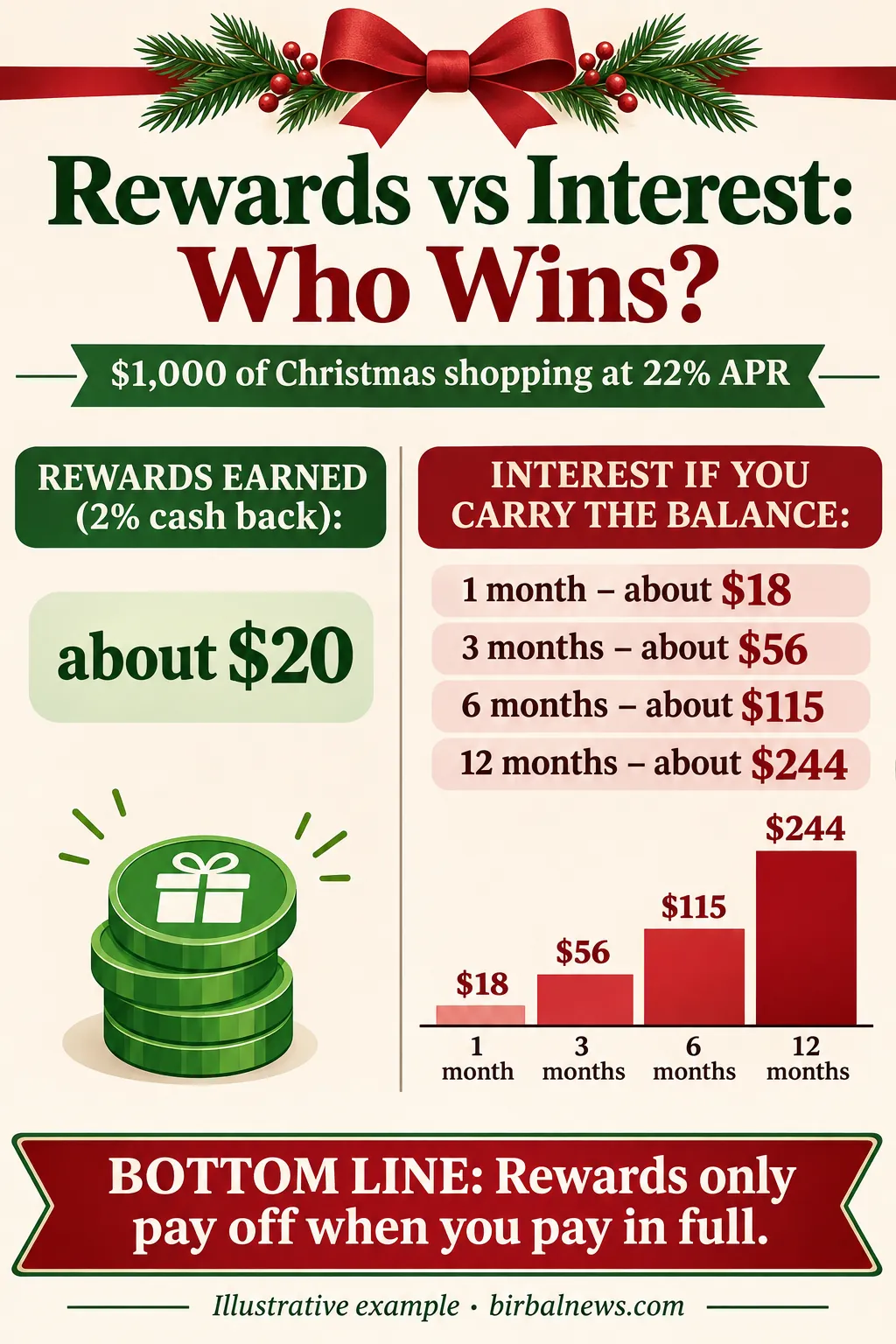
Now compare those costs with a 2% cash-back reward. A $1,000 purchase earns roughly $20, while a balance carried for several months at a high APR can cost many times that amount. The safest way to make rewards worthwhile is to avoid interest by paying in full.
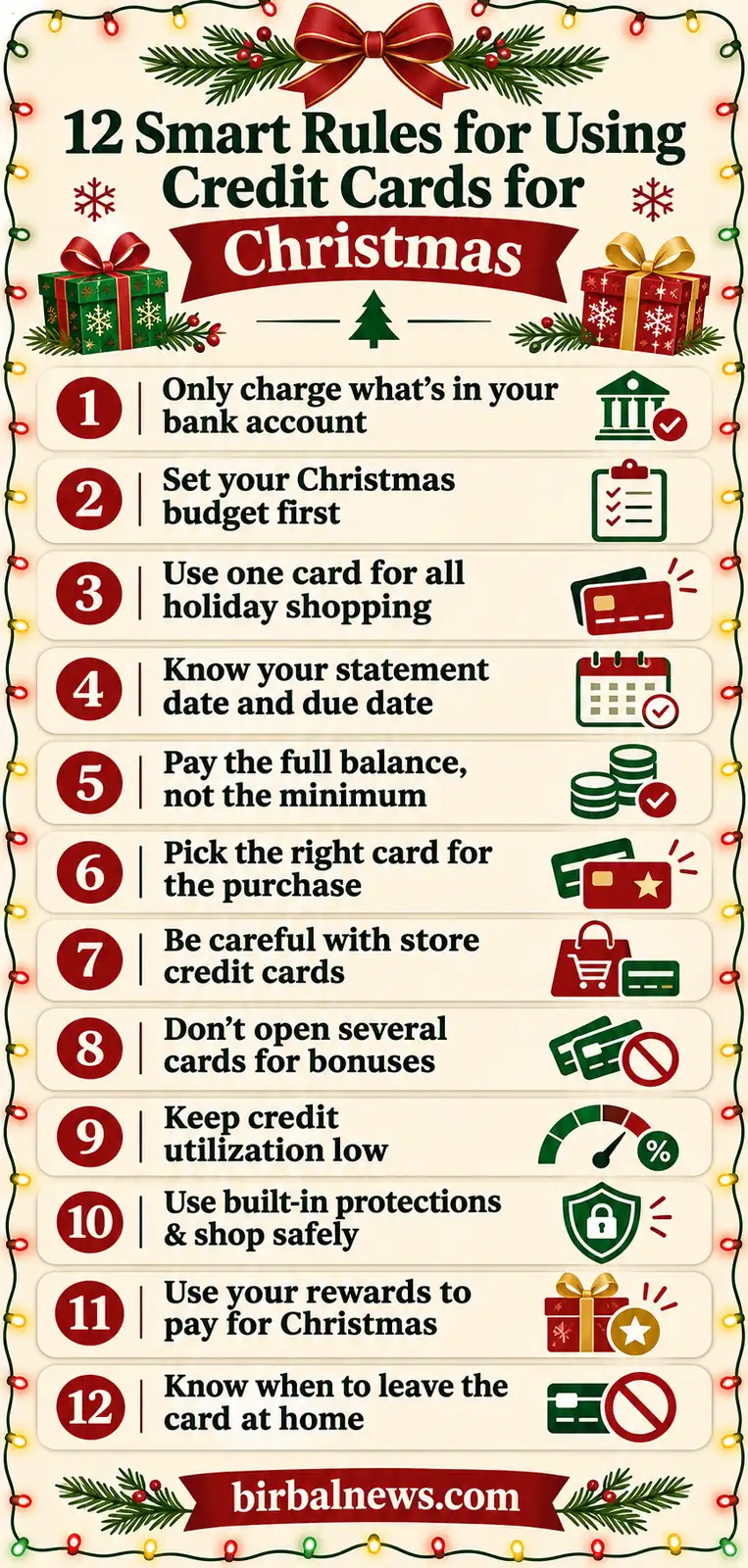
12 Smart Rules for Using Credit Cards for Christmas Shopping
You do not need complicated rewards strategies to shop responsibly. Most of the benefit comes from following the same handful of habits every time you use a card.
Rule 1: Only Charge What Is Already in Your Bank Account
Treat your credit card like a debit card that happens to earn rewards. Before you swipe, ask yourself: Do I already have the money for this purchase? If the answer is no, do not count your credit limit as extra Christmas cash.
One practical method is to move the amount of each holiday purchase into a separate bill-payment account—or make an early credit card payment after the purchase posts. That keeps money from being spent twice. If you have $450 earmarked for gifts, your credit card spending on gifts should remain within that $450 even if your credit limit is $5,000.
Rule 2: Set Your Christmas Budget Before You Swipe
Decide how much you can afford to spend for the entire season, including gifts, food, travel, decorations, shipping, charitable giving and unexpected costs. Then break the total into categories and assign a price cap for each person on your list. Your plan should reflect actual available savings and expected income, not a hoped-for bonus.
For example, an $800 holiday budget might allocate $440 to gifts, $160 to food, $80 to travel, $60 to decorations and wrapping, and $60 to a buffer. The exact split is flexible. What matters is that the categories add up to an amount you can truly pay.
Rule 3: Use One Primary Card for Holiday Shopping
Holiday purchases spread across four cards can make spending hard to monitor. Choose one primary card for planned purchases so your spending, payment date and potential disputed charges are easier to track. Pick a card whose existing rewards and fees already make sense for your spending habits.
- You can check your holiday spending total in one place.
- You have fewer statement dates and payments to track.
- It is easier to reconcile gift receipts and identify unfamiliar charges.
- You reduce the temptation to treat multiple credit limits as separate budgets.
A second card can be useful for a meaningful category benefit or as backup, but only if you can manage both accounts without losing control of the total. Do not overspend merely to qualify for a rewards bonus.
Rule 4: Know Your Statement Date and Due Date
Your statement closing date marks the end of a billing cycle; your due date is when the statement payment must arrive. Knowing both helps you avoid accidentally missing a payment and understand the possible time between shopping and paying.
For example, imagine your statement closes January 1 and the payment is due January 25. A December 2 purchase could be included on the January 1 statement and would not be due until January 25—about seven and a half weeks later. A December 31 purchase in that same cycle would have less than four weeks before its due date.
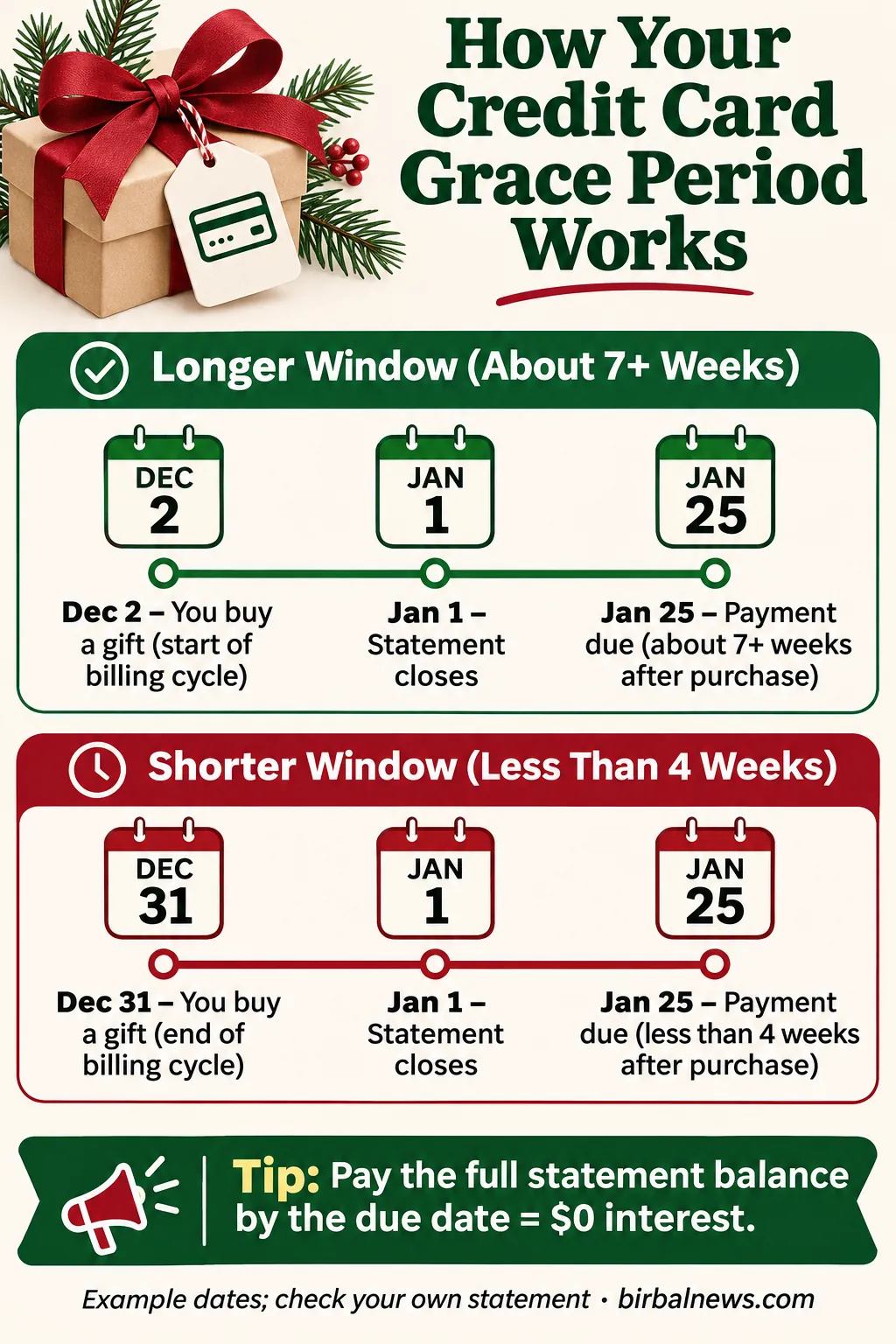
Those dates are examples, not a promise that you can borrow without interest. The grace period normally depends on your account being eligible and your full statement balance being paid on time. Find your own dates in the issuer’s app or statement and set payment reminders several days early.
Rule 5: Pay the Full Statement Balance, Not the Minimum
Your statement usually lists a minimum payment and a statement balance. Paying the minimum on time generally avoids a missed-payment status, but it does not prevent interest on the remaining balance. To retain the purchase grace period when you are eligible for it, arrange to pay the full statement balance by the due date.
Setting autopay for the full statement balance is an easy safeguard, as long as enough money will be in the linked account. If you prefer to pay manually, consider minimum-payment autopay as a backup while still making a separate payment for the full statement amount. Always verify that payments have cleared.
Rule 6: Pick the Right Card for the Purchase
If you already use more than one card comfortably, you can choose among them without opening anything new. A flat-rate cash-back card is straightforward for general gift shopping; category cards may offer extra rewards for eligible grocery, online shopping or travel purchases; and some travel cards earn points that can be used for flights or hotels.
The key is to compare the benefit with any annual fee, category cap, redemption restriction or extra hassle. Most shoppers do not need a complicated strategy. A single reliable card paid in full can be more valuable than juggling multiple cards for a marginal bonus.
Rule 7: Be Careful With Store Credit Cards at Checkout
A discount for opening a store credit card may sound attractive when your cart is full of gifts. But it is important to read the rate and promotional terms before applying.
- High APRs: Retail and store cards can charge rates around 30% or higher, depending on the issuer and account.
- Deferred interest: “No interest if paid in full” promotions may charge accumulated interest retroactively if you fail to clear the promotional balance before the deadline.
- Hard inquiry: Applying for credit may temporarily affect your credit score.
- Low credit limit: A large holiday purchase could raise utilization on that card.
- Limited acceptance: Some store cards are usable only at the retailer or its affiliated brands.
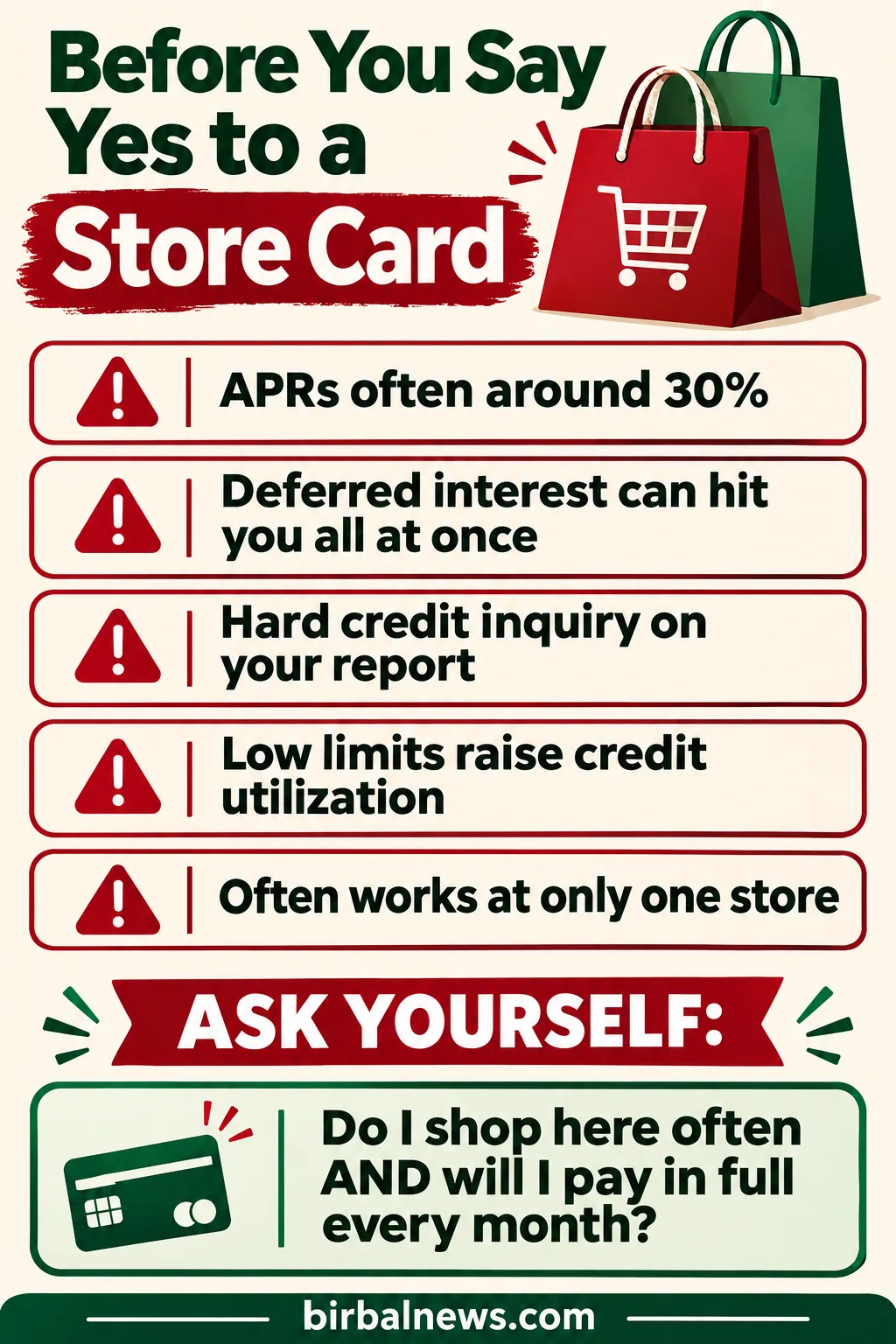
A store card might make sense for a regular customer who understands its terms and can pay in full. But a checkout-counter offer should never replace a careful comparison. A genuine 0% introductory APR offer and a deferred-interest promotion are not the same thing.
Rule 8: Do Not Open Several New Cards Just for Bonuses
Sign-up bonuses are designed to encourage spending, and holiday purchases may help some shoppers meet an existing planned requirement. However, applying for several cards in a short period can mean multiple inquiries, new accounts to manage and pressure to buy more than you intended.
If you expect to apply for a mortgage, car loan or another major credit product soon, be especially cautious about unnecessary new accounts. A welcome bonus is not a saving if reaching its spending target pushes your Christmas purchases beyond your budget.
Rule 9: Keep Your Credit Utilization Low
Credit utilization is the percentage of available revolving credit you are using. If your card limit is $5,000 and the reported balance is $2,500, that card is at 50% utilization. Lower reported utilization is generally better for many credit scoring models, although the effects depend on the score and your broader credit history.
Issuers often report balances around the statement date, so holiday purchases may temporarily increase utilization even when you eventually pay the statement in full. If you are about to apply for important credit, making a payment before your issuer reports could reduce the displayed balance. Do not rely on a universal reporting date; check your account.
Rule 10: Use Built-In Protections and Shop Safely Online
Card protections are useful, but holiday scams can still waste time and money. Keep your account secure while shopping and act quickly if something seems wrong.

- Enable transaction alerts for every purchase so unusual activity is easier to spot.
- Use a secure digital wallet or virtual card number when available.
- Type retailer addresses directly or verify them carefully; be suspicious of unfamiliar holiday ads and fake delivery notifications.
- Avoid entering card details on public or shared devices, and use a trusted connection.
- Keep order confirmations and receipts until products arrive and return windows close.
- Contact your issuer promptly about unauthorized or incorrect charges and follow its dispute instructions.
For U.S. credit card billing errors, the CFPB advises consumers that a written billing-error notice generally must be sent within 60 calendar days after the charge appears on the statement to preserve certain federal dispute rights. An app message alone may not satisfy every formal notice requirement; review your issuer’s instructions.
Rule 11: Use the Rewards You Already Have
Before spending more, check the rewards balance on cards you already hold. Depending on your issuer, you might be able to redeem rewards for a statement credit, gift cards, travel or eligible purchases. Some redemptions offer better value than others, so compare your options before clicking “redeem.”
For example, if your account lets you redeem $75 in cash back for a $75 statement credit, applying it to a planned holiday purchase could reduce the amount you need to pay from your budget. It does not justify spending another $75 on unplanned gifts.
Rule 12: Know When to Leave the Card at Home
Even a rewards card is the wrong tool when you are unable to repay it in full or when using it makes overspending easier. Consider a cash envelope, debit card or smaller holiday plan if you are already carrying an expensive balance, have recently missed payments, have no clear repayment funds, or tend to treat your limit as spendable income.
There is nothing wrong with a simpler Christmas. Ending the season without new debt is a much better reward than earning points on gifts you will still be paying for next summer.
Credit Card vs. Debit Card vs. Buy Now, Pay Later for Christmas
Each payment method solves a different problem. A credit card may offer rewards and additional purchase benefits; debit can make borrowing less tempting; and a buy now, pay later (BNPL) plan divides one purchase into scheduled installments. The right choice depends on what you can actually afford and how reliably you track payments.
| Feature | Credit card | Debit card | Buy now, pay later |
|---|---|---|---|
| Interest | None on eligible purchases if the grace-period conditions are met; potentially high APR otherwise | No borrowing interest; overdraft fees may apply | Some short pay-in-four plans charge no interest; other plans may charge interest or fees |
| Rewards | Often cash back, points or miles | Less common | Less common |
| Fraud/disputes | Federal protections and issuer policies generally apply | Protections exist, but account funds may be unavailable during a dispute | Rights and processes vary with the product, provider and law |
| Credit impact | Payment history and reported balances can matter | Typically no direct credit-score effect | Depends on reporting, inquiries and collection activity |
| Primary risk | Carrying high-interest debt | Overdrafts or temporary loss of account funds | Overlapping payment plans and missed installments |
| Good fit | Shoppers who reliably pay in full | Shoppers who prefer to spend from their bank balance | A carefully planned purchase with affordable scheduled payments |
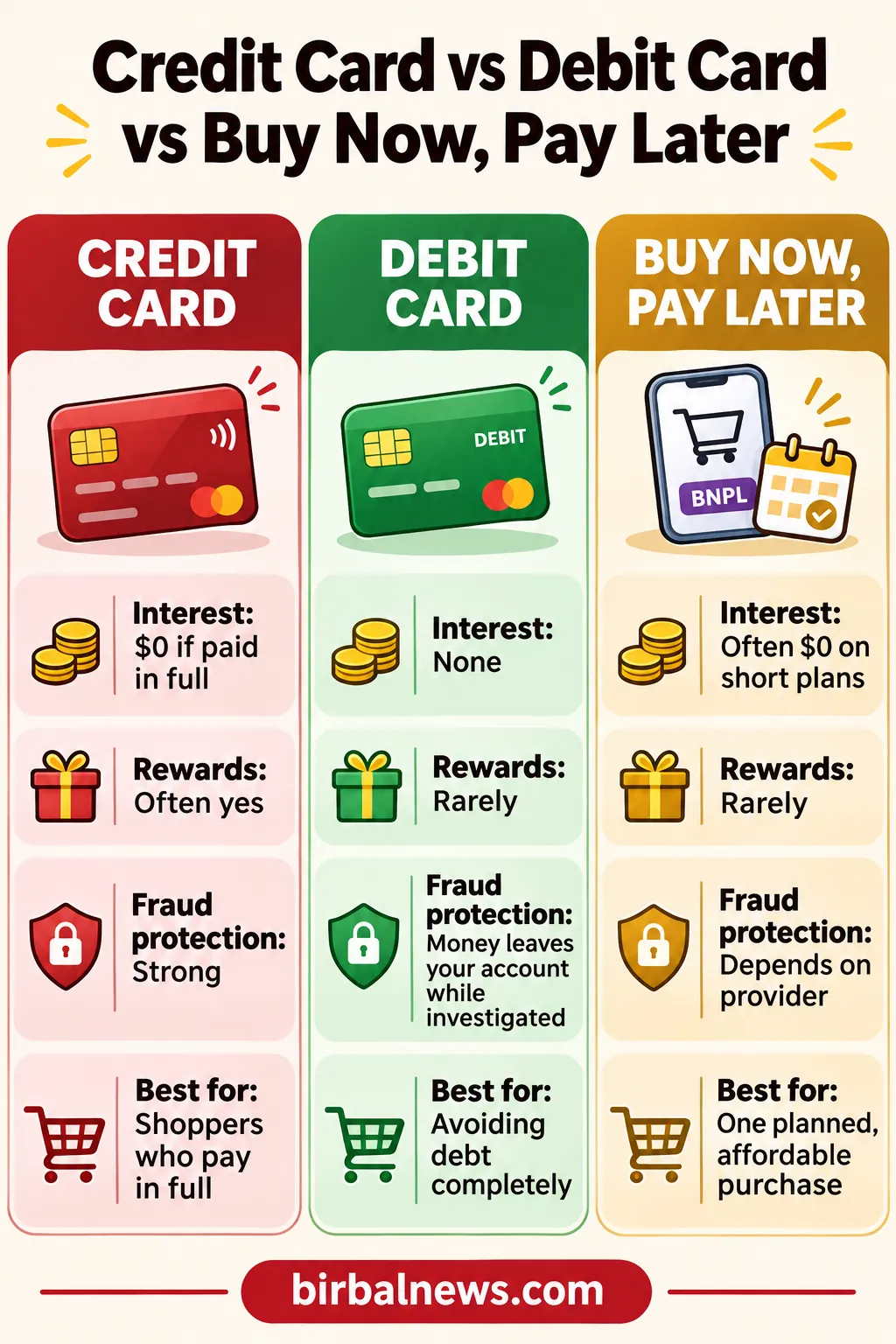
The CFPB notes that many short BNPL plans have no interest but may impose late fees. Do not assume every BNPL product offers the same legal protections, reporting practices or terms. If you use several payment methods, keep one master holiday spending total.
Quick Holiday Credit Card Checklist
Use the following list before your first major shopping day, then review it once a week until Christmas:
- ☐ I have set one total Christmas budget and a gift price cap for each person.
- ☐ The money for my planned purchases is available in my bank account.
- ☐ I have chosen one primary card for holiday shopping.
- ☐ I know my statement closing date and payment due date.
- ☐ Autopay is set up for the full statement balance, or I have a reliable payment plan.
- ☐ Transaction alerts are turned on.
- ☐ I have reviewed my card’s purchase protection and return benefits.
- ☐ I have checked my existing rewards balance and redemption value.
- ☐ I will decline unplanned store-card offers.
- ☐ I will track holiday purchases every week.
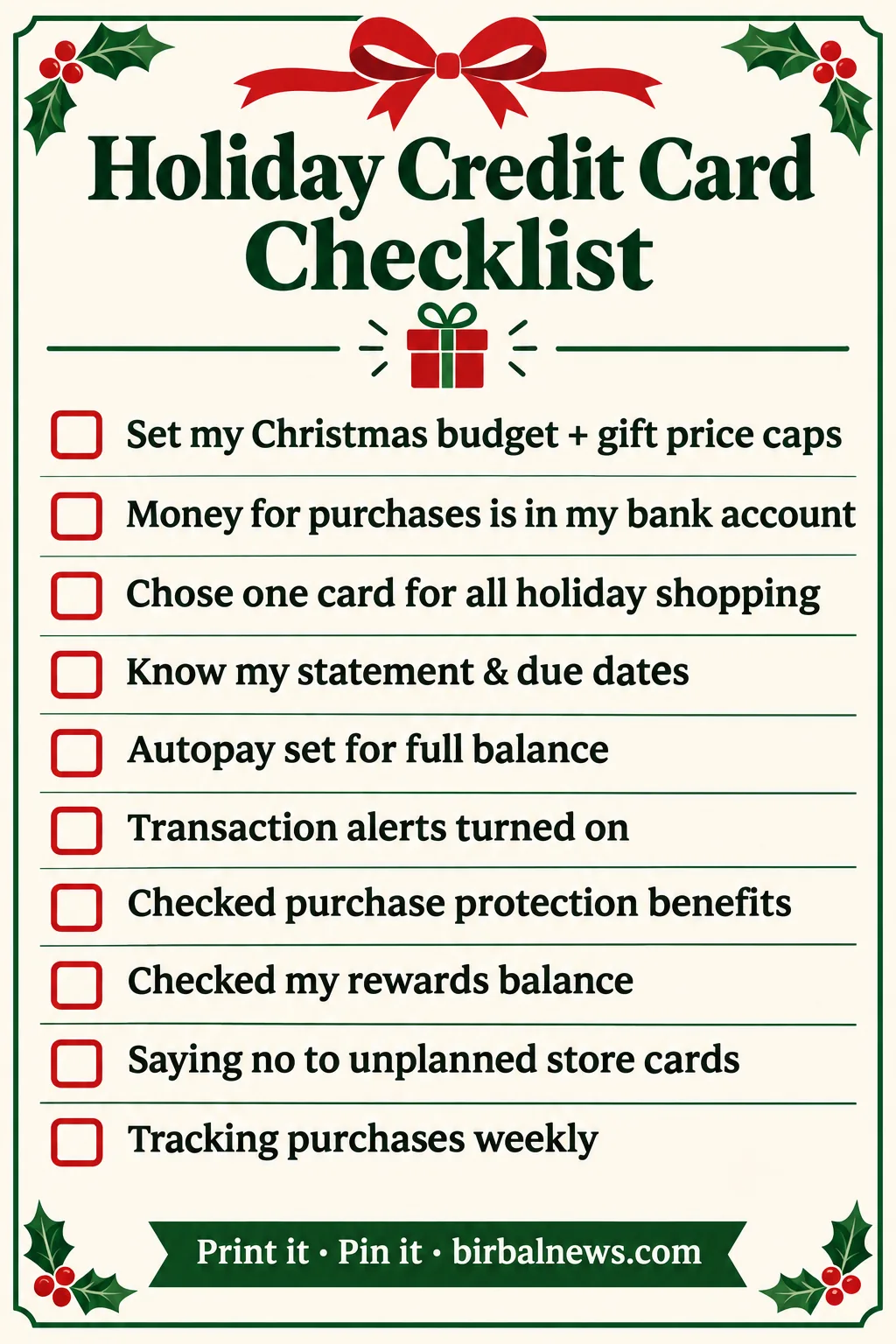
Save the checklist for yourself, print a copy, or pin it to your holiday budgeting board. It works best when you update the numbers throughout the season rather than only checking them once.
What to Do If You Have Already Overspent
If you have already spent more than planned, start by listing each card balance, APR, minimum payment and due date. Pay at least the minimum on time to avoid additional late-payment problems, then direct as much extra money as you can toward one debt at a time.
You can use the debt avalanche method, which targets the highest-interest debt first, or the debt snowball method, which pays the smallest balance first for a quicker psychological win. Both require making required payments on all accounts.
To free up cash, consider returning unneeded purchases within the store’s policy, pausing optional spending in January, selling unused items, or canceling subscriptions you no longer use. A balance-transfer card with a 0% introductory APR may help in some circumstances, but check transfer fees, eligibility, expiration dates and the regular APR. You can also ask your current issuer about payment assistance or a lower rate.
Frequently Asked Questions
Is it better to use a credit card or a debit card for Christmas shopping?
For someone who always pays the full eligible statement balance on time, a rewards credit card may offer cash back and additional purchase benefits. For someone who struggles with card balances, debit or cash may make it easier to stick to money already available—while still watching for overdraft risks.
Should I open a store credit card for a holiday discount?
Only after comparing the real savings with the card’s interest rate, fees, limitations and any promotional terms. A deferred-interest promotion is especially important to understand because failing to pay in full by the deadline can trigger back interest.
Does holiday credit card shopping hurt my credit score?
Purchases themselves do not automatically hurt your credit score, but higher reported credit utilization can affect some scoring models. Missed payments and multiple new applications can have additional consequences. Paying on time and monitoring reported balances helps.
What if I can only afford the minimum payment in January?
Make at least the minimum on time, but recognize that interest can accrue and the grace period on new purchases may be lost. Stop adding unnecessary charges, review your budget and prioritize paying the expensive balance down.
Are credit card rewards worth it when I carry a balance?
Usually not when your card charges a high APR and you maintain an unpaid balance for weeks or months. A one-time 1%–2% reward is easily overtaken by repeated interest charges. Focus on avoiding interest before optimizing rewards.
Is a 0% introductory APR credit card useful for holiday shopping?
It may be an option for a planned purchase if you qualify and have a realistic repayment schedule, but it is not free money. Check whether the offer is a true introductory 0% APR or a deferred-interest promotion, and make sure you understand when the promotion ends and what rate applies afterward.
Final Thoughts: Make Your Credit Card Work for You This Christmas
A credit card is a payment tool, not extra income. Used carefully, it can earn rewards, make transactions easier to track and provide certain consumer protections. Used without a budget, it can turn a few cheerful December purchases into months of high-interest payments.
The best holiday strategy is simple: set a realistic spending limit, keep the money available, know your card’s dates and terms, and pay the full statement balance on time. Follow these 12 rules and you can enjoy Christmas without making credit card debt part of your new year.
Save this guide and the printable checklist to your Pinterest holiday budgeting board, and share it with someone preparing their Christmas shopping list.
Sources and Methodology
- Bankrate, 2025 Holiday Spending Report (survey figures).
- TransUnion, November 2025 Consumer Pulse news release (payment preference).
- Bank of America, October 29, 2026 Holiday Spending Survey (2026 payment preference).
- Federal Reserve Bank of St. Louis / Bankrate Monitor, November 4, 2026 APR reading.
- LendingTree, Credit Card Debt Statistics (average offered APR).
- CFPB, What Is a Grace Period for a Credit Card?
- CFPB, How Do I Dispute a Charge on My Credit Card Bill?
- CFPB, What Is a Buy Now, Pay Later Loan?
Interest illustration methodology: Starting principal $1,000, nominal APR 22%, monthly periodic rate 22% ÷ 12, compound interest without payments or purchases, rounded to whole dollars. Figures are educational examples, not actual lender quotes.