Skip to content
Every January, millions of families open their credit card statements and feel the same sinking feeling. The presents are unwrapped, the cookies are gone, the decorations are back in their boxes, but the bill for all that holiday cheer is just arriving. If that sounds familiar, you are far from alone.
According to LendingTree’s 2025 holiday debt survey, 37% of U.S. consumers took on holiday debt during the 2025 season, and those who borrowed owed an average of $1,223, the highest level since 2022. Parents of children under 18 were hit even harder: 48% of them borrowed to cover the holidays, taking on an average of $1,324. Even more telling, 41% of people who went into holiday debt said they were still paying off the previous year’s Christmas.
That last number is the real problem. Christmas debt rarely stays a December problem. Thanks to high credit card interest, it can roll into spring, summer and right into the next holiday season, until you are paying for two Christmases at once.
The good news is that holiday debt is one of the most preventable kinds of debt there is. Christmas comes on the same date every year, which means you can plan for it. And if you have already overspent, a clear plan can get you back to zero faster than you might think.
This guide is divided into two parts:
- Part 1: Eight practical ways to enjoy Christmas without going into debt.
- Part 2: A step-by-step plan to pay off Christmas debt fast if you already have it, plus a 30-day kickstart checklist.
Financial education disclaimer: This article is for general educational purposes only and is not personal financial advice. For decisions about your specific situation, consider speaking with a qualified financial professional or a nonprofit credit counselor.
Why Christmas Debt Happens to So Many People
Before we get to solutions, it helps to understand why holiday debt is so common. Very few people set out to overspend at Christmas. In LendingTree’s 2024 survey, only 44% of people who took on holiday debt said they had actually planned to. For most, it simply crept up on them.
Gifts are the biggest driver
In a December 2025 survey by Credible, gift spending was the number one reason people went into holiday debt, cited by 63% of borrowers. Everyday living expenses came second at 25%, followed by holiday travel, food and decor at 12%. That tells us something important: the pressure to buy gifts, for kids, partners, parents, coworkers, teachers and neighbors, is where most budgets break.
Hidden costs add up quietly
Gifts are only part of the picture. Think about everything else December asks of your wallet: wrapping paper, shipping fees, holiday cards, office party contributions, a new outfit for the family gathering, extra groceries for hosting, gas for travel, tips for service workers, and that “just one more thing” purchase in the checkout line. None of these feel big on their own. Together, they can easily add hundreds of dollars to your holiday total.
Credit makes overspending feel painless
Swiping a card or clicking “Pay in 4” doesn’t feel like spending money in the moment. The pain is delayed until the statement arrives. That delay is exactly what makes it so easy to go past what you can actually afford.
Interest turns a small problem into a big one
In LendingTree’s 2024 survey, 42% of people with holiday debt said their highest interest rate was 20% or more. Here is what that means in real life.
Example: Imagine you put $1,200 of Christmas shopping on a card with a 22% APR, and you only pay the minimum each month (calculated here as the monthly interest plus 1% of the balance, with a $25 floor). It would take you about 88 months, more than seven years, to pay it off, and you would pay roughly $1,130 in interest. That’s almost the cost of a second Christmas. Now imagine paying a fixed $150 a month instead. You would be debt-free in about 9 months and pay only around $110 in interest.
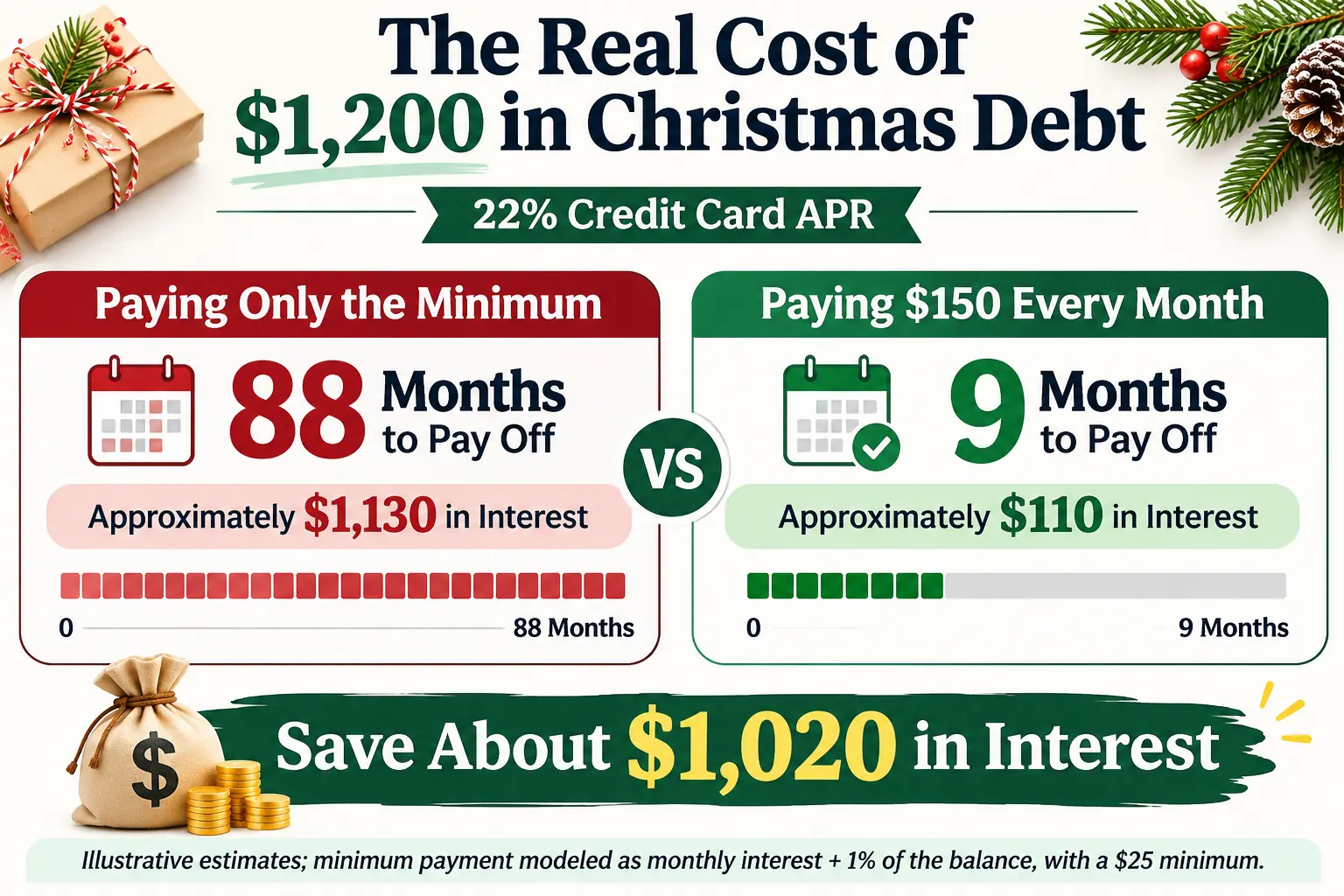
(Illustrative calculations; actual minimum payment formulas and interest vary by card issuer.)
The difference between those two outcomes is a plan. Let’s build one.
Part 1: How to Avoid Christmas Debt
1. Set Your Total Christmas Number First
The single most powerful thing you can do is decide on one total Christmas budget before you buy a single gift. Not a gift budget. Not a “try to keep it reasonable” goal. One clear number for the entire season.
Base that number on money you actually have or will have by December, not on your available credit limit. Start by looking at:
- Cash you have already saved for the holidays
- Any extra money you can set aside from your remaining paychecks before Christmas
- Any expected bonus, but only count it once it’s actually in your account
Once you have your total, divide it into categories. A simple split many families find workable looks like this:
| Category | Share | $500 Budget | $1,000 Budget | $1,500 Budget |
|---|---|---|---|---|
| Gifts | 50% | $250 | $500 | $750 |
| Food & hosting | 20% | $100 | $200 | $300 |
| Travel | 10% | $50 | $100 | $150 |
| Decor | 5% | $25 | $50 | $75 |
| Giving & charity | 5% | $25 | $50 | $75 |
| Buffer for surprises | 10% | $50 | $100 | $150 |
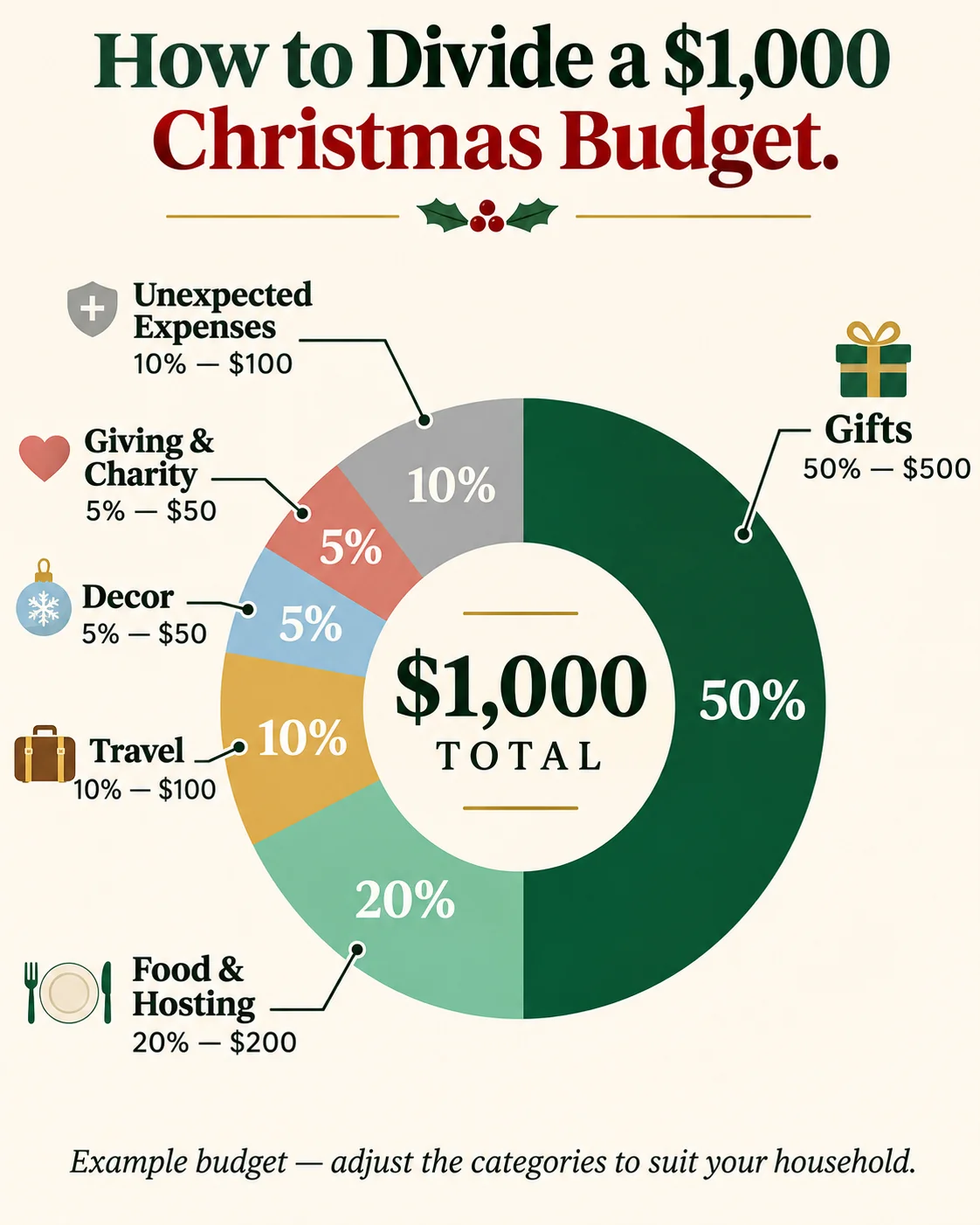
Your percentages will look different depending on your life. If you’re traveling across the country, travel might take a much bigger slice. If you already own plenty of decorations, that line can drop to zero. The point isn’t to follow a formula perfectly; it’s to make sure every dollar has a job before December gets busy.
Don’t skip the buffer. Something unexpected always comes up, whether it’s a forgotten relative, a last-minute party invitation or a gift that costs more than you thought. A buffer keeps those surprises from landing on a credit card.
2. Make a Gift List With a Price Cap for Each Person
Once you know your gift budget, write down every single person you plan to buy for. Then assign each name a maximum amount. Seeing the list on paper often reveals the problem right away: you may be shopping for far more people than your budget can comfortably cover.
Here are a few proven ways to shrink the list without feeling like a Scrooge:
- Secret Santa or a gift exchange: Instead of everyone buying for everyone, each adult in the family draws one name and buys one nicer gift with a set spending limit.
- The 4-gift rule for kids: Something they want, something they need, something to wear and something to read. It keeps gift-giving thoughtful and stops the pile from growing every year.
- Group gifts for coworkers and teachers: Chip in together for one meaningful gift rather than buying many small ones.
- Experience gifts: A homemade dinner, a babysitting coupon or a day trip together can mean more than another object.
If you’re worried about how family will react, keep it simple and honest. You might say: “We’re trying to be more intentional with money this year, so we’d love to do a name draw instead of buying for everyone. Would you be up for that?” You may be surprised how many people feel relieved that someone else said it first.
3. Pay With Cash or Debit, Not Credit
Research and everyday experience agree on one thing: people tend to spend more when they pay with credit than when they hand over cash. Paying with money you can physically see, or watching your debit balance drop, creates a natural brake on spending.
Some ways to make this work:
- The envelope method: Withdraw your Christmas budget in cash and divide it into labeled envelopes for each category. When an envelope is empty, that category is done.
- Digital envelopes: Many banks and budgeting apps let you create separate “buckets” or sub-accounts so you can keep holiday money apart from bill money.
- A separate holiday checking account: Move your entire Christmas budget into its own account with its own debit card. When that account hits zero, you stop.
When is a credit card okay? If you have a strong habit of paying your full statement balance every month, using a card for holiday purchases can earn you rewards and purchase protection. The key is to only charge what’s already sitting in your bank account, and to pay the full balance before interest kicks in. If you aren’t confident you can do that, leave the card at home this season.
4. Be Careful With Buy Now, Pay Later
Buy now, pay later (BNPL) services have become a common checkout option, especially during the holidays. They usually split a purchase into four smaller payments, often with no interest if every payment is made on time. That sounds harmless, and for one carefully planned purchase it can be.
The danger comes from stacking. It’s easy to use BNPL for a toy here, a coat there and a gadget somewhere else, until you have several plans running at once with payments due on different dates. Each payment looks small, but together they can take a big bite out of your January and February budget, right when your regular bills are also due.
Also keep in mind:
- Missed payments can lead to late fees, depending on the provider.
- Some BNPL plans, especially longer ones for bigger purchases, do charge interest.
- Payment activity may be reported to credit bureaus, depending on the provider and its policies.
- Returns can be complicated, since you may still owe payments while a refund is being processed.
Before you click “Pay in 4,” ask yourself:
- Is this item already on my gift list and within its price cap?
- Do I have the full amount in my budget right now?
- How many BNPL plans do I already have open?
- Have I written down every payment date?
If you can’t answer yes to the first two questions, it’s a purchase you can’t afford yet, no matter how it’s split up.
5. Track Every Holiday Purchase in Real Time
Budgets don’t fail all at once. They fail one small, untracked purchase at a time. The fix is simple: write down every holiday expense as it happens, not at the end of the month.
You can use whatever tool you’ll actually stick with:
- A budgeting app that syncs with your bank account
- A simple spreadsheet with columns for date, person or category, store, amount and remaining budget
- A printable holiday spending tracker kept on the fridge or in your planner
Then schedule a quick weekly check-in from Black Friday through December 26. Spend ten minutes comparing what you’ve spent against your plan. If one category is running high, you can adjust early, maybe by trimming the decor budget or simplifying a dinner, instead of discovering the overspending when it’s too late to fix.
6. Shop Smarter, Not More
Holiday sales are designed to make you buy more, not to save you money. A “40% off” sign is only a saving if you were going to buy that item anyway. Here’s how to make sales work for you instead of against you:
- Follow the list rule: Only buy sale items that are already on your gift list. Everything else is extra spending, however good the discount looks.
- Use price tracking: Browser extensions and retailer apps can alert you when an item you want drops in price.
- Stack cashback and rewards: Cashback apps and portals can return a small percentage of what you were already planning to spend. Treat that cashback as a bonus to put toward savings, not as permission to spend more.
- Compare shipping costs: Free shipping thresholds can tempt you to add items you don’t need. Sometimes paying a few dollars for shipping is cheaper than hitting the minimum.
- Consider handmade and edible gifts: Homemade cookies, fudge, spiced nuts or a jar of hot cocoa mix, packed in a pretty tin with a handwritten tag, are thoughtful, personal and usually much cheaper than store-bought gifts. If you need ideas, our collection of Christmas dessert recipes is a great place to start.
Related read: 23 Creative DIY Handmade Christmas Gifts Craft Ideas — ideas for thoughtful gifts without buying expensive presents.
7. Cut the Hidden Holiday Costs
Remember those “small” expenses that quietly add up? Here’s how to bring them under control:
- Travel: Book flights and trains as early as you can, be flexible on dates, and consider driving or carpooling for shorter trips. Traveling on the holiday itself is often cheaper than the days around it.
- Hosting: Turn a big dinner into a potluck where every guest brings a dish. You’ll save money and everyone gets to share their favorite recipe.
- Decor: Reuse what you already have and refresh it with natural touches like pine cones, evergreen branches, oranges and cinnamon sticks. Dollar-store and thrift-store finds can look beautiful with a little creativity.
- Wrapping: Brown kraft paper, newspaper, fabric scraps and reusable gift bags all look charming and cost far less than premium wrapping paper.
- Cards: Send digital cards or a single family photo by email or text instead of printing and mailing dozens of cards.
- Parties: It’s okay to say no to some invitations, or to attend without buying a new outfit for each one.
8. Start a Christmas Sinking Fund for Next Year
The easiest way to avoid next year’s Christmas debt is to start saving for it in January. A sinking fund is simply money you set aside regularly for a known future expense. Since Christmas arrives on the same day every year, it’s the perfect candidate.
Here’s the math: take your total Christmas budget and divide it by 12. If you want to spend $1,200 next Christmas, that’s $100 a month. If you get paid every two weeks, it’s about $46 per paycheck. Set up an automatic transfer to a separate savings account (ideally a high-yield one that earns a little interest) and forget about it until next November.
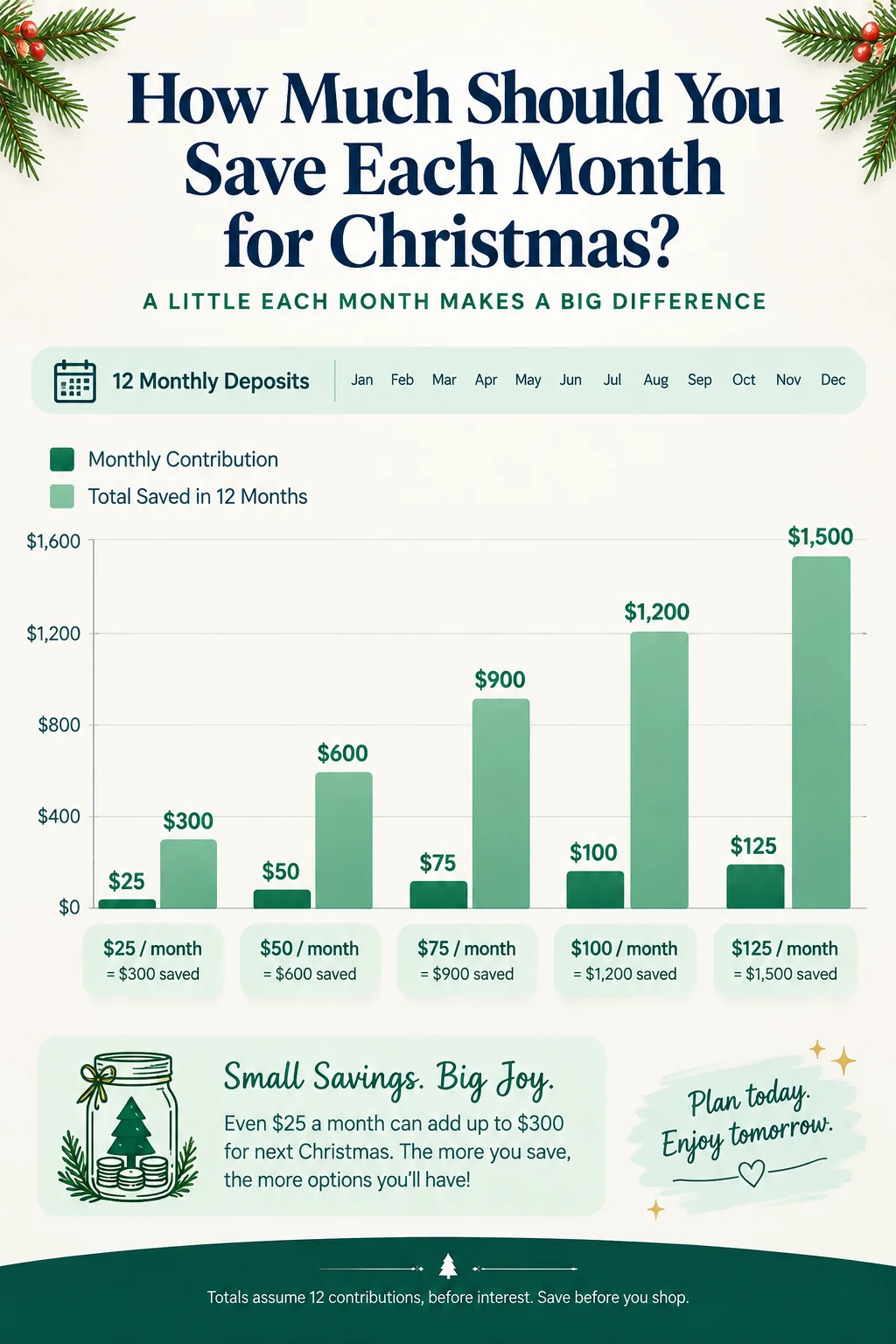
When the holidays come around again, you’ll be shopping with cash that’s already saved, and the January dread will be gone.
Part 2: How to Pay Off Christmas Debt Fast
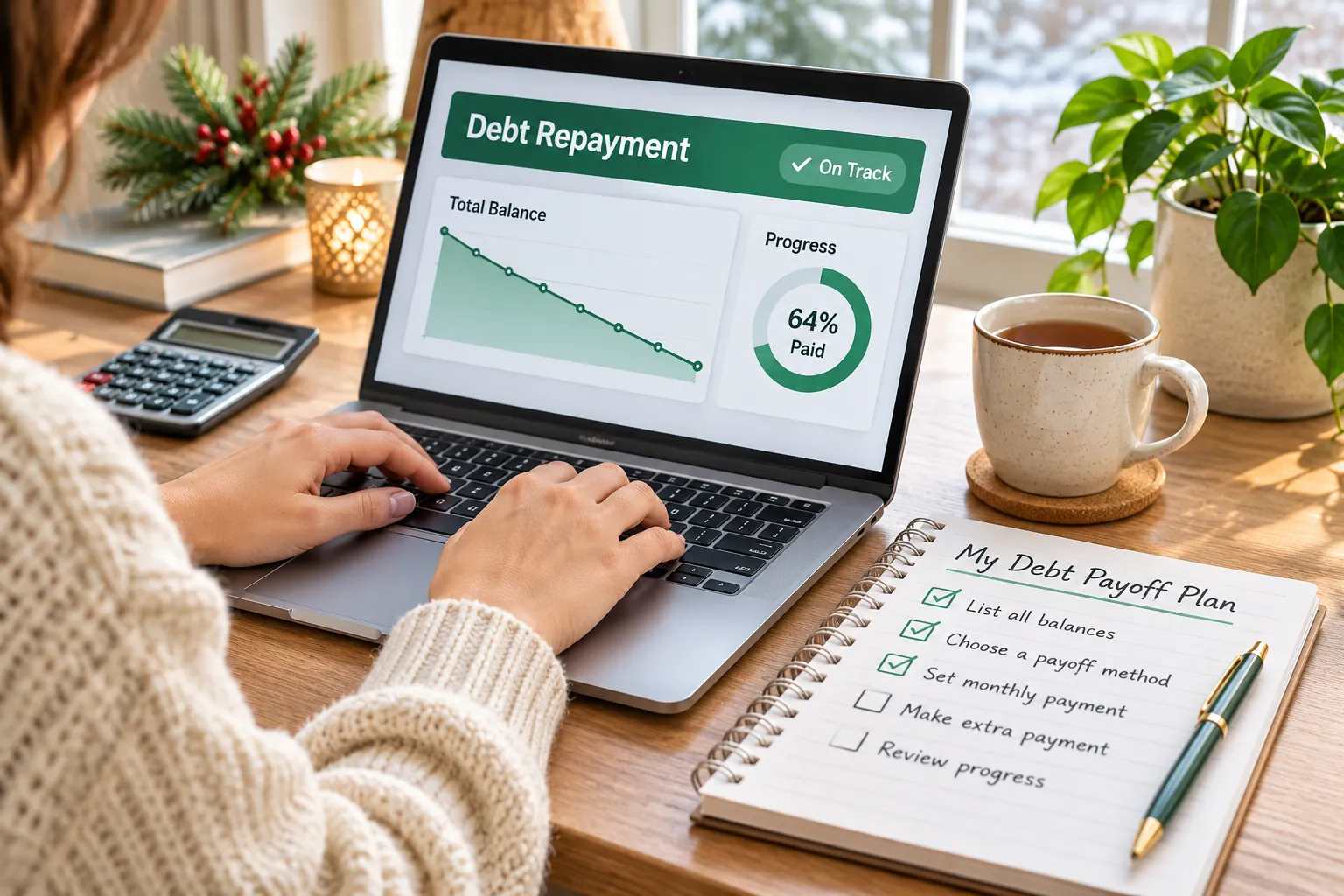
If you’re reading this with a fresh holiday balance, take a deep breath. You’re in the same position as more than a third of shoppers, and this is completely fixable. The goal now is to pay it off as quickly as possible so interest doesn’t turn a one-month problem into a one-year problem. Follow these steps in order.
Step 1: List Every Single Balance
You can’t make a plan for debt you can’t see. Sit down with your statements and apps, and write down every holiday-related balance, including credit cards, store cards and every buy now, pay later plan. For each one, note:
| Debt | Balance | APR | Minimum payment | Due date |
|---|---|---|---|---|
| Example: Store card | $250 | 27% | $25 | 15th |
| Example: Card B | $400 | 18% | $25 | 3rd |
| Example: Card C | $550 | 24% | $25 | 22nd |
| Your debt here |
Seeing the full picture can feel uncomfortable, but it’s also empowering. Now you know exactly what you’re dealing with, and you can make a plan to beat it.
Step 2: Choose Your Payoff Method: Avalanche or Snowball
There are two popular, proven ways to tackle multiple debts. With both, you pay the minimum on every debt, then put all your extra money toward one target debt at a time. When that debt is gone, you roll its payment into the next one.
The debt avalanche targets the debt with the highest interest rate first. Mathematically, this saves you the most money.
The debt snowball targets the debt with the smallest balance first. You get quick wins that build momentum and motivation, which helps many people stick with the plan.
Let’s see both methods in action using the example debts above: a total of $1,200 across three cards, with $150 a month to put toward debt.
| Debt avalanche | Debt snowball | |
|---|---|---|
| Target order | Store card (27%) → Card C (24%) → Card B (18%) | Store card ($250) → Card B ($400) → Card C ($550) |
| First debt paid off | Month 3 | Month 3 |
| Second debt paid off | Month 7 | Month 6 |
| Debt-free | Month 9 | Month 9 |
| Total interest paid | About $107 | About $113 |
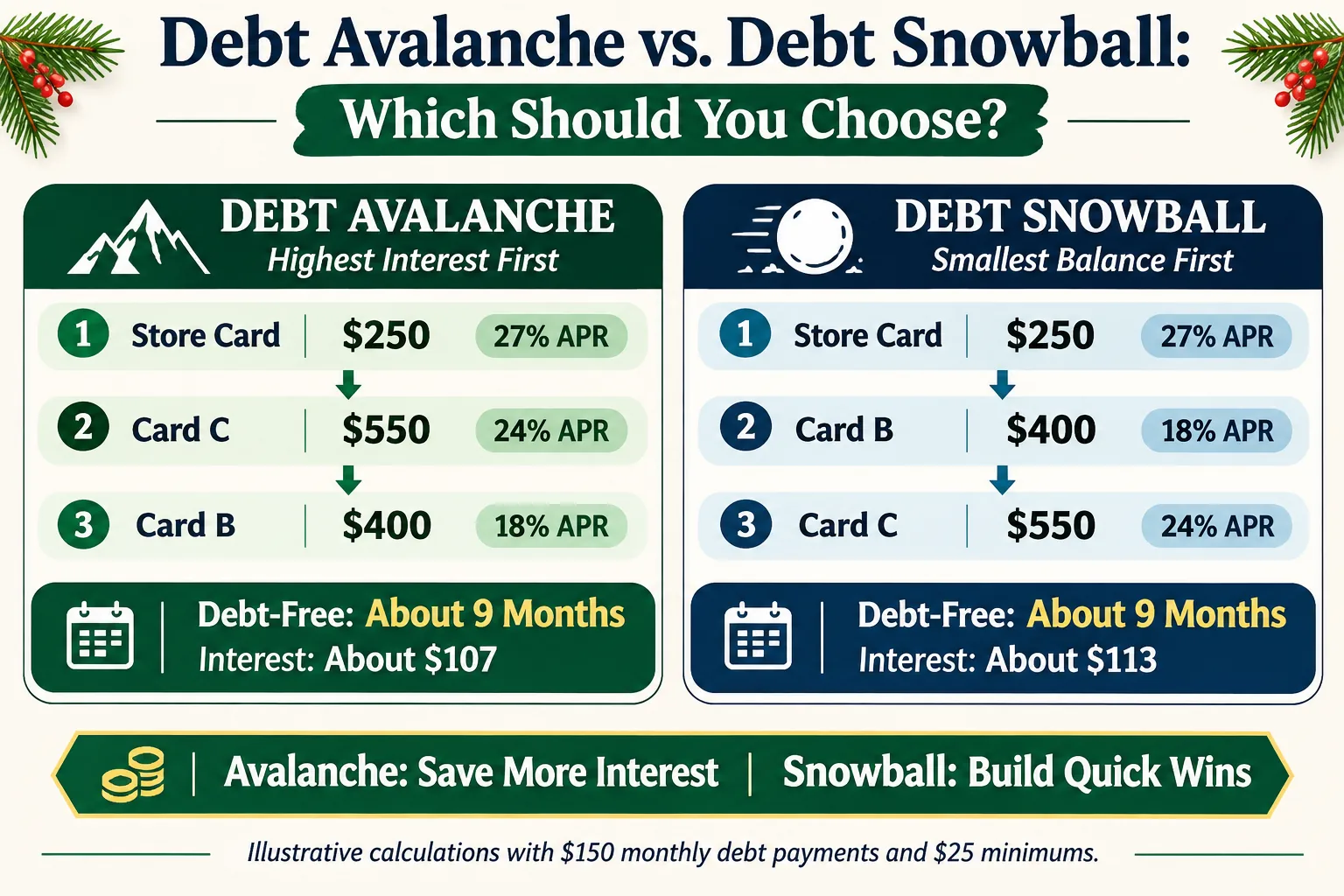
(Illustrative calculations assuming $25 minimum payments and monthly interest.)
In this example, the avalanche saves only a few dollars, while the snowball wipes out a second card a month sooner. With larger balances or bigger gaps between interest rates, the avalanche’s savings grow. So which should you choose?
- Choose the avalanche if you’re motivated by numbers and want to pay the least possible interest.
- Choose the snowball if you’ve struggled to stay motivated with debt before and need to see progress quickly.
Honestly, the best method is the one you’ll stick with. Both are far better than paying only the minimums.
Step 3: Find Extra Money to Throw at Your Debt
The faster you pay, the less interest you’ll owe. Even an extra $50 a month can shave months off your payoff timeline. Here are some realistic places to find it:
- Try a no-spend January: For one month, spend only on true essentials like housing, utilities, groceries, transportation and medicine. Put every dollar you would have spent on extras toward your debt.
- Return or sell unwanted gifts: That duplicate kitchen gadget or sweater in the wrong size can become a debt payment. Online marketplaces make selling easy.
- Cancel subscriptions you don’t use: Streaming services, apps and memberships signed up for during holiday free trials are easy to forget. Cancel the ones you don’t need.
- Use your tax refund: In Credible’s survey, 45% of people planned to use their tax refund to pay off holiday debt. If you expect a refund, decide now that it will go to your balance.
- Put gift money to work: If you received cash or gift cards, consider using gift cards for necessities like groceries and sending the money you save to your debt.
- Pick up short-term extra income: Extra shifts, freelance work, pet sitting, babysitting or selling crafts can all speed things up. Make sure every dollar earned goes straight to debt.
- Trim your grocery bill: Meal planning, cooking at home and using pantry staples you already have can free up a surprising amount each week.
Related read: 27 Christmas Side Hustles to Make Extra Money Before December 25th — practical seasonal income ideas for the holidays.
Step 4: Consider a Lower Interest Rate, Carefully
If your balance is large enough that you can’t pay it off within a few months, lowering your interest rate can make a real difference. There are a few common options, each with trade-offs.
Call your card issuer. It costs nothing to ask. If you have a good payment history, politely ask whether they can lower your APR. Not every request is approved, but some are.
Balance transfer credit cards. Some cards offer an introductory 0% APR on transferred balances for a set period, often 12 to 21 months. This can save a lot of interest, but read the fine print:
- There is usually a balance transfer fee, commonly 3% to 5% of the amount transferred.
- You’ll typically need good to excellent credit to qualify.
- When the promotional period ends, the regular APR applies to any remaining balance.
- A balance transfer only works if you stop adding new charges. Otherwise, you may end up with two balances instead of one.
Debt consolidation loans. A personal loan with a lower fixed interest rate can combine several balances into one predictable monthly payment. This can be helpful for larger amounts, but compare the total cost including any origination fees, and only consider it if the rate is genuinely lower than what you pay now.
Nonprofit credit counseling. If you feel overwhelmed, a reputable nonprofit credit counseling agency can review your situation and may offer a debt management plan. In the U.S., look for agencies affiliated with the National Foundation for Credit Counseling (NFCC).
Every person’s financial situation is different. Compare offers carefully and consider getting professional advice before taking on any new credit product.
Step 5: Protect Your Credit While You Pay
While you’re paying down your holiday balances, keep your credit healthy so you have better options in the future:
- Never miss a minimum payment. Late payments can lead to fees, penalty interest rates and damage to your credit score. Set up autopay for at least the minimum on every account.
- Understand credit utilization. This is the share of your available credit you’re using. High balances relative to your limits can lower your score, so paying balances down tends to help your credit over time.
- Avoid opening several new accounts at once. Each application can result in a hard inquiry on your credit report.
- Don’t add new charges to the cards you’re paying off. Put them away until the balance is zero.
Step 6: Break the Cycle for Next Year
Once your holiday debt is gone, the final step is making sure it doesn’t come back. Go back to Part 1 and start your Christmas sinking fund. Here’s a great trick: when your last holiday debt is paid off, keep making that same monthly payment, but send it to your Christmas savings account instead. You’re already used to living without that money, so you won’t miss it.
Set a few calendar reminders, too: one in July to check your savings progress, one in October to set your Christmas budget and make your gift list, and one in early November to plan your shopping before the sales begin.
Your 30-Day Christmas Debt Payoff Kickstart Plan
Feeling ready to start? Use this simple checklist to build momentum in your first month.
| Week | Focus | Action steps |
|---|---|---|
| Week 1 | Face the numbers | List every balance, APR, minimum payment and due date. Set up autopay for minimum payments. |
| Week 2 | Pick your plan | Choose avalanche or snowball. Decide your fixed monthly debt payment. Make your first extra payment. |
| Week 3 | Find extra cash | Return or sell unwanted gifts, cancel unused subscriptions and start your no-spend challenge. |
| Week 4 | Lock in the habit | Review progress, call your card issuer about a lower rate if needed, and plan your Christmas sinking fund. |
Print it, stick it on your fridge and check off each step as you go. Small actions done consistently are what get you to zero.
Frequently Asked Questions
How much do people usually spend on Christmas?
It varies widely by household, income and family size. Rather than comparing yourself to averages, the most useful number is the one you can pay for with cash you’ll have by December. Start from what you can afford and build your budget from there.
Is it bad to use a credit card for Christmas shopping?
Not if you pay your full statement balance before interest is charged. Used this way, a card can offer rewards and purchase protection. It becomes a problem when you charge more than you have in the bank and carry the balance from month to month.
How long does it take to pay off $1,000 of credit card debt?
It depends on your interest rate and how much you pay each month. As an illustration, at a 22% APR, paying $100 a month would clear $1,000 in about 12 months with roughly $115 in interest. Paying $200 a month would clear it in about 6 months with roughly $60 in interest. Paying only the minimum could take years.
Is buy now, pay later better than a credit card?
It can be cheaper for a single planned purchase if the plan charges no interest and you make every payment on time. But having several plans open at once makes it easy to lose track and overspend. Neither option is a good idea for purchases you can’t actually afford.
Should I use my savings to pay off holiday debt?
Many people choose to keep a basic emergency fund in place first so a surprise expense doesn’t push them back into debt. Savings beyond that emergency cushion can often be put to better use paying off high-interest debt, since card interest is usually much higher than what savings accounts earn. Your situation may differ, so weigh your own needs.
How can I start saving for next Christmas in January?
Decide on next year’s total budget, divide it by 12 and set up an automatic monthly transfer to a separate savings account. Even small amounts add up: $50 a month becomes $600 by December.
Sources and Further Reading
- LendingTree: 2025 holiday debt survey — holiday debt prevalence and amounts.
- LendingTree: 2024 holiday debt survey — borrowing expectations and interest-rate distribution.
- Credible: Holiday spending statistics — reasons for holiday debt and repayment plans (survey conducted December 2025; article updated January 2026).
- Consumer Financial Protection Bureau: Buy now, pay later fees — fees and repayment risks.
- National Foundation for Credit Counseling — nonprofit credit counseling resources.
Final Thoughts: A Merry Christmas Without the January Hangover
Christmas should be remembered for laughter, good food and time with the people you love, not for a credit card bill that follows you into the new year. Avoiding holiday debt comes down to a few simple habits: decide on your total number first, give every gift a price cap, pay with money you actually have, track as you go and start saving early for next year.
And if you’ve already overspent, don’t be hard on yourself. List your balances, pick the avalanche or snowball method, find a little extra money each month and stay consistent. You could be completely debt-free in a matter of months, ready to enjoy next Christmas with savings in the bank.
Save this guide to your Pinterest budgeting board so you can come back to it before your next holiday shopping trip, and share it with a friend who could use a calmer, debt-free Christmas this year.