
Buying your first home can be exciting right up until the big questions arrive: How much can you comfortably afford? What credit score will a lender consider? What will you need besides a down payment? And how do you know a house is the right one before making an offer?
The best time to answer these questions is before you begin touring homes. This first-time home buyer checklist walks you through 25 practical steps, organized into five phases: money, credit, mortgages, priorities and the people who can help you buy. Use it to prepare without rushing into a payment you may regret.
This article covers home buying in the United States. It is for general educational purposes, not individualized financial, legal, tax or mortgage advice. Loan eligibility, costs and real estate rules vary by lender, state and property. Confirm details with qualified professionals before making commitments.
According to the National Association of REALTORS® 2026 report, first-time buyers accounted for 22% of home purchases, their median age was 40, and their median down payment was 9%. These numbers are a useful reminder that there is no single right age or savings amount for buying your first home.
The Five Phases of Buying Your First Home
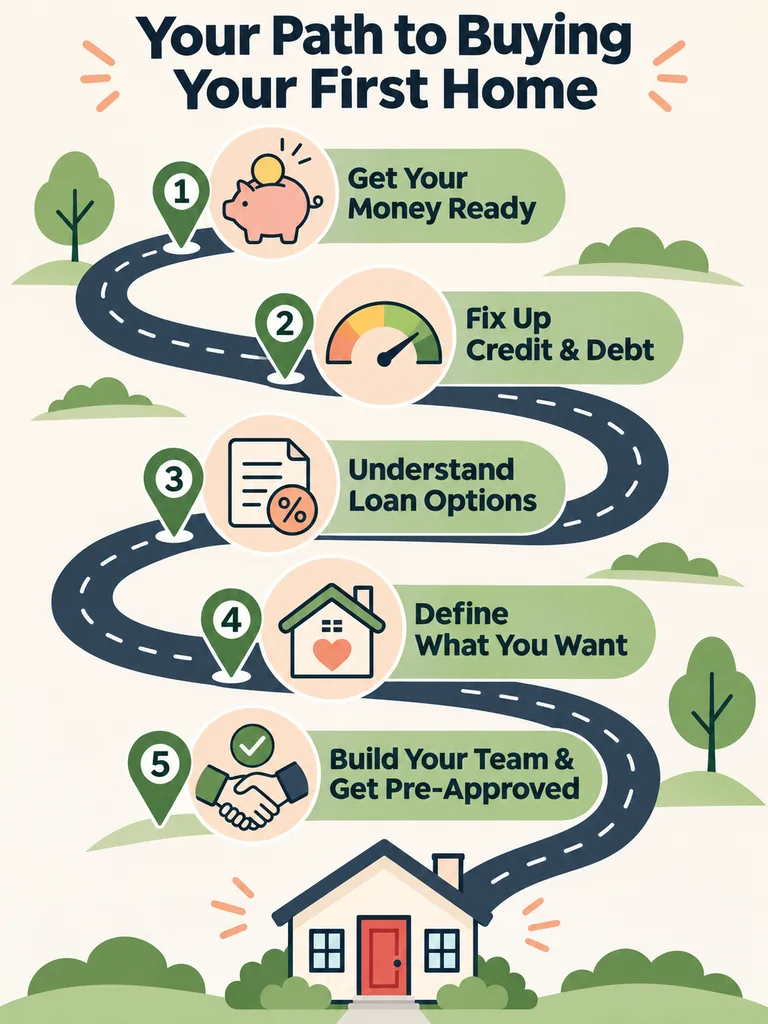
These five phases give you a straightforward order for planning. You can revisit earlier steps as your home search, savings or mortgage options change.
- Get your money ready (Steps 1–6): Set a comfortable housing budget and save for the down payment, closing costs and emergencies.
- Improve credit and organize debt (Steps 7–11): Review your credit reports, calculate debt-to-income ratio and collect documents.
- Understand mortgage choices (Steps 12–15): Compare loan types, interest-rate structures, assistance programs and lenders.
- Decide what home fits your life (Steps 16–21): Set priorities, study neighborhoods and identify deal-breakers.
- Build your team (Steps 22–25): Get pre-approved, understand agency agreements, find an inspector and organize home tours.
Phase 1: Get Your Money Ready
Before shopping for houses, work out how buying will affect your everyday cash flow. A lender’s approval amount is useful information, but it is not your personal spending target.
1. Decide on a Monthly Budget You Can Actually Live With

Start with the amount you can comfortably spend on housing each month while still paying other bills and saving. Include not just the loan’s principal and interest, but also estimated property taxes, homeowners insurance, applicable mortgage insurance, HOA fees, utilities and a maintenance allowance.
For example, a household bringing home $5,000 a month might decide that around $2,000 in total housing-related costs works for its budget. Another household with the same income but expensive childcare or student loans may need a lower number. The familiar 28% of gross income housing guideline can be a rough screening tool, but it is not a universal affordability rule or a lender guarantee.
Your action: Write down a comfortable monthly total and a firm ceiling. Use the comfortable number—not the maximum loan amount—as the starting point for your search.
2. Save for the Down Payment You Need, Not an Imaginary 20%
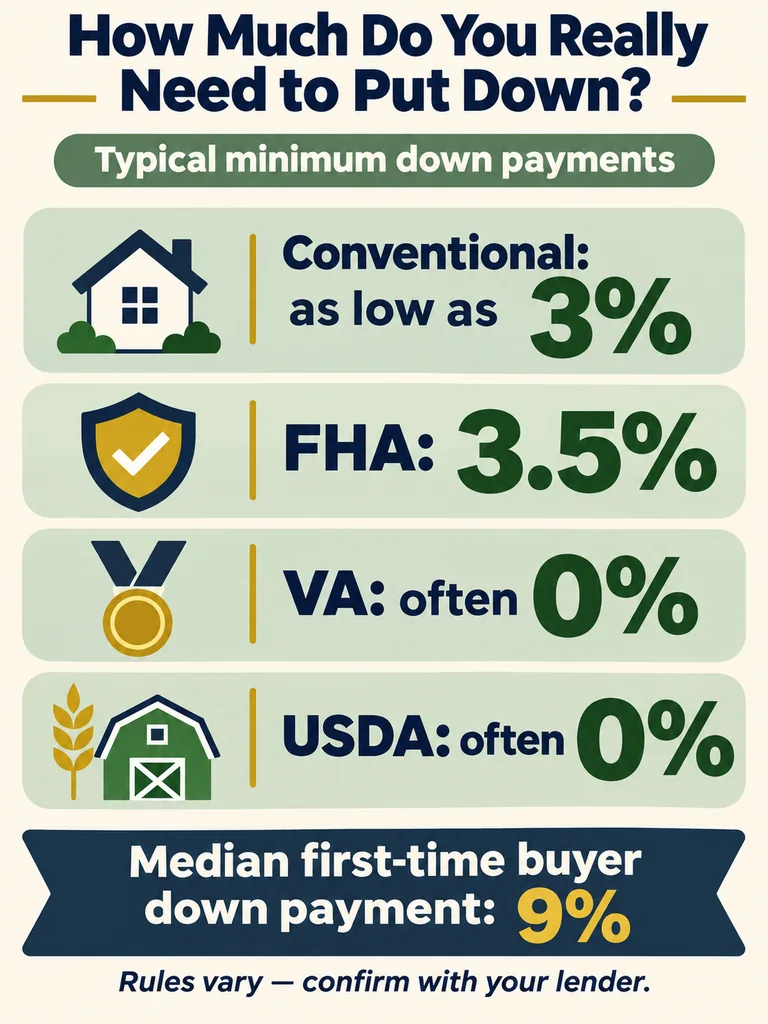
You do not always need a 20% down payment. Some conventional mortgage programs allow eligible borrowers to put down as little as 3%. Certain FHA loans allow 3.5%, while eligible VA and USDA loans may require no down payment. Qualification, property restrictions, insurance and other loan costs still apply. A 0%-down loan is not necessarily a zero-cash-to-close purchase.
The 9% median first-time buyer down payment reported by NAR in 2026 is what buyers actually paid in that survey; it is not a required minimum or the best target for everyone. A larger down payment can reduce the loan balance, but using up every dollar of savings can leave you vulnerable after you move in.
Your action: Pick a realistic home-price range, compare your eligibility across loan programs and set an automatic savings transfer. Saving $200 each month adds $2,400 to your house fund over a year, before any interest.
3. Budget for Closing Costs Separately
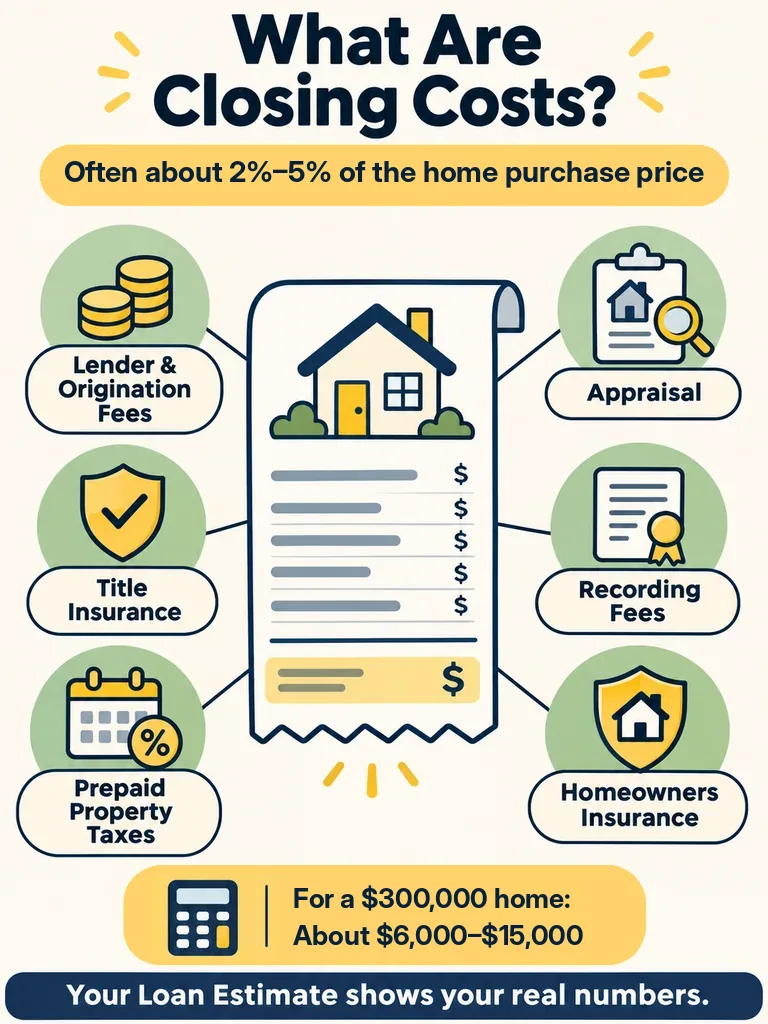
Closing costs include expenses such as lender origination charges, appraisal and title services, recording charges, prepaid taxes and homeowners insurance. As an early planning estimate, the Consumer Financial Protection Bureau (CFPB) says they typically run around 2%–5% of the home’s purchase price, excluding your down payment. Your actual expenses depend on the location, lender, loan, purchase contract and taxes.
For a $300,000 home, that rough range is $6,000–$15,000. Ask about possible seller credits, but do not assume the seller will pay. You may also pay earnest money earlier in the process; that deposit generally counts toward what you owe at closing rather than becoming a completely separate expense.
Planning note: Use the purchase price, rather than the amount borrowed, when applying this early 2%–5% closing-cost estimate. The actual amount will be shown in your loan documents.
4. Keep an Emergency Fund After Your Purchase
A down payment should not consume the cash you need for medical expenses, job interruptions or a broken appliance. Homeowners are responsible for repairs a landlord would ordinarily handle. A reserve of three to six months of essential living expenses is a useful longer-term planning goal, although the right amount varies by circumstances.
If that is not realistic yet, begin with a smaller reserve and a clear plan to replenish it. Some mortgage programs also have their own cash-reserve requirements, which are separate from what you personally need to feel secure.
Your action: Keep an emergency-fund target separate from down payment and closing-cost accounts. Do not count money that you will need immediately after closing as available for the down payment.
5. Prepare for Moving and First-Month Expenses
Moving can mean truck rental, professional movers, boxes, storage, deposits, cleaning, locks, curtains and utility setup. You may also need appliances, basic tools or safety repairs. These are ordinary costs, not failures of your budget.
Make a list of essentials you must purchase immediately and items that can wait. If you are purchasing a larger property, request utility estimates and price the upkeep before you move. A modest move-in fund can prevent you from adding credit card debt right after closing.
Your action: Add a separate moving-and-setup line to your cash savings target. Try not to finance furniture or a car while your mortgage application is underway.
6. Calculate the Full Monthly Cost of Owning
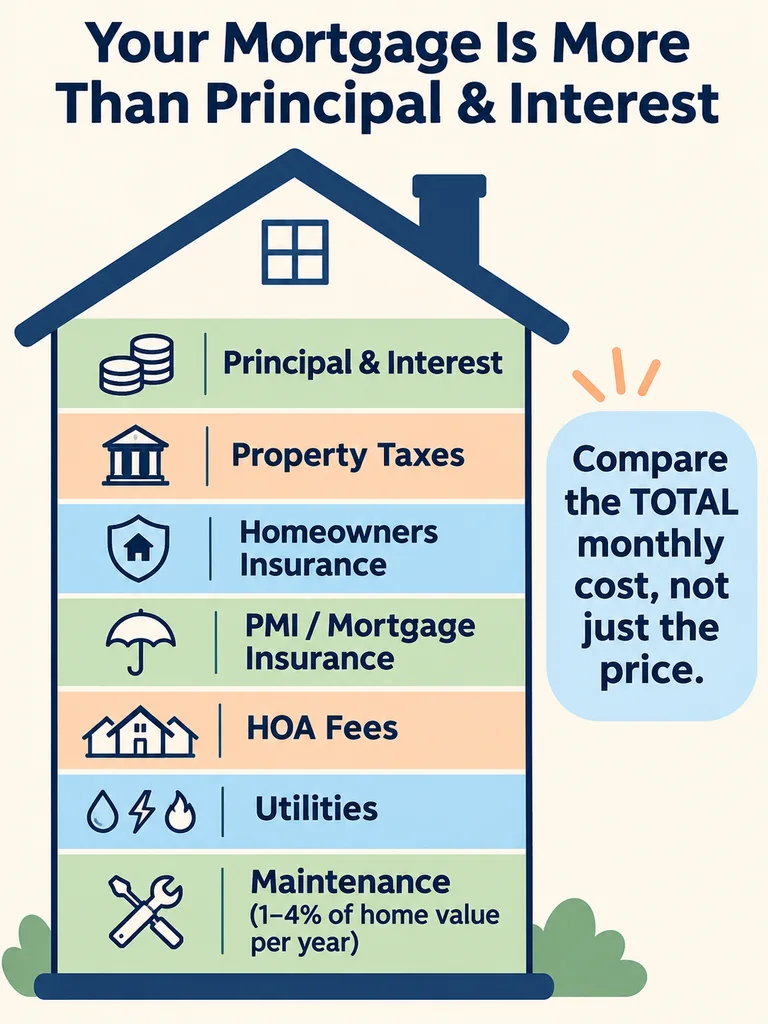
A mortgage’s principal-and-interest amount is only part of a homeowner’s real monthly expense. Property taxes and homeowners insurance may be paid through escrow; mortgage insurance may also be required. HOA dues, utilities and routine maintenance are additional ownership costs that are not always included in the lender’s advertised payment.
For an illustrative home budget, imagine $1,800 for principal and interest, $300 for taxes, $140 for homeowners insurance, $120 for mortgage insurance, $200 for utilities and $300 set aside for maintenance. That totals $2,860 per month, before any HOA fee. The amounts are hypothetical, not a local quote or forecast.
On many conventional loans, PMI can eventually be canceled when specific requirements are met. FHA mortgage insurance has different rules and often lasts longer; eligible VA loans generally do not require monthly mortgage insurance. Compare all these costs before deciding which loan is cheaper.
Your action: Make an all-in monthly estimate for every potential home, including an allowance for rising insurance premiums, taxes and repairs.
A Realistic Savings Example for a $300,000 Home
Here is one simple preparation scenario for a buyer targeting a $300,000 property with a 5% down payment. The figures do not represent a loan offer.
| Expense | Illustrative amount |
|---|---|
| Purchase price | $300,000 |
| 5% down payment | $15,000 |
| Estimated closing costs, 2%–5% of purchase price | $6,000–$15,000 |
| Down payment plus closing costs | $21,000–$30,000 |
| Moving costs and emergency savings | Additional funds needed |
The total above is an initial cash-planning range, not your final cash-to-close figure. Your Loan Estimate and, later, Closing Disclosure will provide transaction-specific estimates and actual figures. Earnest money already paid and negotiated credits can affect the balance due at closing.
Phase 2: Improve Your Credit and Organize Your Debt
Good mortgage preparation is not about achieving a perfect credit score. It is about understanding what lenders may see, correcting errors and avoiding surprises while they review your finances.
7. Review All Three Credit Reports
Visit AnnualCreditReport.com, the authorized source for free credit reports from Equifax, Experian and TransUnion. Check for accounts you do not recognize, incorrect balances, late payments reported in error and outdated personal information.
If you find an error, dispute it through the credit bureau and the company furnishing the information. Allow time for investigation and resolution before applying. A credit report and a consumer credit score are not the same thing, and the score a mortgage lender uses may differ from the one displayed in a banking app.
Your action: Save a copy of each report and record any items you need to correct. Checking your own report does not hurt your score.
8. Learn What Matters for Your Mortgage Credit Assessment
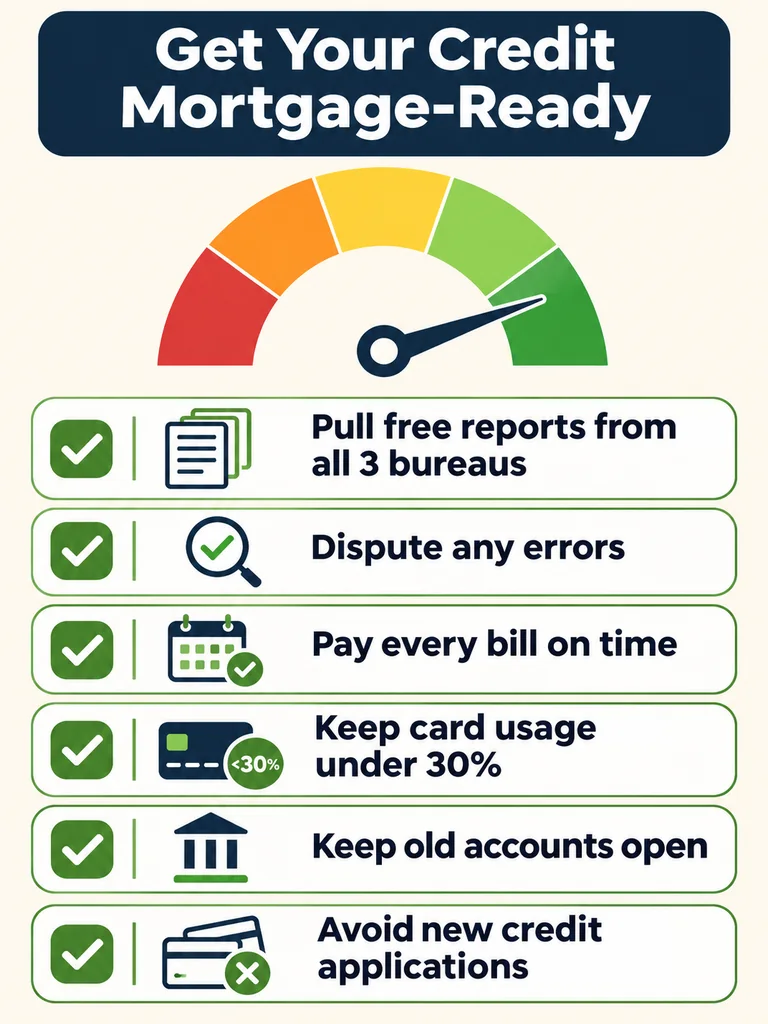
A credit score can affect your interest rate and loan options, but there is no single minimum score for every conventional mortgage. Since November 2025, Fannie Mae’s Desktop Underwriter system has not imposed a minimum third-party credit score on loans evaluated through that system. Manually underwritten loans and individual lenders may still have score requirements; other loan programs follow their own standards.
Paying bills on time, reducing revolving credit balances and avoiding unnecessary new applications remain sensible steps. The “under 30%” credit-card usage guideline in the infographic is a common rule of thumb, not a magic cutoff: lower utilization can sometimes help, and the effect varies.
Your action: Ask prospective lenders which loan programs and underwriting methods they use, and whether their own requirements are stricter than the program minimums.
9. Calculate Your Debt-to-Income Ratio Before Applying
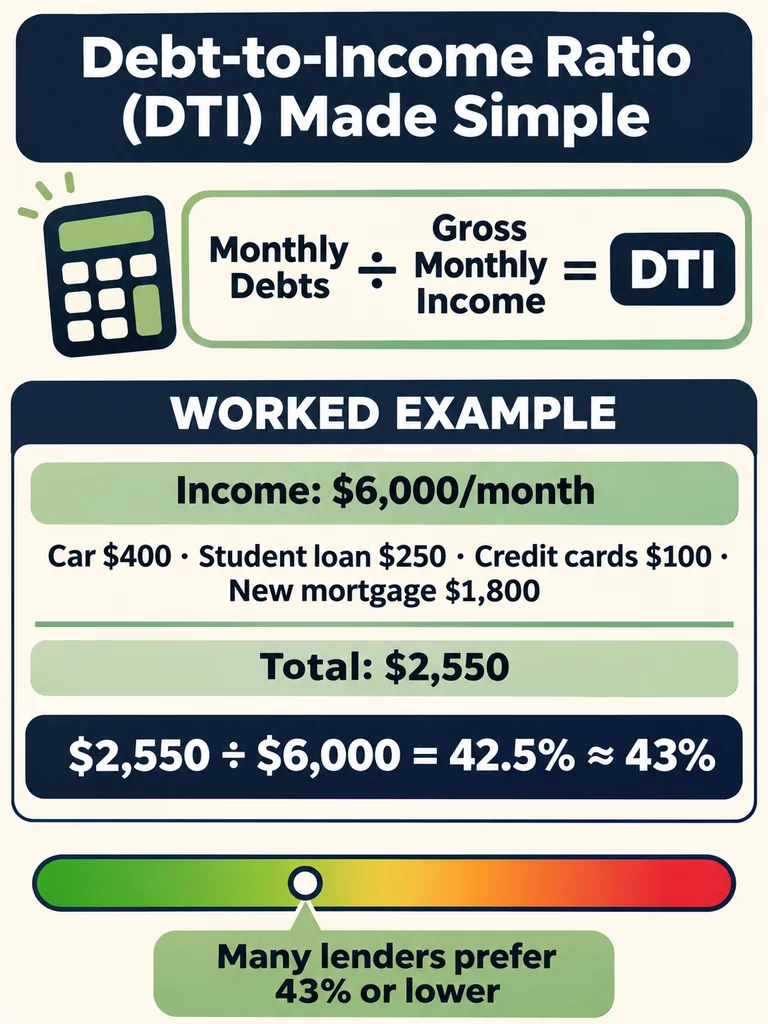
Your debt-to-income ratio, or DTI, compares monthly required debt payments—including a proposed housing payment—with your gross monthly income. Lenders use it as one factor in deciding whether a loan is manageable.
Suppose your income before taxes is $6,000 per month. You pay $400 toward a car loan, $250 toward a student loan and $100 in required credit card payments. Add a proposed housing payment of $1,800 and your total required monthly obligations become $2,550. The calculation is $2,550 ÷ $6,000 = 42.5%.
The infographic uses 43% as an easy reference point, but 43% is not a universal mortgage limit or guaranteed approval threshold. Acceptable DTI depends on the loan program, underwriting findings and lender requirements. A stronger credit history, more reserves or a smaller loan may also matter.
Your action: Calculate your own DTI using realistic housing costs, then ask a lender to verify which payments and income count for your chosen program.
10. Avoid Big Financial Changes Until Closing
Large purchases, new vehicle loans, personal loans, co-signing, unexplained deposits or opening several credit accounts can change your mortgage application even after you receive a pre-approval letter. Lenders may recheck employment, debts or credit before closing.
Do not assume that every job change is disqualifying, but discuss a planned move, income change or unusual transfer with your lender first. Keep documentation for gifts and large account transfers. Delay buying new furniture on credit until the purchase is complete.
Your action: Keep your finances stable and notify your loan officer before making a change that could affect your application.
11. Gather the Documents a Lender May Request
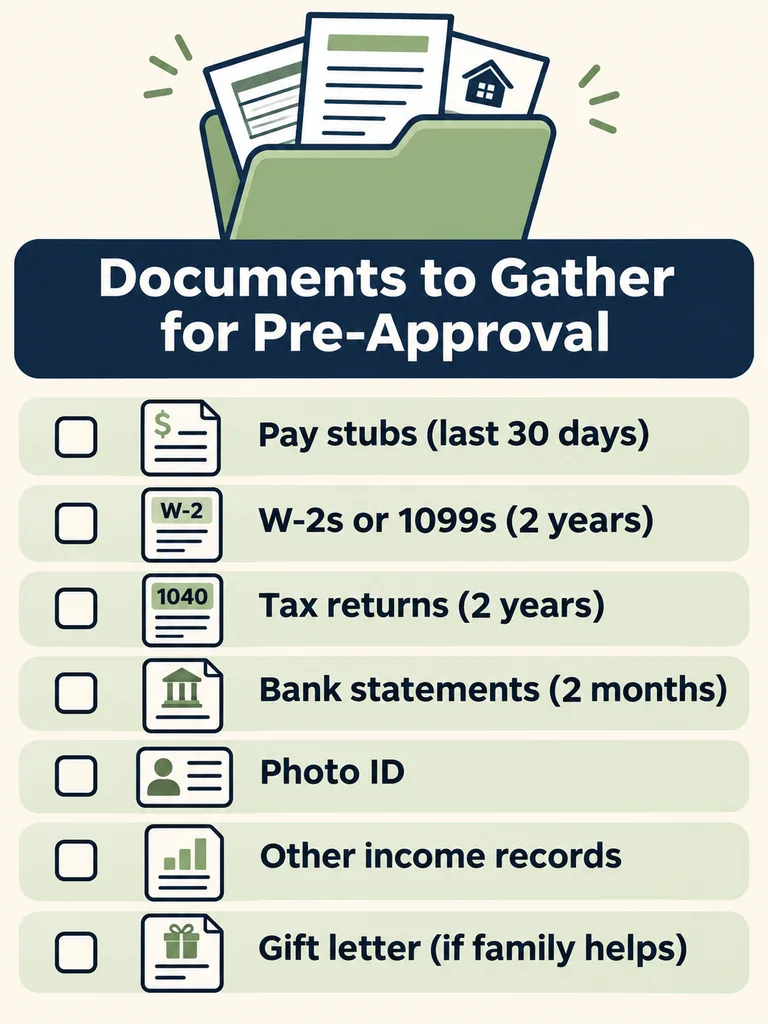
Organize recent pay stubs, W-2 or 1099 forms, tax returns when applicable, bank and investment statements, identification and any records supporting other qualifying income. If a family member is gifting funds, ask the lender about the necessary gift letter and proof of transfer. Self-employed buyers may need business or additional tax documents.
The checklist infographic is a useful preparation guide, but every applicant will not need every document shown. A lender may ask for different records based on employment type, loan program and underwriting findings. Importantly, the CFPB says lenders generally cannot demand income-verification documents as a condition for issuing a Loan Estimate once you have provided the six required application details.
Your action: Keep digital copies in a secure folder, and send sensitive documents only through a verified lender’s secure process.
Phase 3: Understand Your Mortgage Options
The cheapest-looking interest rate is not always the cheapest mortgage. Compare total borrowing costs, required cash, mortgage insurance and how long you expect to live in the home.
12. Compare the Four Common Home Loan Types
| Loan type | Possible down payment | Important considerations |
|---|---|---|
| Conventional | As low as 3% for qualifying programs | Eligibility varies; PMI is often needed below 20% down |
| FHA | As low as 3.5% for qualifying applicants | FHA mortgage insurance applies; county loan limits and other requirements apply |
| VA | Often 0% for eligible borrowers | Military-service eligibility; possible funding fee; no monthly PMI |
| USDA | Often 0% for eligible borrowers and properties | Household income and qualifying location restrictions; program fees apply |
Ask lenders to price more than one loan type when you qualify. A smaller down payment may preserve savings but increase borrowing costs. FHA and conventional loans can price differently depending on credit and down payment; VA and USDA programs are not open to every property or buyer.
Your action: Write down the loan type, required cash, monthly payment and total estimated costs for each serious option.
13. Understand Fixed-Rate and Adjustable-Rate Mortgages
A fixed-rate mortgage keeps the same interest rate on principal and interest over the loan’s term. A 30-year fixed-rate loan generally has a lower monthly principal-and-interest payment than a comparable 15-year loan, but can result in more total interest over time. Taxes and insurance can still change.
An adjustable-rate mortgage (ARM) may offer an introductory fixed-rate period, after which the rate can rise or fall under the loan’s terms. Ask about the first adjustment date, rate caps, index, margin and maximum possible payment. Do not choose an ARM solely because you expect to refinance later; refinancing may be unavailable or expensive.
Your action: Compare the initial payment, worst-case future payment and total costs under plausible scenarios.
14. Search for Down Payment Assistance Before Choosing a Loan
State housing finance agencies, local governments and eligible nonprofit programs may provide grants, forgivable loans, deferred-payment second mortgages or favorable financing. Some restrict income, purchase price or property location; others require a homebuyer education course or repayment if you sell early.
Start with your state’s housing finance agency and HUD-approved housing counseling resources. Compare the assistance’s actual terms, not just the headline grant amount. The program may affect which lender or mortgage product you can use.
Your action: Check eligibility early, before paying for an application or committing to a particular lender.
15. Shop With at Least Three Mortgage Lenders
Compare a bank, credit union and mortgage lender or broker. Ask each for a comparable quote based on the same purchase price, down payment, loan type and assumed closing timeline. Compare the annual percentage rate (APR), interest rate, points, lender fees, mortgage insurance, estimated cash to close and whether the rate is locked.
There is an important difference between an early pre-approval quote and a formal Loan Estimate. Under CFPB rules, a lender generally must issue a Loan Estimate within three business days after receiving six application details: your name, income, Social Security number, property address, estimated property value and desired loan amount. Before you choose a property, you can compare preliminary lender offers, but the formal disclosure timing may not yet apply.
The CFPB’s lender comparison guidance also explains why mortgage-rate shopping within a focused time window generally avoids repeated score penalties under common scoring models.
Your action: Keep copies of quotes and Loan Estimates, ask what can change and compare the same terms side by side.
Phase 4: Define the Home and Neighborhood That Fit Your Life
After setting your financial boundaries, make sure the houses you tour fit your daily life—not just your saved listings.
16. Separate Must-Haves From Nice-to-Haves
Decide which features are non-negotiable: commute, number of bedrooms, accessibility, outdoor space, parking or a suitable layout. Put cosmetic preferences such as paint colors and light fixtures in a separate column. Many cosmetic changes can happen later, but a location or cramped floor plan is harder to fix.
If you are buying with someone else, agree on priorities in advance. Otherwise, you may spend weeks touring properties that one of you would never consider.
Your action: Keep your must-have list short and rank the items from most to least important.
17. Choose a Home Type With Eyes Open
Single-family homes often offer more independence but put more maintenance on you. Condominiums may have shared amenities and exterior maintenance arrangements, but HOA costs and rules can be significant. Townhomes vary in whether you own the land and what the association covers. Fixer-uppers may require major repairs and financing choices beyond a standard purchase loan.
Review association budgets, reserve studies and potential special assessments where applicable. An attractive listing price can hide substantial monthly dues or repair obligations.
Your action: Compare total ownership responsibilities, not only the asking price.
18. Research Neighborhoods at Different Times of Day

The same home can feel different at 8 a.m., 5 p.m. and after dark. Test the route to work during your normal commute. Look at grocery stores, parks, public transport and services that matter to your household. Check official property-tax information and seek independent details about schools if those are part of your plans.
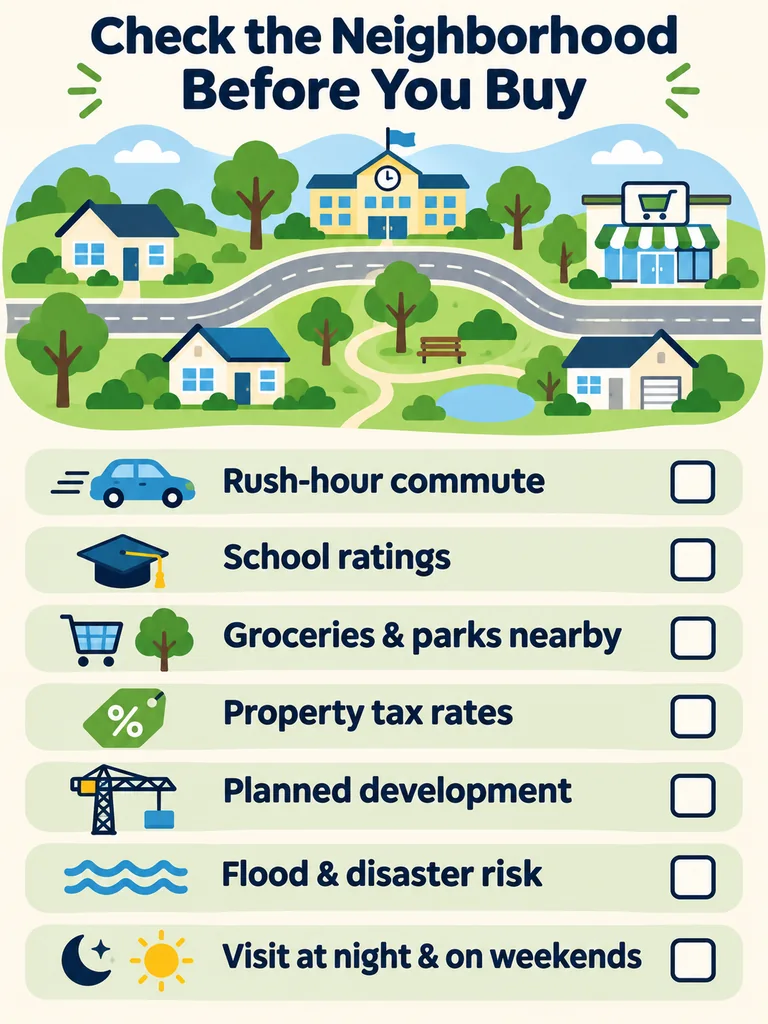
Review flood maps and other local disaster risks before you fall in love with a property. Insurance availability and cost may affect affordability, even when the mortgage payment seems reasonable. Ask about planned development, traffic changes and local restrictions. No neighborhood is risk-free, but knowing the trade-offs helps you make a better choice.
Your action: Visit shortlisted neighborhoods on both a weekday and a weekend, and compare findings with your original priorities.
19. Think About the Next Five to Ten Years
A home may need to accommodate a career change, remote work, a growing family, aging relatives or pets. At the same time, buying far more space than you can comfortably maintain creates unnecessary expenses. Selling soon after buying may involve commissions, transaction costs and market risk.
Do not predict your whole future. Think instead about which changes would make the home still workable and which would require you to move.
Your action: Identify two or three likely lifestyle changes and test how each property would handle them.
20. Learn the Local Market Instead of Trusting Asking Prices
Track recent comparable sales, property condition, time on market and price reductions. A list price is a seller’s asking number, not a verified market value. Ask an experienced local agent to explain comparable sales and what is unusual about each property.
Prices, inventory and negotiation leverage vary across cities and even adjacent neighborhoods. National housing headlines cannot tell you what a particular house is worth.
Your action: Build a comparison sheet of recent sales for the type of home you want, using similar size, age, condition and location.
21. Decide Your Deal-Breakers Before Touring
Write down the conditions that would make you walk away: an unaffordable total payment, structural concerns you cannot resolve, unacceptable flood exposure, restrictive HOA rules, accessibility problems or a commute that does not work. Decide which concerns require expert review rather than a quick judgment.
It is easier to honor a limit when you wrote it before entering a beautifully staged living room.
Your action: Revisit your deal-breakers before every offer and document any reason you choose to make an exception.
Phase 5: Build Your Buying Team and Prepare to Tour Homes
A reliable team can help you move efficiently without giving up essential safeguards. You remain the person responsible for deciding what you can afford and which risks to accept.
22. Request a Meaningful Mortgage Pre-Approval
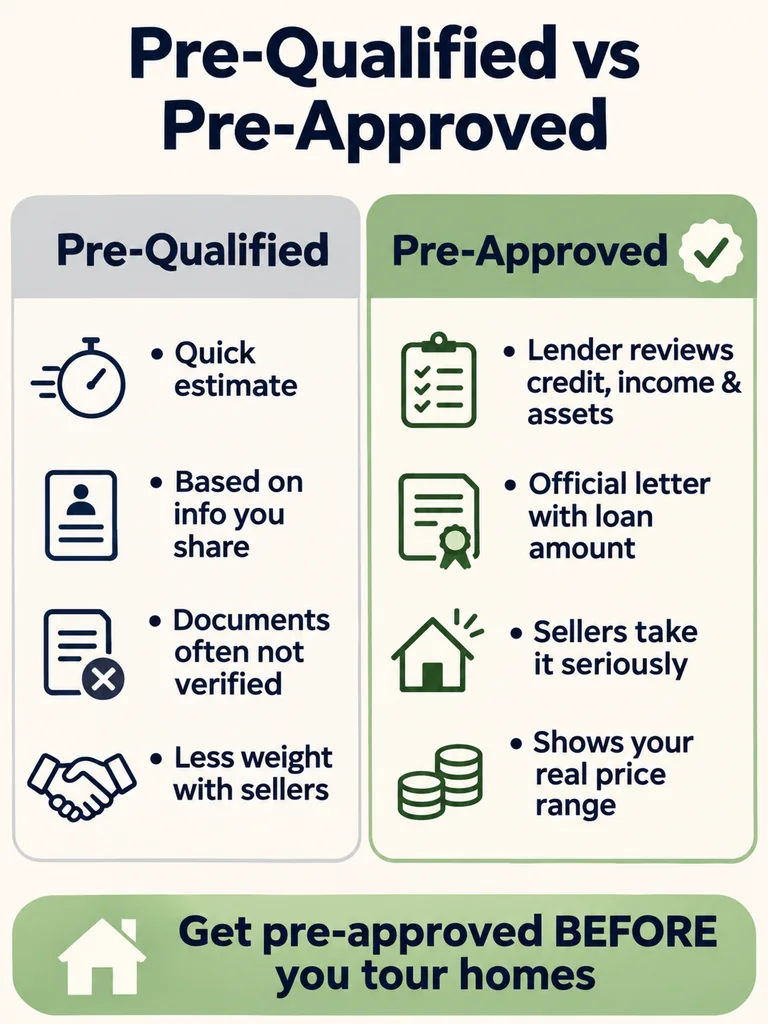
The terms pre-qualified and pre-approved are used differently by lenders. Typically, pre-qualification is an early estimate based largely on information you supply. Pre-approval usually involves a more thorough look at credit, income, assets and debts and may result in a letter indicating a potential loan amount.
Neither is a final loan commitment. Final approval can depend on the property, appraisal, title, updated finances and underwriting conditions. A pre-approval letter can strengthen an offer, but do not use its maximum amount as your budget.
Your action: Ask what your lender actually verified, when the letter expires and which conditions remain before final approval.
23. Interview Buyer’s Agents and Understand the Agreement
A good buyer’s agent can explain local prices, tour properties with you, organize offers and coordinate negotiations. Ask about experience with first-time buyers, availability, local knowledge and how the agent will be compensated. Agent fees are negotiable; do not assume who pays them without reviewing the agreement and purchase terms.
Under rules affecting many real estate professionals working with buyers, a written buyer agreement is generally needed before touring a property with that agent. However, you do not ordinarily need to sign a buyer representation agreement simply to attend an open house on your own. Read the agreement’s term, services, exclusivity, termination provisions and compensation before signing.
Your action: Interview at least two agents, request a copy of the agreement ahead of time and ask questions about any clause you do not understand.
24. Find a Qualified Home Inspector Early

A home inspection can identify signs of defects in the roof, foundation, structure, plumbing, electrical systems or heating and cooling. Inspectors cannot see every hidden problem, and an appraisal is not the same as a home inspection. Licensing rules vary by state, so check qualifications, insurance, reviews and sample reports.
Ask whether specialist inspections may be appropriate for termites, radon, sewer lines, septic systems, wells or other property-specific concerns. Inspection contingencies can protect you, but contract deadlines may be short, so find potential inspectors before you write an offer.
Your action: Keep contact details for qualified inspectors and discuss inspection contingencies with your agent before submitting a contract.
25. Build a Practical House-Hunting Checklist
Bring your must-have list, a notes app or printed worksheet, questions for the seller or agent and a tape measure. If permitted, photograph important rooms and features so listings do not blur together. Pay attention to odors, visible stains, grading, drainage and the age or condition of major systems without treating a quick walkthrough as an inspection.
After each tour, record the asking price, estimated monthly ownership cost, condition, positives, concerns and your overall impression. Comparing the same categories for every house is more useful than trying to remember which kitchen you liked best.
Your action: Rate each home soon after leaving, and revisit your spending ceiling before scheduling a second tour or writing an offer.
Seven First-Time Home Buyer Mistakes to Avoid
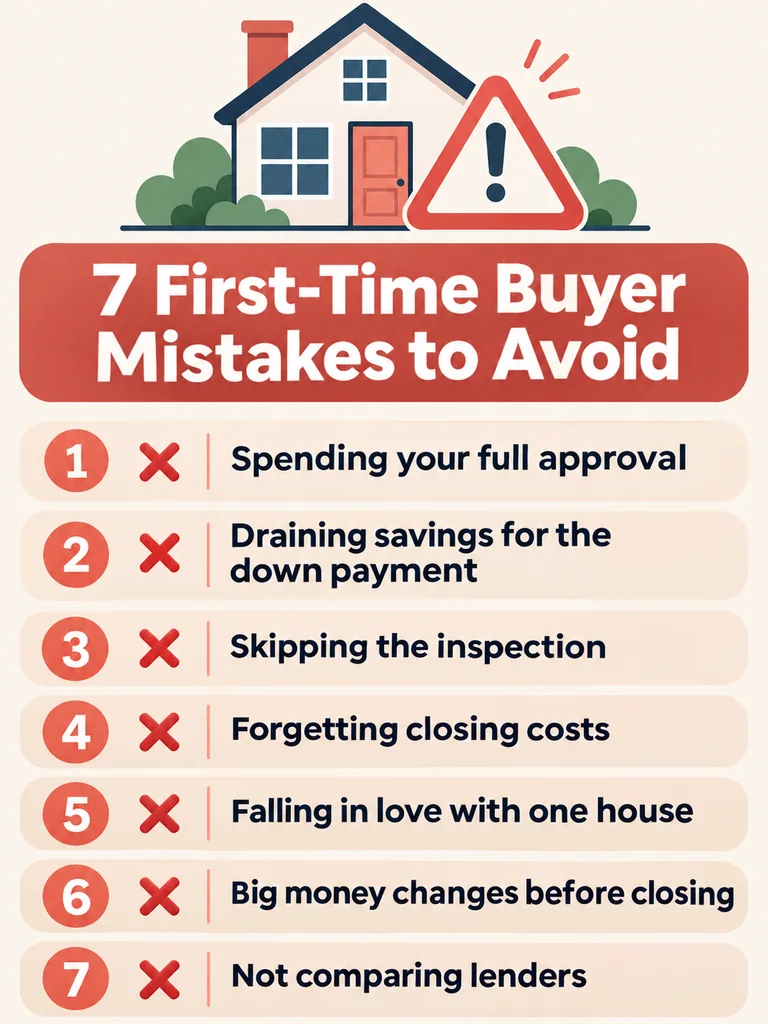
A few avoidable decisions can make a first home considerably more expensive. Use these seven warnings as a final check before making an offer.
- Treating the maximum pre-approval as your personal budget. The lender’s ceiling does not include all your goals and spending priorities.
- Using every dollar of savings for the down payment. Set aside money for closing costs, moving, repairs and emergencies.
- Skipping due diligence to win an offer. Understand the consequences before waiving inspections or other protections.
- Ignoring taxes, insurance, mortgage insurance and HOA dues. Compare the full monthly ownership cost.
- Letting one dream house override your limits. A beautiful home is not a bargain if it leaves you financially stretched.
- Changing jobs or taking on new debt without talking to your lender. These changes can affect financing late in the process.
- Accepting the first mortgage quote. Comparing realistic offers is one of the most useful ways to control borrowing costs.
Frequently Asked Questions
How much should a first-time buyer save before shopping for a house?
Start with your likely down payment, a rough 2%–5% of purchase price for closing costs, plus moving and emergency savings. For a $300,000 home and 5% down, the down payment and estimated closing costs together could be around $21,000–$30,000 before reserves and moving expenses. Programs, seller credits and actual closing charges can change the result.
Do first-time buyers need a 20% down payment?
No. Qualified buyers may be eligible for certain conventional loans starting at 3% down, FHA loans at 3.5%, or eligible VA and USDA loans with no down payment. Requirements and fees differ. Putting less than 20% down on many conventional loans means paying PMI, while FHA has separate mortgage insurance rules.
What credit score do I need to buy my first home?
There is no universal score that applies to every loan and lender. For Fannie Mae loans processed through Desktop Underwriter, no third-party minimum credit score applies as of November 2025, though a borrower’s credit profile still affects underwriting. Manually underwritten mortgages and other programs have their own standards, and lenders may apply additional restrictions.
Does a 43% debt-to-income ratio automatically qualify me for a mortgage?
No. DTI is only one part of underwriting, and maximum acceptable ratios vary. A 42.5% DTI in our worked example illustrates the calculation; it does not establish a guaranteed approval threshold. Ask your lender which income and debt obligations count in your specific case.
Can I obtain a Loan Estimate before I find a house?
You can compare preliminary mortgage quotes and seek pre-approval before choosing a property. For a lender’s formal Loan Estimate obligation to begin under common federal rules, you generally must provide six specific items, including a property address and estimated value. A signed purchase contract is not necessarily required.
Is mortgage pre-approval the same as final loan approval?
No. Pre-approval generally means that a lender has reviewed some or all of your financial information and is indicating a potential borrowing amount. Final approval still depends on underwriting requirements and property-related conditions. Keep your finances stable and respond promptly to document requests.
Should I use a real estate agent and get a home inspection?
Both can provide valuable support. Interview agents, understand the written buyer agreement and compensation terms before touring with one. Research a qualified home inspector early, and understand the risk of waiving inspection or financing contingencies in a purchase offer.
Your First Step Today
You do not need to finish all 25 tasks this week. Start by writing down your comfortable monthly housing budget, checking how much you have saved and pulling your credit reports. Then choose one concrete action—such as setting up a house fund, correcting a report error or talking to a HUD-approved housing counselor.
Work through the checklist before you become attached to a particular listing. A good first home should fit your finances as well as your future plans. Save this guide so you can revisit each step as your search progresses.
Sources and Further Reading
- National Association of REALTORS® — 2026 Profile of Home Buyers and Sellers (November 5, 2026)
- CFPB — Determine Your Down Payment and Closing Costs
- CFPB — Request and Review Multiple Loan Estimates
- CFPB — Six Details Needed for a Loan Estimate
- Fannie Mae — Credit Score Requirements (November 4, 2026)
- CFPB — FHA Loans
- VA — VA Home Loan Purchase Program
- USDA Rural Development — Single Family Housing Loan Program
- CFPB — PMI Cancellation Rules
- CFPB — Find a HUD-Approved Housing Counselor
- NAR — Open Houses and Written Buyer Agreements